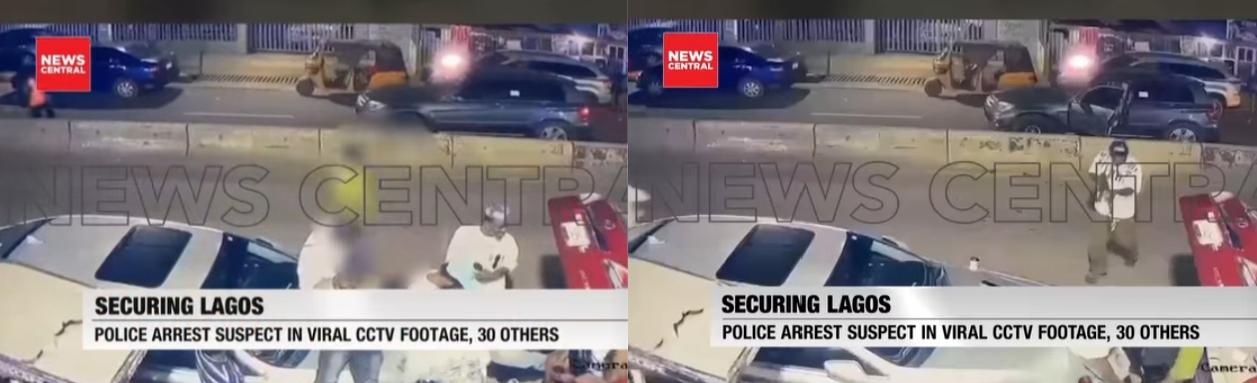
CCTV footage has captured the moment three armed men reportedly attacked a man in Isheri-Idimu, Lagos State, on September 25, 2026. The man was about to change a flat tyre when the gang snatched his car and took other valuables. The attackers then reportedly failed to get away in the stolen car after seeing a police checkpoint. They abandoned it and escaped in the vehicle they came with.
A dangerous moment on a Lagos road (what the footage reportedly shows)
According to the report, the victim had stopped to fix a flat tyre, a task that keeps a driver distracted and out of the car. The three men are said to have approached with weapons, taken the vehicle and made off with other belongings. The footage reportedly ends with the gang leaving the stolen car behind after they spotted the checkpoint. The victim reportedly kept the car, but it is not clear what else was recovered, or whether he was hurt.
The checkpoint is the surprising part of this story. It suggests that visible police presence can still break up a robbery in progress, even when the attackers looked well prepared.
Not an isolated case (past cases of carjacking around Isheri, Idimu and Lagos)
Carjacking is the forcible taking of a vehicle from its owner. Police have arrested suspects in similar cases around the same area in recent months. In October 2025, the Lagos State Police Command raided an alleged hideout on Isheri Igando Road and arrested several suspected members of a syndicate said to specialise in snatching vehicles from owners. These are police allegations, and the suspects have not been shown to be guilty.
In April 2026, police on patrol in Idimu stopped three men on a motorcycle at about 2:00 a.m. and reported recovering a machete, phones and cash that they suspected had been taken from victims. More recently, police arrested three people described as members of an armed robbery and carjacking group in Alakuko, and reported recovering two locally made pistols and a revolver. Together these reports show that gangs keep working in this part of Lagos, and that arrests have not ended the problem.
Why criminals target motorists (causes of roadside robberies)
Drivers are easy targets when they are alone, stopped and busy. A flat tyre forces a driver to slow down, park and step out, often in a poorly lit spot. Criminals watch for such moments. Cars also carry high value, since a stolen vehicle or its parts can be resold quickly.
Weak deterrence adds to the danger. In January 2025, security expert Anthony Emordi questioned the effectiveness of Lagos’ multi-billion-naira CCTV system. He said criminals keep operating despite claims that the cameras can expose their identities. The state government replied that the project was still being developed and had already helped catch criminals. [] In this case, a camera recorded the crime, but the picture alone did not stop it.
Fear on the road and costs to the nation (effects of car robberies)
The direct effects are clear. Victims lose property and may face injury or trauma. Even when a car is recovered, the loss of phones, wallets, documents and cash can be heavy.
The wider effects reach the whole country. Fear of stopping on the road changes how people live, such as avoiding night travel or driving in certain areas. Businesses that rely on transport and deliveries pay more for security and insurance. Repeated crime in Nigeria’s biggest city also hurts its reputation among investors and visitors, and it weakens trust in the ability of the police to protect citizens.
Keeping roads safer for everyone (possible solutions)
Police checkpoints and patrols appear to work, so they should be steady and visible in known trouble spots, especially at night. Police can also share verified reports of arrests and recoveries, so residents know when action is taken. The Lagos government can make sure that CCTV cameras work, are monitored, and lead to fast follow-up.
Drivers can lower their risk too. If a tyre goes flat at night, it is safer to drive slowly to a busy, well-lit place before stopping, if the car can still move. Doors should stay locked, valuables should stay out of sight, and a friend or family member should be told your location. Installing a vehicle tracker also helps recovery. Residents and estate groups can support this by sharing safety information and reporting suspicious cars to the police.
Visibility works, and we should use more of it
We believe this story teaches two things. First, the police checkpoint did what a good deterrent should do. It made the criminals afraid and helped the victim keep his car. That shows that presence and patrol matter more than announcements.
Second, cameras and checkpoints are not enough on their own. Criminals still planned and carried out an armed attack on a public road. Arrests, prosecutions and steady patrols must follow, or the gangs will simply try again elsewhere. Until then, the safest road is one where lawful presence is visible and predictable. We hope the police will confirm the incident, share what they know, and act on the leads the video provides.
Published by Ejoh Caleb