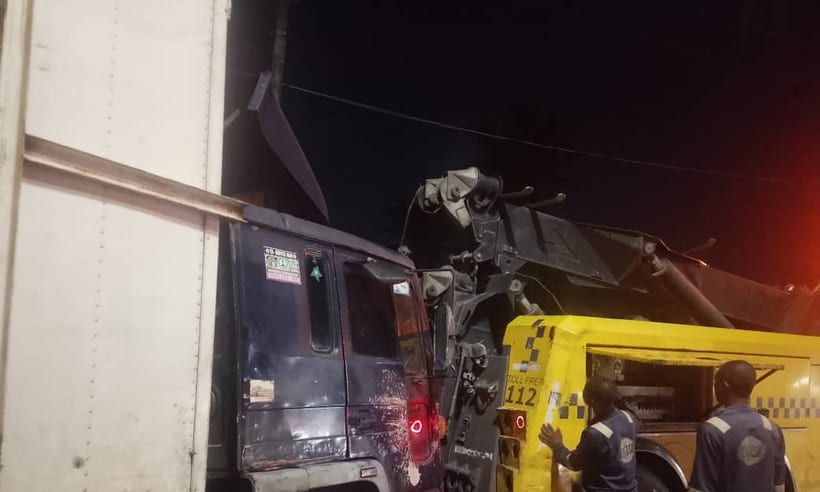
Four people have been killed and 16 others injured after a container truck overturned onto an interstate Toyota Hiace bus on Berger Bridge, inward Eleko, along the Ibeju-Lekki Expressway in Lagos State. The crash happened in the early hours of Wednesday, October 28, 2026.
The Lagos State Emergency Management Agency (LASEMA) said all four dead were adult men who died at the scene. The injured were taken to Epe General Hospital. Responders from LASEMA, the Federal Road Safety Corps (FRSC) and the police rescued the survivors and secured the area.
What LASEMA Says and What Is Still Being Established (Preliminary Findings Are Early Conclusions That May Change)
LASEMA’s Permanent Secretary, Olufemi Oke-Osanyintolu, said early findings point to excessive speed. He said the truck was going up the bridge too fast when it hit the bus. The truck driver reportedly lost control while trying to avoid the collision, and the truck and its 20-foot container overturned onto the bus.
LASEMA also said the truck hit a solar-powered streetlight pole and mounted the road median before it came to rest. These are preliminary findings. A full inquiry should still check the truck’s condition, the driver’s state and the state of the bridge, because speed may not be the only cause. We have not heard from the driver or from the bus operator.
A Road That Keeps Taking Lives: Earlier Crashes Involving Heavy Vehicles and Fast Driving
Crashes like this are common in Nigeria. A Guardian report noted that Nigerians often wake up to news of container-carrying trucks falling onto buses, cars and pedestrians. It also described a deadly 48-hour stretch in July 2025, in which 39 lives were lost in three crashes in Kano, Lagos and Ogun. Most of those crashes were linked to speeding, wrong-way driving and reckless overtaking.
The pattern continues in 2026. In August, a trailer crashed into a Sienna bus at Badeggi in Niger State and killed 10 people. The same report said the state FRSC command recorded 110 deaths in 234 crashes between January and July. The FRSC commander named wrongful overtaking, overloading, speeding and carrying passengers with goods in heavy trucks as major causes. These are different roads and different crashes, but the warnings look alike.
Heavy Loads, Fast Drivers and Tired Roads: What Sits Behind Truck Crashes (Overspeeding Means Driving Faster Than the Law or Conditions Allow)
A loaded container truck is hard to stop. It needs far more distance to brake than a car or a minibus, and a bridge slope can make control harder. When a driver goes too fast, even a small error can have a heavy cost. A container that tips over can crush a vehicle beside it in seconds.
Other factors can add to the danger. Drivers may feel pressure to deliver quickly, and long hours can lead to fatigue. Poorly kept trucks, loose container locks and damaged roads can also play a part. FRSC officials have said that bad roads, weak signage and driver tiredness add to the problem. Minibuses carrying passengers on busy routes sit close to these trucks, which means passengers carry the risk of someone else’s mistake.
Lives, Livelihoods and a Heavy Cost for the Country
Four families have lost a father, brother, son or breadwinner. All four dead were adult men, and many such men support several people at home. The injured may face weeks of treatment and lost income, and some may not be able to work again.
The wider cost falls on the nation. Road crashes drain hospitals, take skilled workers out of the economy and hurt businesses that depend on safe transport. Crashes on a key corridor like the Ibeju-Lekki Expressway also disrupt traffic and trade for hours. Repeated accidents also weaken public confidence that the state can keep roads safe.
Racing the Clock: What Rescuers Face After a Truck Falls on a Bus
Responders were reportedly called to the scene early in the morning. LASEMA said it used a private crane to lift the container and truck, so that victims and the dead could be recovered safely.
This shows a hard truth. When a container lands on a bus, rescue needs heavy lifting equipment that may not be on hand. Every minute without a crane can cost lives. Emergency agencies need ready access to such equipment on busy routes, and drivers and passers-by should clear the way for responders.
Safer Roads Within Reach: Speed Control, Truck Checks and Better Lanes (Enforcement Means Making Sure Rules Are Followed in Practice)
Many fixes are already known. The FRSC and Lagos traffic officers can use speed cameras and regular checks on heavy trucks, especially on bridges and long slopes. Truck owners should be made to service vehicles on time and fit speed limiters that cap speed. Drivers of heavy trucks should have strict rest rules and regular medical checks.
Roads can also be improved. Clear signs, good lighting and safer bridge designs help drivers slow down. Separate lanes or time limits for heavy trucks on busy routes could reduce the risk to buses and cars. LASEMA urged motorists to observe speed limits and avoid reckless driving after Wednesday’s incidents. That advice matters, but it needs support from firm enforcement.
Mourning, Then Action: Our Reading of a Repeating Pattern
We offer our sympathy to the families of the four men who died, and we wish the injured a full recovery. We also thank the emergency teams who worked in difficult conditions.
We do not decide who is at fault before the full inquiry ends. The early finding of excessive speed is serious, and it must be tested with evidence. The driver also deserves a fair hearing.
But the larger lesson is clear. The same kinds of crash keep happening, and the same warnings are repeated each time. We urge Lagos State, the FRSC, truck owners and drivers to treat this event as a reason to act, with stricter checks, better equipment and real punishment for reckless driving. Safe roads are not a favour. They are a basic duty owed to every passenger.
Published by Ejoh Caleb