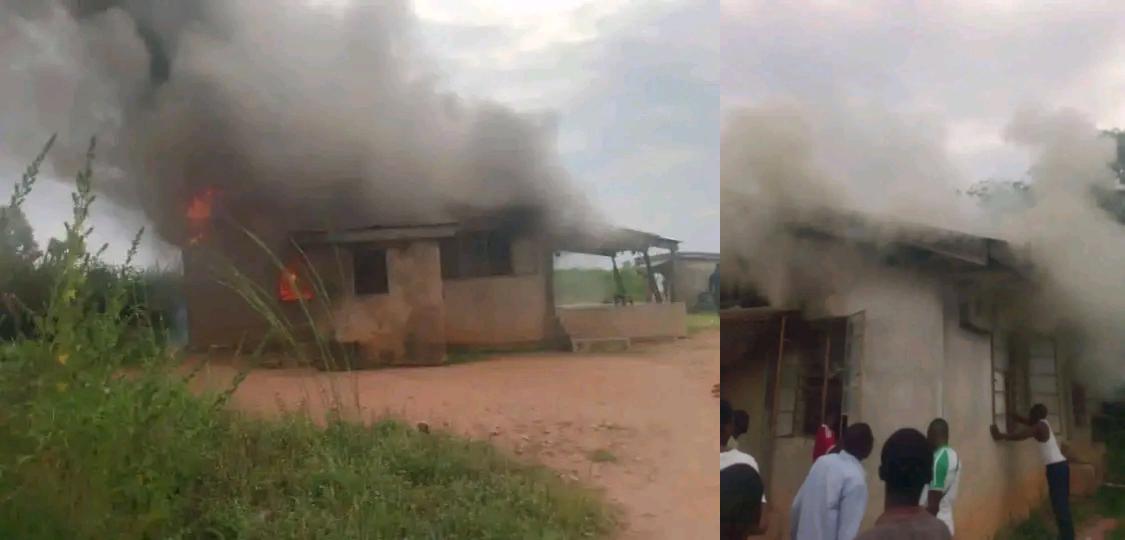
A fire has reportedly killed two children, a 2-year-old boy and a 4-year-old girl, at the staff quarters of General Hospital, Gboko, Benue State, on the evening of Tuesday, October 27, 2026.
Eyewitnesses and hospital sources say the children were in a room that their parents had locked before stepping out briefly. A hospital staff member reportedly noticed smoke and raised the alarm. Rescuers tried to force the door open, but the fire had already spread through the room.
What Eyewitnesses Report and What Is Still Unconfirmed (Early Accounts Can Change When Investigators Finish)
Almost everything we know comes from people at the scene and unnamed hospital sources. We have no statement from the hospital management, the police or the Benue State Fire Service. No one has said what caused the fire, how long the children were alone, or whether the door was locked from outside or simply closed.
The detail about the locked door deserves care. It is reported but not proven. It also tells us nothing about the parents’ intentions. Many families make quick decisions that look different after a tragedy. We urge readers not to assign blame before the facts are known, and to treat a grieving family with respect.
Fires That Have Taken Children Before: Earlier Losses Across Nigeria
Child deaths in fires are not new in Nigeria. In January 2026, three children died in Ilorin, Kwara State. The state fire service said the fire began after fuel stored in a building was ignited by sparks from charcoal cooking nearby. The service called the loss heartbreaking and avoidable.
In September 2026, a mother and her four children died in a house fire in Okochiri community, Okrika, Rivers State. Community youths rushed to the scene but could not save them, and police began an investigation. In February 2025, a fire at an Islamic school in Kaura Namoda, Zamfara State, killed 17 children. Emergency officials said preliminary findings pointed to a pile of chewing sticks near the school.
These cases differ in cause and place. But each shows how quickly a small fire can overwhelm children, and how hard rescue is once flames spread.
Small Children, Long Shifts and Few Safe Options: The Pressures Behind Unattended Children (Unattended Means Left Without an Adult)
If the account holds, the parents lived in hospital quarters and may have worked at the hospital. Health workers often work long shifts and can be called away at short notice. Childcare is hard to find and costly, and many families rely on relatives or neighbours who may not be free.
In such cases, a parent may decide that a short absence is safer than carrying a toddler into a ward. Some also lock a room to stop young children from wandering into danger. These choices often come from a lack of options. They can turn deadly when a fire starts and nobody is there.
Safety Where Staff Live: Who Keeps Government Housing Safe From Fire? (Fire Safety Means Having Equipment, Exits and Training to Stop a Fire From Spreading)
Staff quarters on a hospital compound raise a clear question. Do they have working fire extinguishers, clear exits and trained people who know what to do? We do not know the answer for this building, and no official has said.
Poor wiring, cooking fires, candles, fuel stored at home and unattended appliances are common causes of home fires. Old government quarters may have weak wiring and few safety tools. A locked door can also slow rescue, even when the people outside are brave and quick. The investigation should look at all of these points without assuming any one of them.
A Grief That Spreads: Families, Hospital Staff and the Country’s Record on Child Safety
The first loss is to the family. Two children are gone, and the parents face grief and the weight of questions from others. Hospital staff, many of whom spend their days saving lives, now carry the shock of failing to save these two.
The impact also reaches the nation. Each fire like this shows that many homes lack basic safety checks and that rescue services may arrive too late. It puts pressure on health workers who are already stretched and on families who cannot afford better care or housing. It also reminds the country that children are most at risk when adults are away, even for a short time.
Practical Fixes: Childcare Support, Fire Equipment, Doors That Open From Inside and Quick Response
Hospitals and other public employers can help by setting up childcare support for staff, such as a crèche on the compound. They can also check staff quarters for faulty wiring and install fire extinguishers and smoke alarms. Staff and residents should get basic fire training, including how to break a door and use an extinguisher.
Families can help by never leaving young children alone, even for a short time, and by choosing safe adults to watch them when they must go out. Where a room must be secured, there should always be an exit that a child or a rescuer can open quickly. Fire services also need clear emergency numbers, working vehicles and good response routes, so that help can arrive in minutes.
Grief First, Then Answers: Our Reading of a Loss No Family Should Face
We offer our deepest sympathy to the family and to the staff and residents of the hospital community. Two young lives have been lost, and nothing we write can ease that pain.
We do not know what caused this fire, and we do not accuse anyone. Many questions are open. We urge the Benue State Fire Service, the police and the hospital management to investigate openly and to tell the public what they find.
If the facts show gaps in safety, the lesson should be fixed everywhere, not only in one compound. We urge other hospitals and public housing managers to check their own quarters now. A stronger safety net for working parents, and basic fire protection in every home, could save other children from a tragedy like this.
Published by Ejoh Caleb