
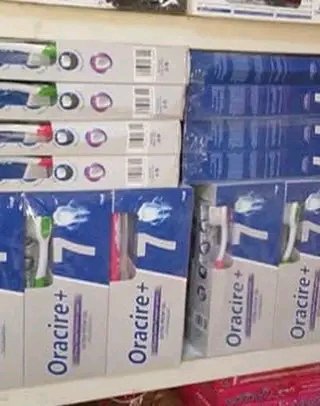
The National Agency for Food and Drug Administration and Control (NAFDAC) has alerted the public to the circulation of a suspected counterfeit toothpaste, ORACIRE+ Toothpaste, being distributed in Nigeria under the guise of the registered ORACARE+ Toothpaste.
In Public Alert No. 041/2026, published on social media on September 14, the agency said the alert followed a formal complaint and a market intelligence report on the widespread distribution of the suspected counterfeit product. Market surveillance conducted at Ojuwoye Market in Mushin, Lagos, found that the product closely resembles the registered ORACARE+ Toothpaste in packaging design and overall presentation, making it difficult for consumers to tell the two apart.
NAFDAC said the origin, composition, safety, and quality of the suspected counterfeit product have not been verified, warning that “counterfeit personal care products may not meet established quality and safety standards and could pose health risks to consumers.” The agency has commenced surveillance activities nationwide, directing all zonal directors and state coordinators to investigate the availability and distribution of the product in their jurisdictions and take appropriate regulatory action. Consumers, distributors, retailers, and healthcare providers have been advised to purchase toothpaste only from reputable, authorised outlets and to examine packaging and the source of supply carefully before buying.
Not an Isolated Find: NAFDAC’s Widening Crackdown on Fake Oral-Care and Consumer Products
This alert lands in the middle of a much larger enforcement push. NAFDAC disclosed this month that criminal proceedings remain ongoing before federal courts against suspects arrested in Kano, Sokoto, Delta, and Anambra states over the alleged importation and distribution of counterfeit oral-care products, showing that fake toothpaste and related items are already a live prosecution issue for the agency, not a one-off discovery.
More broadly, NAFDAC Director-General Prof. Mojisola Adeyeye said enforcement operations in Lagos and the South-East led to the seizure and destruction of counterfeit and substandard products worth more than ₦1.5 trillion, with the agency securing 64 convictions against counterfeiters between June 2025 and June 2026, the highest number it has recorded in a single year. One case resulted in a five-year prison sentence for the operator of an illegal beverage laboratory in December. This followed an earlier six-month enforcement drive between July and December 2024, during which NAFDAC destroyed over ₦120 billion worth of substandard and falsified medicines and food products, including a fake rice packaging factory in Nasarawa State and counterfeit alcohol packaging centres in Lagos.
From Imported Fakes to Local Factories: Why Counterfeiting Is Getting Harder to Stop
NAFDAC’s Director of Investigation and Enforcement, Martins Iluyomade, said the agency’s intelligence points to a worrying shift: some counterfeit operations that previously required products to be manufactured abroad and imported can now be coordinated from within Nigeria. He described how Chinese-linked operators identify fast-selling Nigerian products, send samples to China for replication, and then distribute the counterfeit versions locally through logistics companies the networks themselves control. “Before, to fake a product, you needed to go to China to bring it. Now, they are here with us,” Iluyomade said.
This shift matters because it removes a key chokepoint regulators once relied on, border and port inspection of imported goods, and replaces it with domestic production that is harder to trace back to its source. For individual consumers, the risk is direct: a counterfeit toothpaste of unverified composition could contain harmful ingredients or simply fail to protect dental health as intended, particularly for children who use these products daily. Nationally, a counterfeiting trade valued in the trillions of naira undermines legitimate manufacturers, costs the government tax revenue, and damages confidence in Nigeria’s consumer goods market at a time the country is trying to strengthen local production and manufacturing credibility.
Vigilant Consumers, Overwhelmed Regulators: Where the Responsibility Really Lies
Some of the burden of catching counterfeits currently falls on individual shoppers, since NAFDAC’s own advice centres on consumers examining packaging and buying only from authorised outlets. But packaging in this case was reportedly close enough to the genuine product that even careful shoppers at a busy market like Ojuwoye could struggle to spot the difference, raising the question of how much responsibility can fairly rest on the average buyer.
At the same time, NAFDAC’s own figures suggest genuine enforcement momentum, record convictions, trillions of naira in seized goods, and active federal prosecutions specifically involving oral-care counterfeits. The tension is less about whether NAFDAC is acting and more about whether enforcement can keep pace with counterfeiters who, by the agency’s own account, have adapted faster than expected by localising production.
Closing the Gaps: What Would Actually Stop Fake Products from Reaching Nigerian Shelves
Continued disruption of the logistics companies NAFDAC says are owned or controlled by counterfeit networks, rather than only targeting individual market sellers, would address the distribution backbone of the trade rather than its most visible, lowest-level point of sale. Expanding simple product-verification tools, such as scratch codes or QR verification already used by some manufacturers, and publicising how to use them, would give ordinary shoppers a genuine way to confirm authenticity beyond visually comparing packaging.
Faster public alerts specifically naming affected markets, as NAFDAC did with Ojuwoye Market here, help traders and consumers in those exact locations respond quickly, and expanding this practice consistently across all major markets would strengthen early public awareness. Continued prosecution and public disclosure of case outcomes, including the federal cases already pending from Kano, Sokoto, Delta, and Anambra, would also reinforce that enforcement leads to real consequences, not just seizures.
Our Reaction to Yet Another Reminder to Check What’s in Our Bathroom Cabinet
We think it’s genuinely unsettling that something as routine as buying toothpaste now requires this level of caution, and that counterfeiters have reportedly gotten sophisticated enough to replicate not just a product but its entire trusted packaging. This is not a minor consumer inconvenience; it is a public health risk hiding in plain sight on market shelves.
We also think NAFDAC’s disclosure about Chinese-linked networks localising production deserves more public attention than a single product alert can carry. If counterfeiters can now manufacture convincing fakes inside Nigeria itself, this alert on ORACIRE+ is unlikely to be the last of its kind. Nigerians deserve a regulatory response that keeps pace with that shift, and clear, timely alerts like this one are only the first, not the final, step in getting there.
Published by Ejoh Caleb