
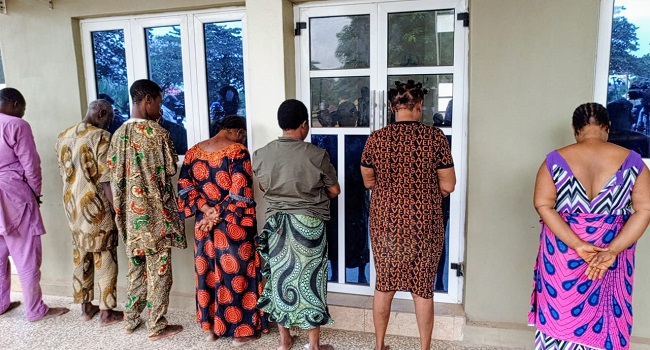
Nigeria’s Police Force has uncovered a child-stealing and human trafficking syndicate operating across Oyo, Ogun and Delta states, rescuing 17 children and arresting seven suspects. In a video showing one of the arrested suspects, a woman described selling her own children, saying, “God gave me the gift of pregnancy, once a man sleeps with me twice, I get pregnant, and I won’t be able to take care of them, which is why I later sell the children. I sold one kid and another twins for Oluwakemi. She gave me 300k for the twins.” The suspect also reportedly admitted to stealing children from public events such as churches and parties.
The investigation, led by the Oyo State Police Command, began after the disappearance of a three-year-old boy, Ifakunle Ifagbenro, during a masquerade festival in Oyo town in June. Detectives arrested a suspect, Adejoke Popoola, also known as Orente Alagbo, who allegedly confessed to stealing, moving and selling children from churches, parties and other event venues. Her disclosures reportedly led police to other suspects across Oyo, Ogun and Delta states, including two people arrested in Agbor, Delta State, who had allegedly bought children stolen from Oyo. Disturbingly, investigators also said some children who died in captivity were allegedly sold to ritualists, leading to the arrest of two more suspects, an Alfa and a herbalist, who reportedly confessed to involvement in ritual-related activities. Police are calling on parents who have lost children in recent times to visit the Oyo State Police Command Headquarters in Eleyele, Ibadan, to help identify the rescued children.
A Crime That Keeps Resurfacing Across Nigeria
This is not an isolated case. Just weeks earlier, police in Ondo State busted a baby factory and human trafficking syndicate after a 17-year-old victim, who had been lured from Akwa Ibom State under the pretence of a job offer, escaped and reported what she had seen. Investigators rescued five pregnant girls and a baby boy from the facility, where babies were reportedly being sold for between ₦400,000 for girls and ₦600,000 and above for boys.
So-called “baby factories,” where women are held, sometimes against their will, until they give birth so the infants can be sold, have been uncovered repeatedly across southern Nigeria in recent years, most often in Abia, Anambra, Imo and Ondo states. Nigerian authorities and child rights groups have long described this as one of the country’s most persistent forms of human trafficking.
Why This Trade Persists, and the Damage It Leaves Behind
Poverty, lack of access to family planning, and weak social support systems for struggling mothers are among the factors experts say drive some women to sell children they feel unable to care for, as the suspect in this case described. Traffickers exploit this desperation, alongside gaps in adoption regulation, to build black-market networks that move children between states, making them harder to trace and rescue.
The human cost falls hardest on the children themselves, who are stolen from their families, sold to strangers, or in the most horrifying cases, sold to ritualists when they die in captivity. For the families of missing children, like that of three-year-old Ifakunle, the uncertainty of not knowing what happened to a child can be devastating and prolonged. At a national level, cases like this expose serious weaknesses in Nigeria’s child protection systems, including how easily children can be stolen from public gatherings and moved across state lines undetected, and they damage Nigeria’s international reputation on human trafficking, an issue the U.S. State Department and other bodies have flagged in past trafficking reports.
What Could Help Break This Cycle
Police say they are working to dismantle the wider network and identify more victims, and the Inspector-General of Police has directed that investigations continue until the entire syndicate is uncovered. Strengthening security at public gatherings like religious events, festivals and parties, where several of these children were reportedly taken, could help prevent similar abductions.
Longer term, child rights advocates argue that expanding support systems for vulnerable and struggling mothers, including accessible family planning and social welfare support, could reduce the desperation that drives some parents toward selling their own children. Tighter regulation of informal adoption arrangements, which traffickers often exploit to legitimise trafficked children, alongside sustained cross-state police cooperation like the kind that helped uncover this network, could also help close the gaps that let these syndicates operate for as long as they do.
A Reminder of How Much Is Still Hidden
We find this case especially disturbing not just because of its scale, 17 children across three states, but because of how ordinary and unguarded the settings were where children were taken: churches, parties, a masquerade festival. That should worry every parent who has ever let go of a child’s hand in a crowd for even a moment. We’re relieved that police pursued this thread as far as they did, but we think the confessions here, a mother selling her own children, bodies allegedly sold to ritualists, deserve full, transparent prosecution, not a case that quietly fades once the headlines move on. We hope every one of the 17 rescued children finds their way back to a family that is looking for them.
Published by Ejoh Caleb