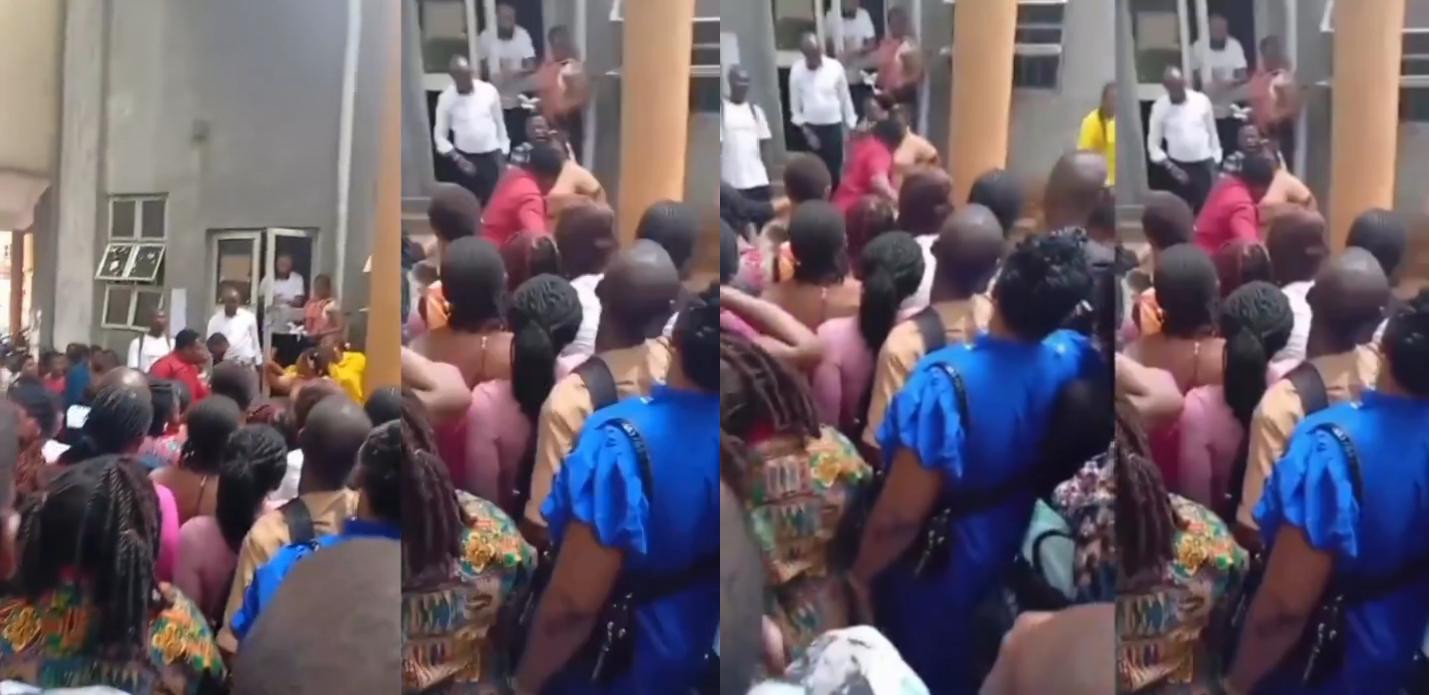
A video circulating online has caused outrage over claims that teachers were flogged during a staff verification exercise in Awka, Anambra State. It shows a large crowd outside a government building at the Jerome Udoji State Secretariat Complex, amid visible commotion and officials addressing those present. The identities of those allegedly responsible and the circumstances of the reported flogging have not been independently established.
The Anambra State Government has been conducting staff verification exercises to authenticate public servants’ records and strengthen payroll accountability. A verification exercise is a check that the workers on a payroll are real and entitled to their pay. The state also began verifying pensioners on October 5, with a digital option so that they would not have to travel to Awka. Those unable to use it could attend a physical centre beside the UBA Secretariat Branch at the Jerome Udoji Secretariat Complex. This shows the secretariat is a regular venue for such exercises.
Verification Exercises Have Left Pain Behind Before: Past Cases of Mistreatment and Disputes (Earlier Incidents Involving Workers and Pensioners)
Complaints about how verification exercises and protests are handled go back many years. In August 2020, hundreds of pensioners in Imo State said they were flogged at the gate of the Government House in Owerri during a protest over unpaid pensions. They said the attackers were government-backed thugs, and the government denied that the senior citizens were flogged. That case was a protest and not a verification, but it shows how disputed such accounts become when people are allegedly beaten at a government building.
Verification queues have caused physical harm too. In 2015, two men aged 75 and 77 collapsed after standing for hours in a pensioner verification queue in Akure, Ondo State. The state defended the screening as necessary to remove ghost workers (names on the payroll that belong to no real worker), while the opposition party called the process “dehumanising.” In 2016, three pensioners collapsed in a verification queue in Yenagoa, Bayelsa State. The pensions board said the exercise was not meant to inconvenience them, but some retirees called it stressful and punitive. In October 2023, Cross River pensioners complained of poor treatment and poor planning at an exercise in the north of the state.
Teachers have been caught up in payroll checks before. In June 2026, Cross River’s government said its verification found more than 2,000 invalid or questionable records among teachers and other workers. The state branch of the Nigeria Union of Teachers (NUT) supported the clean-up but said some teachers who complied still had salaries delayed or suspended. In Anambra, a 2016 verification under then-Governor Willie Obiano was described as the start of an effort to remove ghost workers, with teachers and local government staff to be covered in later phases. In June 2022, teachers in Anambra protested at the State House of Assembly over claims that some had been sacked, and Governor Chukwuma Soludo said no qualified teacher had lost a job and that affected teachers had only been asked to regularise their employment through a recruitment test. These cases show that the goal of cleaning the payroll is often accepted, while the method is where trouble starts.
Why Exercises Meant to Protect Public Money Can Turn Rough: Crowds, Pressure and Weak Planning (Causes of Tension at Verification Centres)
We do not know what caused the commotion in Awka, so we cannot name a cause. Past exercises point to some common weak spots. One is crowding. When many workers are told to appear at one place within a short time, queues grow and tempers rise. The Lagos State council of the Nigeria Union of Pensioners once said federal verification exercises caused casualties because of poor planning that ignored the hardship pensioners faced.
Fear of losing income is another. Verification can decide who gets paid, so workers may fear being dropped for a missing document, and officials may feel pressure to move quickly. In Cross River, the NUT said some verified teachers still struggled to get paid. Uncertainty like that adds to anger.
A third is crowd control. Where large groups gather outside a government building, someone has to keep order. If that role is given to people who are untrained, unclear in authority or unaccountable, force may be used when words would do. We do not know whether that applied here.
A Teacher Is Not a Suspect Because of a Payroll Check: Effects on Dignity, Schools and Public Trust (Consequences of Rough Treatment)
The first effect is on the individual. Section 34 of the Constitution says every individual is entitled to respect for the dignity of his person and that no one shall be subjected to torture or inhuman or degrading treatment. A court has described degrading treatment as doing unpleasant things to someone that make him lose self-respect. If teachers were flogged, that would raise serious questions under that section. Verification is a records check, and it does not justify physical punishment.
The second effect is on schools. Teachers who are humiliated or fearful may lose morale, and their pupils feel it. If workers stay away from verification out of fear, genuine staff may risk losing pay, which could disrupt classrooms.
The third effect is on trust. Governments need workers’ cooperation to clean up payrolls properly. If the exercise is linked to mistreatment, even a worthy goal such as removing ghost workers can look like punishment. That reduces public support for the anti-fraud effort.
For the country, the issue is bigger than one state. Payroll fraud wastes public money, and every state wants to stop it. But the way an exercise is run shapes how citizens see their government. A paper on the right to dignity in Nigeria found that violations remain common despite constitutional guarantees, partly because of weak institutions and inadequate enforcement.
Cleaning Payrolls Without Harming Workers: Practical Steps for Government and Teachers (Possible Solutions)
First, the facts should be established. The Anambra State Government, the police and the teachers’ union can ask for the video, identify those involved and say publicly what happened. If anyone was flogged, the people responsible should be held to account. If the allegation is wrong, the government can say so and show why.
Second, exercises should be planned to avoid crowds. Anambra’s pensioner verification offered a digital option to reduce travel and crowding, with a physical centre for those who needed help. The same approach could be used for teachers, with staggered times, enough desks and shaded waiting areas.
Third, communication matters. Clear schedules, a list of the documents needed and a public helpline would reduce panic. The Head of Service has warned pensioners against touts and said no payment is required for verification. Workers should be told the same, and those who cannot attend should have a way to be verified.
Fourth, the teachers’ union can play a role. Unions can help by checking that their members’ records are complete and by documenting any mistreatment. Cross River’s NUT supported payroll clean-up while pressing for fair treatment of genuine teachers, which is a useful balance.
Fifth, anyone whose rights are violated can seek redress. A person who believes he was subjected to degrading treatment can approach a court under the Fundamental Rights Enforcement Procedure, as litigants have done before.
Accountability for the Payroll Must Not Cost Workers Their Dignity: Our Closing Reflection (Fairness, Respect and Good Governance)
We want to be fair to everyone involved. The Anambra State Government has a legitimate aim in making sure public money goes only to real workers. Ghost workers steal from the state and from honest colleagues, and no one should defend them.
But we believe the way an exercise is run matters as much as its goal. Teachers shape the next generation, and they should never be handled as if they are criminals because of a records check. If the claim in the video is true, those responsible should face consequences. If it is not, the government should say so clearly.
We urge the state government to investigate and publish its findings, and to make future verification exercises orderly and respectful. We also urge teachers to document any mistreatment and report it through proper channels. We will update this story when the government or the police respond.
Published by Ejoh Caleb