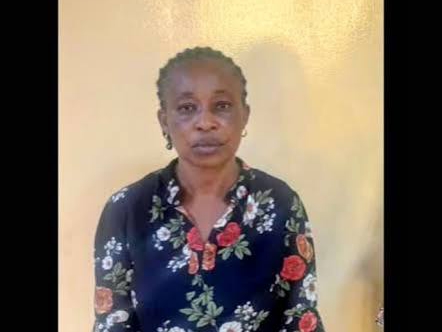
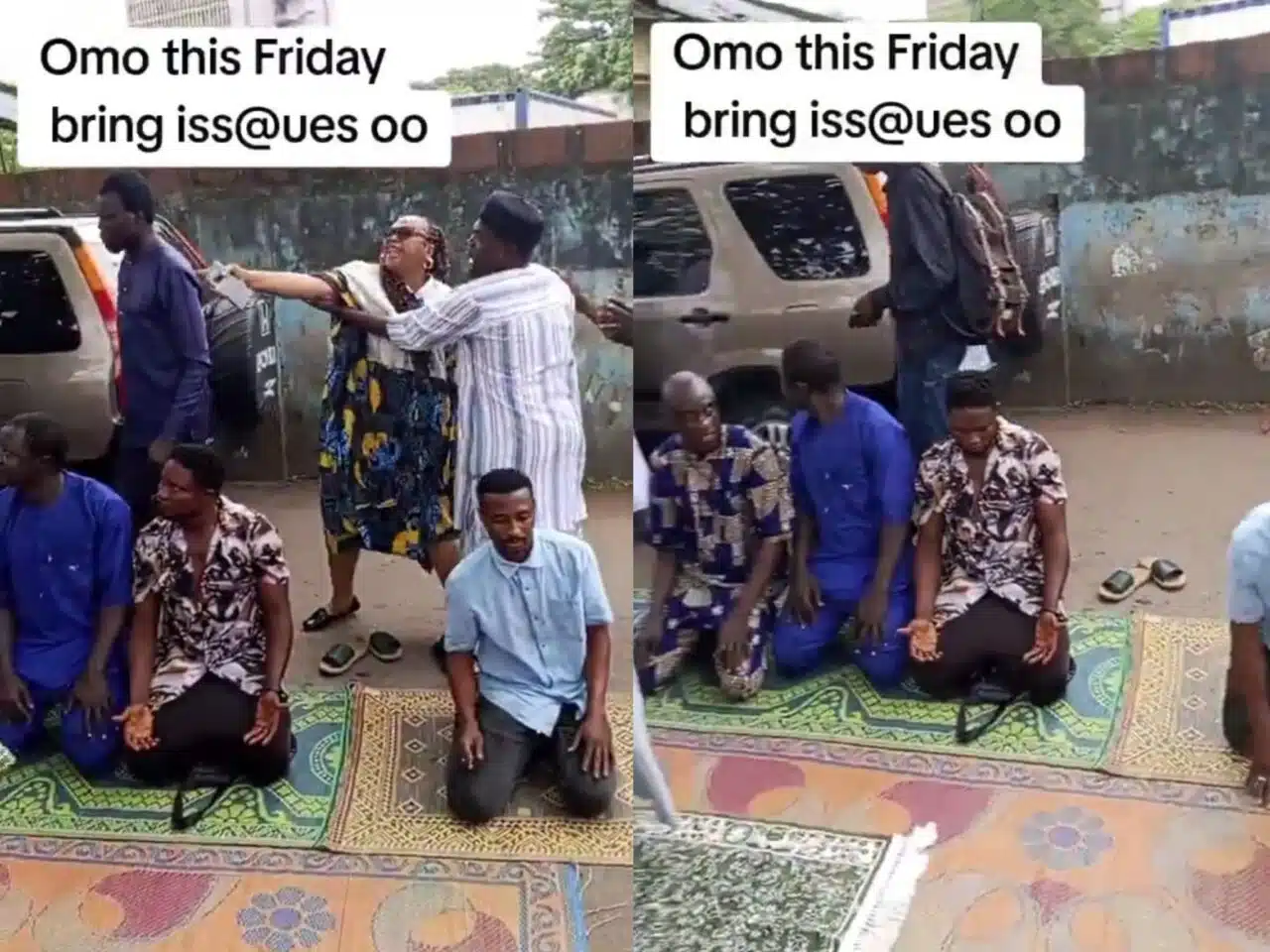
A video of a woman confronting a group of Muslim worshippers who had spread prayer mats across part of a road for Friday, or Jumat, prayers has gone viral in Nigeria, reigniting a long-running debate about religion and public space. The footage shows the woman, who appeared to have been blocked from getting home from work, pointing and remonstrating with the men as another bystander tried to calm her down.
Promise Emmanuel, the Senior Special Assistant to the Kogi State Governor on Cybercrime, popularly known as Kogi Rebel, responded to the clip with a Facebook post arguing that the outrage was one-sided. “You criticise Muslims for blocking the road on Fridays ONLY to pray,” he wrote, “but you as a Christian, you go to knock on people’s homes to preach to them uninvited. You stand in a bus that some people just want a few minutes of sleep and peace before alighting to preach. Some use very loud speakers in public places to preach. These are also wrong.” He said the real answer was tolerance, describing it as “a little discomfort for each other to tolerate ourselves in living together because life was created in diversity.”
Emmanuel did not excuse the road-blocking itself. He acknowledged that obstructing traffic to pray is wrong, but said the practice is partly driven by how large Friday congregations have grown against how little dedicated prayer space is available, and he called on religious leaders to work with town planners on the problem rather than trade blame.
A Fight Nigeria Keeps Having, in Different Cities and Decades (Earlier Clashes Over Worship and Public Space)
Nigeria has argued about roadside prayer for a long time, and it is not only a Christian-versus-Muslim complaint. One of the clearest examples came from the Muslim group NASFAT itself. After its Lagos gatherings outgrew a stadium in 2000, the group moved its prayers to the Lagos-Ibadan Expressway. At the close of one 2001 prayer session, thousands of members spilled onto the highway, creating what was described as vehicular chaos, showing that the space problem behind roadside prayer is decades old, not a new phenomenon.
Government officials have weighed in before, too. In 2018, Lagos State’s then Commissioner for Home Affairs, Abdulhakeem Abdullateef, publicly told religious bodies of all faiths to stop blocking roads during worship, warning that it could endanger lives, citing a case where worshippers reportedly refused to let an ambulance carrying a sick woman pass. Notably, he made clear the rule applied equally to churches and mosques, framing it as a shared obligation rather than one group’s failing.
The debate over disruptive preaching runs on a parallel track. In July 2026, the Senate passed the Federal Road Safety Corps Amendment Bill, which sets a ₦50,000 fine for hawking, trading or preaching inside commercial vehicles. The bill drew heavy criticism online, with some Nigerians accusing lawmakers of specifically targeting Christian evangelism. The Senate later clarified that the rule was not new, pointing to a 2007 provision in the FRSC Establishment Act that already banned the practice, and said the amendment was simply raising the penalty as part of a wider overhaul of 52 traffic offences.
Why Public Worship Keeps Colliding With Everyday Nigerian Life (The Practical Roots of the Conflict)
At the heart of the road-blocking problem is simple arithmetic. Friday prayers can draw far more worshippers than a mosque building can physically hold, and where there is no adjoining prayer ground, the overflow spills onto the nearest open space, which is often the road itself. Emmanuel’s post explicitly named this as a driver of the Kogi incident, arguing that the issue is not really disrespect for other road users but a shortage of adequate space for a fast-growing congregation.
Door-to-door and in-transit preaching has a different root. Nigerian Christianity places a strong emphasis on active evangelism, spreading the gospel directly to people who have not sought it out, which is why preachers approach strangers’ homes or address passengers on public transport. The conflict arises because the person delivering the message experiences it as an act of care or duty, while the person receiving it, especially in an enclosed space like a bus, often experiences it as an imposition they cannot easily escape. In both cases, a genuine religious obligation on one side becomes an unwanted disruption on the other, and neither side set out to cause offence.
Who Pays the Price When Worship Spills Into Public Space (Local Friction and What It Signals Nationally)
For ordinary commuters and residents, the immediate effect is practical: lost time in traffic, blocked ambulances, or, in the case of preaching, a bus ride that becomes uncomfortable rather than restful. These are minor irritations individually, but they accumulate into real resentment, as the viral video itself demonstrates. The woman in the clip was not attacking anyone’s faith; she was reportedly trying to get home from work and found her path physically obstructed.
Nationally, disputes like this feed into a wider and far more serious undercurrent in Nigerian public life: the sense, real or perceived, that one’s own religious community is inconvenienced or persecuted more than the other. Nigeria’s history includes violent religious unrest, including riots in the early 2000s that were triggered partly by disputes over access to Friday prayers during a curfew. A minor viral video is nowhere near that scale, but it draws on the same underlying anxiety, which is why comments like Emmanuel’s, insisting that both communities share the blame, tend to spread quickly and provoke strong reactions in both directions.
How Other Cities Have Tried to Ease the Tension (Possible Ways Forward)
Lagos State’s approach in 2018 offers one template: a public, even-handed appeal from government that names the problem in both churches and mosques rather than singling out one faith, paired with a request that citizens report genuine nuisances so the state can respond. Emmanuel’s own suggestion follows a similar logic at a lower level, urging religious leaders to sit down with municipal planners so that fast-growing congregations get dedicated prayer space instead of defaulting to the road.
For preaching in transit, the newly passed FRSC amendment offers a narrower, enforceable rule specific to commercial vehicles, though its rollout will need clear public communication to avoid the backlash the Senate faced in July, when many Nigerians mistakenly read the bill as a new, religiously targeted restriction rather than an update to a seventeen-year-old rule. In both cases, the common thread is treating the issue as a shared civic problem rather than a contest over whose religion is more disruptive.
A Fair Complaint Deserves a Fair Response From Everyone Involved
We think the woman in the video had every right to be frustrated. Being physically blocked from getting home from work is a real inconvenience, whatever the reason behind it, and her anger does not need to be about religion to be valid.
We also think Emmanuel’s underlying point holds up: no single faith community in Nigeria has a monopoly on inconveniencing others in the name of worship. Road-blocking during Friday prayers and uninvited preaching in homes or buses both stem from real religious devotion colliding with other people’s right to move through public space undisturbed. Treating one as a scandal and waving away the other as harmless zeal is not fairness; it is selective outrage.
What Nigeria actually needs is less of what happened in this video, worshippers left without adequate space, commuters trapped in traffic, and more of what Lagos attempted in 2018: officials and religious leaders naming the problem honestly on both sides and working out where large congregations can pray, and where preachers can speak, without anyone else paying the cost.
Published by Ejoh Caleb