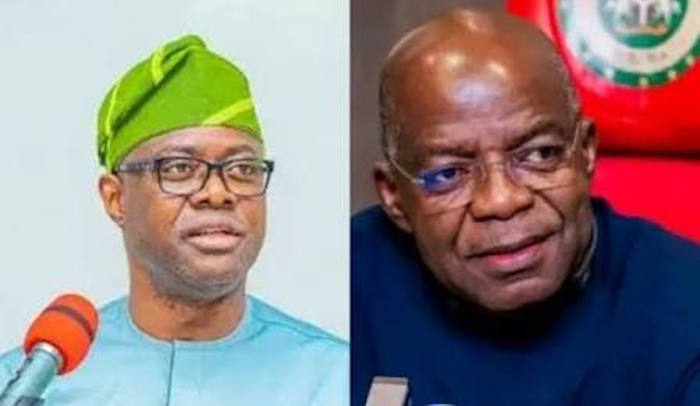
Oyo State Governor Seyi Makinde and his Allied Peoples Movement (APM) have sued Abia State Governor Alex Otti, along with the state’s Attorney-General, the Abia State Signage and Advertisement Agency (ABSAA) and the State House of Assembly, over a mandatory ₦200 million fee that any presidential candidate must pay before displaying campaign materials anywhere in the state. The suit, marked HC/214/2026, was filed at the Abia State High Court on September 17, 2026, through senior lawyer Musibau Adetunbi. Makinde and the APM say they only learned of the fee while preparing to begin their nationwide campaign, and that it violates the Constitution and the Electoral Act 2026.
The plaintiffs are asking the court to set aside the ABSAA regulation entirely, along with any similar fee, and to grant a permanent injunction stopping Abia officials from enforcing the charge or removing, damaging or obstructing their campaign billboards in the state. Their central legal argument is that only the Independent National Electoral Commission (INEC) has the constitutional power to regulate political campaigns, relying on Item F, Section 15(a) and (f) of the Third Schedule to the Constitution and Section 99(1) of the Electoral Act 2026. They also cite Section 99(2) of the Act, which bars using a state agency to give any party or candidate an advantage or disadvantage in an election, arguing that a fee this size effectively uses ABSAA to push non-incumbent candidates out of public view.
Money is the other half of the argument. The Electoral Act 2026 caps total spending in a presidential campaign at ₦10 billion. Makinde and the APM say that if every state charged a similar ₦200 million fee just for billboard permits, candidates could burn through a large share of that legal limit on signage alone, before paying for travel, media or anything else needed to actually reach voters. As of the time of reporting, Governor Otti and Abia State officials had not issued a public response to the lawsuit.
A Bigger Fight Over Billboards Is Already Playing Out Nationwide (Similar Fee Disputes in Other States)
Abia is not the only flashpoint. In Lagos, the Lagos State Signage and Advertisement Agency (LASAA) has also come under fire this campaign season, though the complaints there are less about the size of its fees and more about how evenly they are applied. An NDC candidate for a Surulere federal constituency seat, Dr Adefolaseye Adebayo, publicly accused LASAA of removing her campaign banners across the constituency while leaving ruling-party banners untouched, saying supporters alerted her that only her materials were being pulled down. LASAA has denied charging any party more than another, insisting its rates depend only on billboard size, location and duration, with political advertising typically costing between ₦500,000 and over ₦5 million a month, plus a non-refundable ₦500,000 application fee.
The pattern extends well beyond these two states. Reports indicate that opposition parties, including the ADC and PDP, have raised similar objections to signage levies elsewhere, with the PDP going as far as calling the charges a form of political extortion designed to disadvantage rivals, while the APC in Abia has separately called for the fee to be withdrawn and urged INEC to take notice. One report estimates that if every state imposed comparable charges, the cumulative cost to candidates nationwide could run into billions of naira, a figure one analysis put at roughly ₦7.4 billion. What makes the Abia case notable is less that a dispute like this exists, since similar arguments are unfolding in several states, and more that it is now the first of these fights to be tested directly in court by a presidential candidate.
Why State and Federal Rules Are Colliding Over the Same Billboards (The Legal Grey Area Behind the Dispute)
The core of this dispute is a genuine grey area in Nigerian law: states have long had the power to regulate outdoor advertising within their borders, covering things like billboard size, safety and location, largely for planning and aesthetic reasons that have nothing to do with elections. At the same time, the Electoral Act gives INEC exclusive authority over the rules governing political campaigns. When a state’s advertising agency sets a fee specifically for campaign billboards, as ABSAA has done, that authority overlaps directly with INEC’s turf, and nobody has yet definitively settled which one wins.
This ambiguity gives state governments room to set fees that look like ordinary planning charges but can function very differently depending on who is paying them. A ₦200 million fee is a minor cost for a well-funded incumbent party but a serious barrier for a smaller party or a first-time presidential candidate trying to stretch a limited campaign budget across 36 states. Legal commentary on the wider dispute notes that this exact tension, between a state’s legitimate power to regulate outdoor advertising and INEC’s federal safeguards for fair campaigning, is likely something only the courts can resolve.
What a Ruling Either Way Would Mean for the 2027 Race (Effects on Candidates and on Nigeria’s Elections)
For Makinde and the APM directly, the immediate effect is straightforward: until this case is resolved, they say they cannot legally display campaign materials anywhere in Abia State without paying a fee they consider unconstitutional, which limits their visibility to voters in one of Nigeria’s states during a critical early stretch of the campaign. If similar fees are quietly in place or being considered in other states, as the wider reporting suggests, the same problem could repeat itself for any candidate without deep financial backing, regardless of party.
Nationally, the case matters because it will help determine what state governments can and cannot charge political candidates going into the 2027 general election, at a moment when several parties are already alleging that state agencies are being used to disadvantage them. If courts side with Makinde and the APM, it could force every state signage agency to revisit fees specifically targeted at political campaigns. If the fee is upheld, it could open the door for more states to introduce similar charges, potentially reshaping how much money it costs simply to be seen as a candidate in Nigeria, separate from the cost of actually campaigning.
How This Kind of Dispute Typically Gets Resolved (Paths Forward for Candidates and Regulators)
The most direct fix is the one now before the Abia court: a judicial ruling clarifying exactly where a state’s ordinary regulatory power over billboards ends and INEC’s exclusive authority over campaign rules begins. Legal commentators tracking the wider dispute say this is likely to be the only way to settle it definitively, since neither INEC nor the National Assembly has yet issued clear guidance on the question.
Short of a court ruling, some stakeholders are calling for INEC itself to step in and issue clear guidelines separating legitimate administrative fees from what effectively amounts to a campaign cost, alongside a National Assembly amendment to the Electoral Act that would explicitly cap what states can charge for political advertising. Until either happens, individual candidates appear to be left with the option Makinde has chosen: challenge each fee in court, state by state, as it arises.
Fair Rules Should Not Depend on Who Is Enforcing Them
We think Makinde’s underlying complaint deserves to be taken seriously on its own terms, separate from who is making it. A ₦200 million fee just to hang a billboard is a real barrier for a smaller party, and if states can set fees at whatever level they choose with no cap, there is nothing stopping a future government, of any party, from pricing a rival out of visibility entirely under the cover of an ordinary advertising rule.
At the same time, we think this case is a useful reminder that fair process matters as much as fair outcomes. Some online reactions to the lawsuit have pointed out that Makinde did not raise similar objections to Lagos’s LASAA fees, which other candidates have also criticised this year, and that inconsistency is worth noting even if it does not undermine the legal merits of his Abia case.
What this dispute really tests is whether Nigeria’s states will be allowed to keep regulating political advertising without any real ceiling, at a moment when trust between parties and state institutions is already thin. We would welcome a swift ruling, not just for Makinde’s sake, but because every candidate heading into 2027, in Abia and everywhere else, deserves to know the actual price of being seen before the campaign, not after a court case decides it for them.
Published by Ejoh Caleb