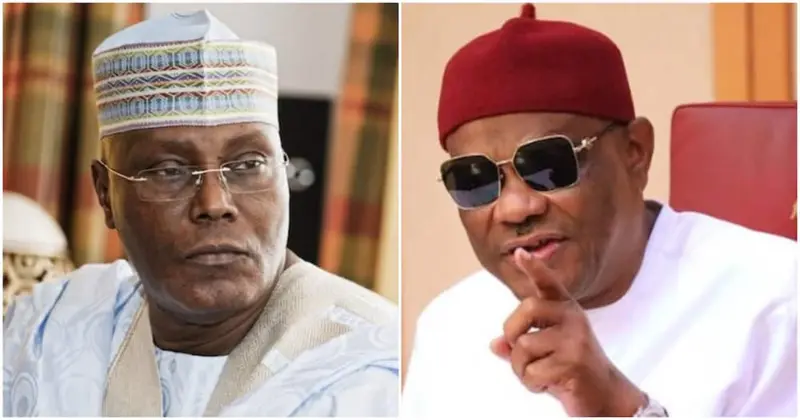
FCT Minister Nyesom Wike has again taken aim at African Democratic Congress (ADC) presidential candidate Atiku Abubakar, calling him a “voodoo economist” over his changing stance on fuel subsidy. Wike spoke to journalists in Abuja on Thursday while inspecting road projects in the territory.
Wike said Atiku once called the fuel subsidy a fraud and promised to remove it if elected in 2022. Now, ahead of the 2027 election, Atiku says he will bring the subsidy back. “Atiku, who is confused? Who acts like a voodoo economist? Atiku would say anything just to be president,” Wike said.
Wike also said Atiku does not count among the leading candidates for 2027. He insisted only President Bola Tinubu qualifies as a frontrunner.
A Pattern of Changing Positions on Petrol Support
This is not the first time a Nigerian politician has been accused of shifting on fuel subsidy for political gain. The subsidy has divided leaders for decades. Past governments promised to remove it, then backed down under public pressure. Others removed it quietly and faced nationwide strikes and protests as a result.
Atiku himself has a long history with the subsidy debate. As a presidential candidate in past elections, he argued the subsidy mainly benefited a small group of fuel importers rather than ordinary Nigerians. He called for its removal as part of broader economic reforms.
Tinubu’s government removed the subsidy in 2023, shortly after taking office. The move immediately doubled fuel prices in many parts of the country and pushed up transport and food costs.
Now, Atiku has unveiled what his campaign calls the Atiku Economic Recovery Plan (AERP) 2027. Under this plan, government-approved refineries would get Nigerian crude oil at a lower price, in exchange for meeting strict production and transparency rules. His team says this is different from the old subsidy system because it would be tracked and audited.
What Is Driving the Disagreement, and Who Feels the Effects
The disagreement centers on where the money from subsidy removal has gone. Atiku argues that removing the subsidy failed ordinary Nigerians. He says the funds meant to ease the pain of removal have not reached the people who need them. “Where is the money now? It seems they are just stealing it,” he said.
Wike disagrees. He said subsidy removal has increased the money that flows to states and local governments every month. He claimed this has helped many state governments pay salaries and pensions on time, something they struggled with before.
Nigeria’s Finance Minister, Taiwo Oyedele, backed this up with figures. He said subsidy removal generated about 15.8 trillion naira in extra resources for the federal, state, and local governments between June 2023 and December 2025.
For ordinary Nigerians, the effects are felt daily at the fuel pump and in the market. Higher fuel prices mean higher transport fares, which raise the cost of food and other goods. Businesses that depend on generators for power also pay more to operate.
At the national level, the debate goes beyond one policy. It touches how much Nigerians trust their leaders to keep their word once in office. When politicians change positions on major economic policies close to elections, it can deepen public doubt about whether campaign promises mean anything. This makes it harder for any future government, regardless of party, to convince citizens to accept short-term economic pain for long-term gain.
Possible Ways Forward on Fuel Pricing
Some economists suggest a middle path between full subsidy and full removal, such as targeted support for public transport and low-income households rather than a blanket subsidy on fuel for everyone.
Others argue that boosting local refining capacity, so Nigeria relies less on imported fuel, would do more to lower prices long-term than any subsidy program. Atiku’s new plan appears to lean in this direction, though it has not yet been tested.
A third option raised by critics of subsidy removal is stronger auditing of how subsidy savings are spent, so citizens can see exactly where the money goes each month.
Where We Stand on This Debate
We think Nigerians deserve consistency from their leaders, not positions that shift with the political wind. Atiku’s changing stance on fuel subsidy gives Wike and the ruling party an easy line of attack, whether or not the criticism is fair on the economics.
At the same time, we believe the ruling party cannot simply point at Atiku’s flip-flop and ignore the real hardship many Nigerians still face from subsidy removal. The naira value of the extra revenue means little to a family struggling to pay for transport and food today.
Whoever leads Nigeria after 2027 will have to answer the same hard question: how does the country balance responsible economic policy with the immediate needs of its people? Neither side of this argument has fully answered that yet.
Published by Ejoh Caleb