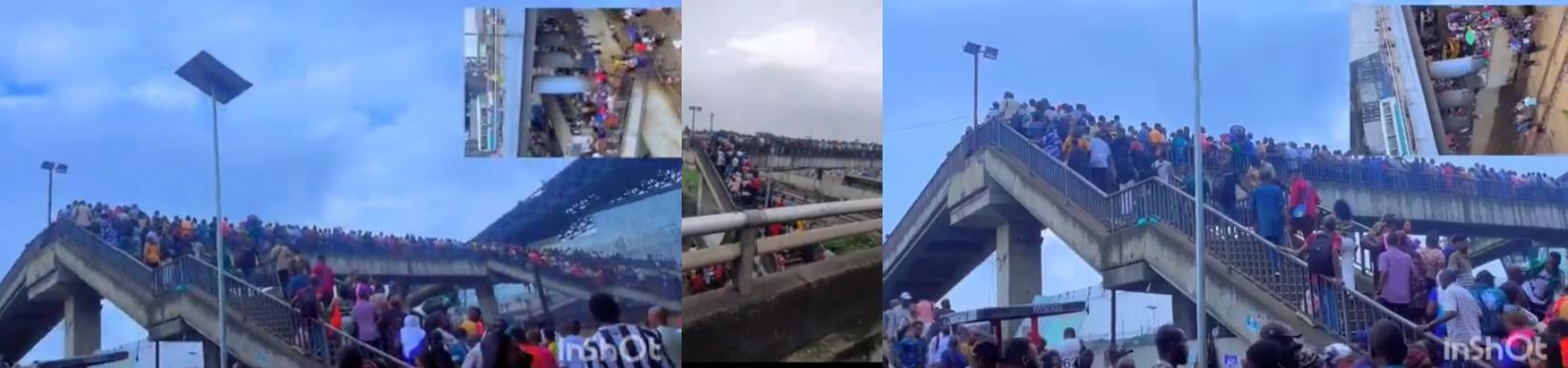
A video making the rounds online shows something many Lagosians know too well. It shows a massive queue of pedestrians standing and waiting. Some wait for several minutes just to climb the pedestrian bridge at Oshodi. The crowd stretches so far back that people cannot move until those ahead of them cross.
This is not just a busy-day crowd. It is now the daily reality at one of Lagos’s busiest transport hubs. The problem traces back to a bridge that was shut down for repairs about a year and a half ago. It still has not reopened.
What Is Happening: One Bridge Is Now Carrying All of Oshodi’s Foot Traffic
Oshodi Bus Terminal has two pedestrian bridges. They connect Terminals 2 and 3. In January 2025, the Lagos State Government shut down one of them. The government said it was worried about the bridge’s structural safety. The Commissioner for Transportation, Oluwaseun Osiyemi, said the contractor was told to block the entrances with concrete barriers. Pedestrians were told to use the second bridge instead. It sits about 30 metres away.
The government said engineers would check the closed bridge. They would then decide if it needed repairs or a full rebuild. Over a year later, the bridge is still closed. The one remaining bridge now carries all of Oshodi’s foot traffic alone. That bridge was never built to handle this much weight by itself. This is why we now see long, slow queues of people waiting just to climb it.
Has This Happened Before? A Problem the Government Has Known About for Months
This overcrowding is not new. As early as March 2025, just weeks after the closure, videos and photos of the overwhelmed bridge went viral. Commuters said the crowd was so heavy that the bridge itself seemed to shake. Some said it took them 20 minutes or more just to cross, because of the crush of people.
The complaints were loud. The Commissioner for Environment and Water Resources, Tokunbo Wahab, publicly admitted to the “numerous complaints.” He promised the government was working on a solution. He said the “relevant authorities” had been told that Oshodi needed another bridge. Since then, calls for the government to build a new bridge, or speed up repairs on the closed one, have kept trending online. People have also raised growing concerns about theft on the crowded bridge.
Why This Keeps Happening: The Root Causes
- Only one bridge is left: With just one bridge open, any delay in fixing the second one doubles the pressure on the first. There is no other safe way to cross the busy expressway.
- Slow repair work: The structural check was supposed to lead to next steps. Over a year later, there is no visible repair work and no public timeline.
- The highway crossing ban: Lagos has a “No Crossing of Highway” law. It is meant to protect people from being hit by cars. But it also removes the option to simply walk across the road when the bridge queue gets too long. Everyone is forced onto the one available bridge.
- A busy transit hub: Oshodi is one of the busiest transport points in Lagos. Even with both bridges open, the crowd was already large.
- Little communication from government: Beyond an early promise to “notify relevant authorities,” the government has not clearly told the public when repairs will be done.
The Cost: Wasted Time, Safety Risks, and Rising Frustration
The effects go beyond mere inconvenience. Commuters lose valuable time every day, standing in queues before they can even start their journey to work or school. The tightly packed crowd raises real safety fears, including the risk of a stampede. Commuters have said the bridge itself feels unstable under the extra weight. The crowding has also created chances for thieves. Residents have raised alarms over rising pickpocketing and theft on the bridge. All of this adds daily stress to Lagosians who already deal with long commutes and heavy traffic.
Possible Solutions: How Lagos Can Fix the Oshodi Bridge Bottleneck
- Give a clear repair timeline: The government should tell Lagosians exactly what stage the repair work is at, and give a real date for reopening the closed bridge.
- Speed up the repair or rebuild: Given how long the bridge has been closed, the state should put more money and workers into fixing or rebuilding it fast.
- Build the promised extra bridge: The government’s own commissioner already said, months ago, that Oshodi needs more than one bridge. That promise should now come with an actual construction plan.
- Manage the crowd for now: While repairs continue, traffic officials or marshals could help manage the queue and pace of people climbing the bridge. This would lower the risk of a crush.
- Improve security on the bridge: With more people packed onto one bridge, better lighting, cameras, and visible security could help cut down theft and make commuters feel safer.
My Take
What strikes me about that video is how normal the long queue looks to the people in it. Nobody is panicking or protesting. They are simply standing, waiting their turn. This is how Lagosians have learned to cope with one inconvenience after another. That, to me, is the real story here. A safety decision that made sense in January 2025 has, a year and a half later, become a daily hardship. And the same government that made that decision has not fully fixed it.
Closing an unsafe bridge was the right call. But leaving thousands of commuters to squeeze through one bridge for over a year, with no clear repair date and no second bridge, is not right. Oshodi is too important a crossing point for this kind of open-ended wait. Lagosians deserve to know exactly when this will be fixed. They deserve more than reassurance that the matter has been “noted.”
Published by Ejoh Caleb