
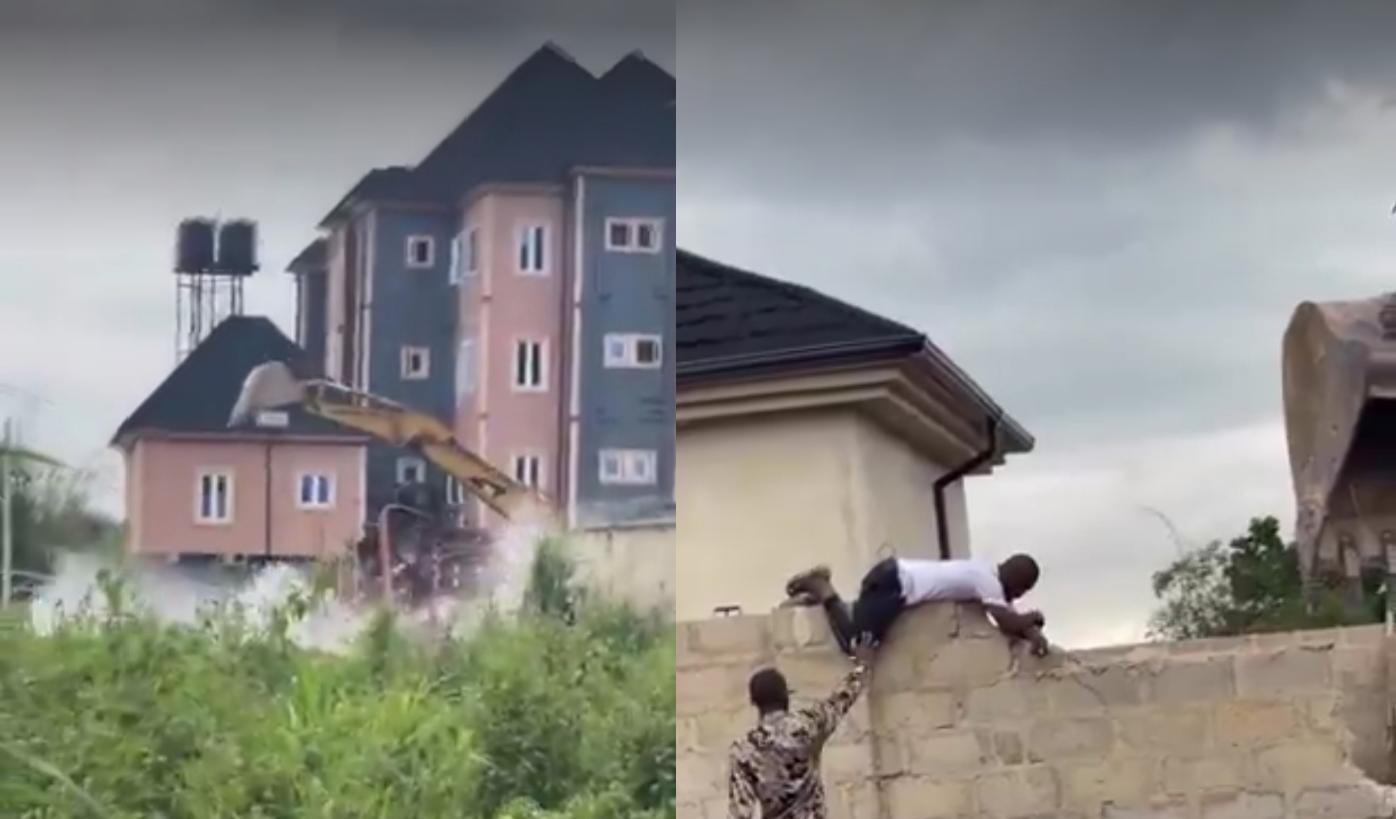
Painful videos are trending online. They show people in Abia State watching as their properties were pulled down. The properties were reportedly worth hundreds of millions of naira. The reason: a land dispute.
In one video, a man climbs the fence of his newly built house. He is trying to stop a bulldozer. He fails.
These videos have reopened a painful question many Nigerians keep asking. What happens when the land you built your home on turns out to be disputed? What happens when the law shows up not to protect you, but to knock down what you built?
What Is Happening: Land Disputes (Fights Over Who Truly Owns a Piece of Land) Are Costing Families Everything
A land dispute happens when two or more people or groups claim the same piece of land. This can be because of fake documents, unclear boundaries, or land sold to more than one buyer. When these disputes reach court or enforcement agents, the losing side can lose everything. Their house, sometimes built with years of savings, can be flattened in minutes.
This is what appears to have happened in Abia State. People stood and watched as machines flattened homes worth hundreds of millions of naira. The man climbing his fence shows how helpless many Nigerians feel when a demolition notice arrives, or when no notice comes at all.
Has This Happened Before? Abia’s Recurring Land Wars
This is not the first time. Abia State has had several land-related clashes in recent months:
In Umunenweze, near Ikwuano/Umuahia, villagers protested at the Abia Government House. They said estate developers used bulldozers to destroy their farms and trees. They accused their traditional ruler of using forged papers to hand their community land to private developers.
In Umuahia, police arrested men who stormed a widow’s property. The men had started removing roofing sheets to prepare for demolition. It turned out to be a long-running dispute, where one side tried to seize the land by force.
In Bende Local Government Area, the Abia State Government had to step in over a land fight between the Amabiaelu and Ohumala/Amoji communities. The dispute is about 70 years old. It dates back to the 1950s and has even gone to the Supreme Court.
This problem is not only in Abia. In Ibadan, residents recently asked the Oyo State Government and the Olubadan to step in over alleged land grabbing. The Olubadan has also warned that land grabbing is a growing problem in the city. Sadly, this kind of story is common across Nigeria.
Why This Keeps Happening: The Root Causes
Several things keep causing these painful demolitions:
- Land sold more than once: Dishonest sellers, sometimes using fake documents, sell the same plot to more than one buyer. This sets up a future clash.
- Weak documentation: Many Nigerians build on land without a Certificate of Occupancy (C-of-O, the official government paper that proves you legally own land). Some also skip checking the land registry. This leaves them exposed if a dispute comes up later.
- Community land sold in secret: Land that belongs to a whole community can be secretly sold by a few people, sometimes even a traditional ruler, without the community’s consent.
- Slow, costly courts: Land cases can drag on for years, even decades. This pushes some people to take matters into their own hands. They hire bulldozers and thugs to seize land while the case is still in court.
- Weak enforcement of the rules: Demolitions sometimes happen without enough notice. Sometimes there is no valid court order at all. Occupants are not always given a fair chance to challenge what is happening.
The Cost: Lives Upended, Investments Wiped Out
The damage goes beyond broken walls. Families lose homes and savings built over many years, sometimes a lifetime. Businesses and property worth millions, sometimes hundreds of millions of naira, can vanish in minutes. Tenants and occupants are often left homeless with little or no warning. They must scramble to find emergency shelter. Beyond the money lost, these events leave deep emotional pain. They also deepen distrust between communities, government agencies, and property developers.
Possible Solutions: How Nigeria Can Reduce These Painful Demolitions
- Check land titles properly: Buyers should always verify land at the state land registry before buying. State governments should make this process faster and clearer.
- Digital land records: A central, digital land registry would make it harder to sell the same land twice. It would also make it easier for real owners to prove ownership quickly.
- Faster courts for land cases: Special fast-track land courts could shorten the long wait many families face. This would reduce the temptation to take the law into one’s own hands.
- Proper notice before demolition: Government agencies should be required to have a valid court order and give reasonable notice before any demolition. Those who skip this should face penalties.
- Hold community leaders accountable: Where community land is involved, there should be stronger checks. This stops a few individuals from secretly selling land that belongs to everyone.
- Fair compensation: Where a demolition is lawful and truly necessary, affected families should be properly compensated. They should not be left to bear the full loss alone.
My Take
The image of a man climbing his own fence to stop a bulldozer says a lot. It captures a painful, very Nigerian kind of helplessness. You work hard for years to build something. Then you watch it disappear because of a paperwork problem, or a dispute you may not have even known about when you bought the land. I don’t think most families caught up in these demolitions were careless. Many simply trusted a seller, a community leader, or an agent who turned out to be dishonest, or who was cheated by someone else further up the chain.
The real fix must start before the bulldozer ever arrives. Nigeria needs clean, easy-to-check land records and faster justice. That way, families don’t spend everything they have building on ground that was never truly settled. Until this changes, scenes of people watching their life savings crumble in seconds will keep repeating, in Abia and everywhere else.
Published by Ejoh Caleb