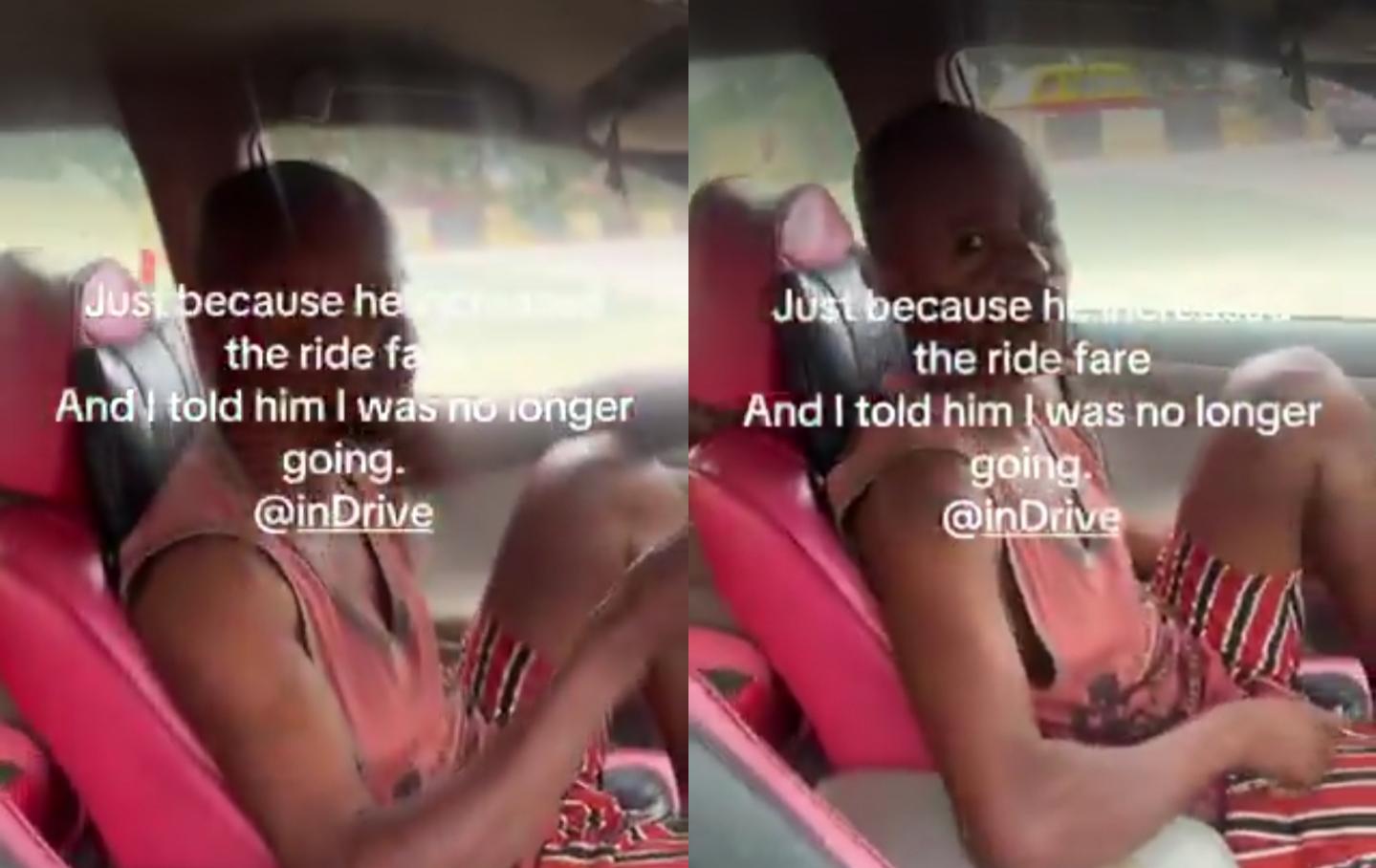
A Nigerian lady has narrated how a ride she booked through InDrive (a ride-hailing app where passengers and drivers agree on a price before the trip starts) turned into a frightening confrontation in Edo State.
According to her, she booked the ride and agreed on a fare through the app. But when the driver arrived, he refused to honour that price and demanded more money. She turned him down. As she tried to book another ride with a different driver, the man began confronting her.
Her story is one of many similar complaints that have piled up against ride-hailing drivers in Nigeria in recent months, raising fresh questions about passenger safety and how much protection these apps actually offer.
This is not a one-off problem
Stories like this keep repeating themselves across Nigeria. In Lagos, a passenger said a driver slapped her twice after she jokingly suggested deducting part of her fare because his air conditioning was not working.
In another Lagos case, a woman identified as Aderemi accused a driver named Samson of slapping, dragging, and punching her after she refused to pay the full fare over the same air conditioning complaint. InDrive suspended the driver while it investigated.
A separate passenger said a driver abandoned her midway on her street over a balance of just ₦600, insisting his map showed he had reached her destination. She said InDrive only apologised without taking further action.
In yet another case, a lady said a driver became aggressive and nearly reversed into her simply because she corrected him on the right route to her house.
And in a case that drew nationwide attention, a passenger accused a driver of colluding with armed men to rob her during a trip in Lagos. Police opened an investigation into the claim.
Why these disputes keep happening
Part of the problem lies in how apps like InDrive work. Unlike Uber or Bolt, where the app fixes the price, InDrive lets passengers name a price and drivers choose to accept, reject, or negotiate it. This system can help passengers get cheaper rides, but it also leaves room for disagreement once the trip is already underway.
Money pressure on drivers is also a major factor. In Edo State, e-hailing drivers have gone on strike to protest what they call unfairly low fares set through the app’s bidding system, saying the cost of fuel and maintenance keeps rising while their earnings shrink. Around the same period, Bolt raised its commission on rides in Benin City, Edo State, from 20 to 21 percent, further squeezing what drivers take home from every trip.
Cash payment adds another layer of risk. Because many rides in Nigeria are still paid in cash rather than through the app, there is often no digital record to settle who is right when a driver demands more than the agreed price.
How this affects passengers, drivers, and Nigeria as a whole
For individual passengers, especially women travelling alone, these disputes can turn a simple trip into a threat to their safety. Many say they now feel unsafe using ride-hailing apps at all, particularly at night.
But the effect goes beyond individual passengers. Every viral case damages the reputation of Nigeria’s ride-hailing industry as a whole, at a time when the sector is a major source of income and mobility for millions of Nigerians. Foreign investors and international users watching these stories may see Nigeria’s gig economy as unsafe or poorly regulated. Repeated incidents also add to the pressure on regulators to step in with stricter rules, which could raise costs for everyone, including honest drivers who depend on these apps to earn a living. And if more women avoid ride-hailing out of fear, it limits their ability to move freely for work, school, and business, which has a real cost to the wider economy.
What can be done
InDrive and similar platforms should make it possible to lock in the agreed fare before the trip starts, so drivers cannot change the price once a passenger is already in the car.
Ride-hailing companies need faster, tougher action against drivers with multiple complaints, instead of only offering apologies.
The police and transport unions, such as AUATON (Amalgamated Union of App-based Transporters of Nigeria), should work together to address both driver welfare and passenger safety, since the two problems feed into each other.
Passengers should be encouraged to use in-app safety features, like sharing their live ride location with a trusted contact.
Government and industry bodies should look at fairer fare structures so drivers are not driven to demand extra money just to break even.
A balanced view: it is not only the drivers who are at fault
It would be unfair to paint every driver as the villain in these stories. Many drivers genuinely struggle with low fares set through the bidding system, rising fuel costs, and rising commissions taken by the apps. Their frustration is real, even when it is expressed the wrong way. At the same time, no amount of financial pressure justifies threatening or assaulting a passenger who simply wants to pay what was agreed. Both problems, driver underpayment and passenger safety, need to be fixed together, not treated as if only one side is to blame.
Our thoughts
What stands out to me in these stories is how avoidable most of them are. A fare disagreement should end in a conversation, or at worst, a cancelled ride, not a confrontation. The bidding system that makes InDrive attractive to price-conscious Nigerians is the same system creating room for these arguments once the ride has already started. I think ride-hailing companies operating in Nigeria need to treat fare disputes as a safety issue, not just a customer service issue, because that is exactly what it has become for many women. Until the fare shown on the app is treated as final by both sides, stories like this one from Edo State will keep happening.
Published by Ejoh Caleb