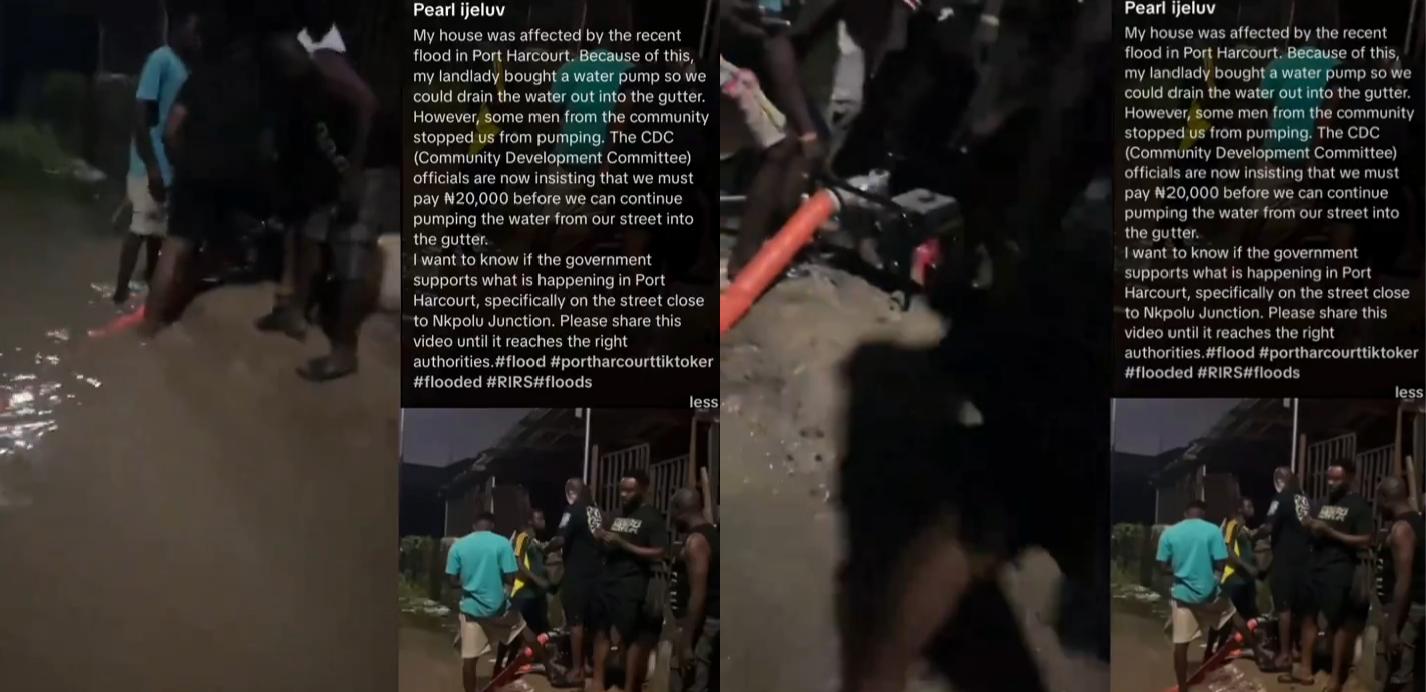
A woman in Port Harcourt, Rivers State, has appealed to government agencies after accusing Community Development Committee (CDC) officials of demanding ₦20,000 before she could pump floodwater from her compound into the gutter. She said her house was hit by the recent flooding, so her landlady bought a water pump. According to her, some community members stopped them from pumping and insisted on payment first.
Flooded Homes Meet Unofficial Charges: The Background to the Complaint (Recent Floods in the City)
The complaint comes after a hard few weeks for Port Harcourt. Channels Television reported that about three days of persistent rain left several parts of the city flooded in late September, including New GRA, parts of the Eliozu–GU Ake Road, Eneka, Elimgbu and Odili Road. In Eneka, residents said floodwater was entering their homes. Videos showed some residents crying and asking for help.
TheCable reported that vehicles and houses were submerged, and that heaps of refuse and sewage floating on the water raised fears of disease. It said the flooding had been blamed on poor town planning, blocked natural waterways and the dumping of refuse, and that the state government had not yet issued an official statement when the report was filed. Residents told Exceed FM that flooding has become a yearly event because of blocked drains and poor planning, and that a government excavator was sent to desilt (clear mud from) a canal at Eliozu. It is against this background that the woman says she was asked to pay.
Complaints of Illegal Payments in Rivers Are Not New: Past Cases of Extortion and Levies (Earlier Reports of Illegal Charges)
Residents and businesses in Rivers State have raised similar complaints for years. In an investigation, the International Centre for Investigative Reporting (ICIR) found that community youths forced traders in Port Harcourt markets to pay levies without receipts. One trader said she was made to pay ₦200, and another had her yams seized for refusing to pay. The report said the demands were not backed by any official receipts.
Business owners have complained as well. BusinessDay reported that investors accused some community leaders and youth bodies of extortion, harassment and threats. It said some owners wondered why they had to pay levies to community leaders after paying the state government the right taxes. A school owner in the report accused a local chief of extortion, and the chief denied it.
Civil society groups have also protested. The Rivers Civil Society Organisations (RIVCSO) urged Governor Siminalayi Fubara to act against illegal “task forces” that it said harass and extort motorists, and said the practice worsened as hardship deepened. These are claims from the group, not court findings.
There has been official action before. In January 2018, then-Governor Nyesom Wike sacked three caretaker council chairmen in Port Harcourt City, Obio/Akpor and Ikwerre for allegedly collecting illegal revenues from companies. That case shows that such complaints can lead to consequences when authorities choose to act.
How a Flooded Home Becomes a Bargaining Table: What May Lie Behind the Demand (Causes)
We cannot say why the officials allegedly demanded ₦20,000, and they may have their own explanation. One possible reason is concern about where the water goes. Pumping water from a compound into a gutter could overload a drain that is already full, and flood a neighbour’s property. A community group might argue it has a duty to control that. If this is the reason, it still does not explain a fixed cash payment, which is what the woman says she was asked for. This is our observation, not something the woman or the officials said.
A second cause is a wider culture of unofficial payments. Past reports describe youths and community groups collecting levies from traders, motorists and businesses, often without receipts. When that is common, residents may feel they must pay for anything they need to do, even on their own property.
A third cause is the flooding itself. The floods have been tied to blocked waterways, refuse and poor planning. When drains fail every rainy season, residents turn to pumps and gutters, and control of those gutters becomes a point of conflict.
Disease, Debt and Distrust: How This Affects Residents and the Wider State (Effects of Flooding and Illegal Charges)
The first effect is on health. TheCable reported that refuse and sewage on the floodwater raised fears of disease. Every hour that water stays in a home adds to the danger, especially for children and older people. Being delayed from draining it makes things worse.
The second effect is on money. Flood victims already lose furniture, electronics and income. A ₦20,000 demand, if true, adds to the loss. The woman said her landlady bought the pump, so the family had already spent money to fix a problem they did not cause.
The third effect is on trust. If residents believe community officials profit from their misfortune, they will lose faith in local leadership. That makes it harder to organise real flood response, such as clearing drains together.
For the state, the effects reach further. Flooding that returns every year, combined with unofficial charges, drives up the cost of living and doing business in Port Harcourt. Investors have already complained of community extortion.
Clear Rules, Fast Relief and Honest Oversight: Practical Steps Forward (Possible Solutions)
First, the facts should be established. The Rivers State Government, the Port Harcourt City Local Government Council and the police can ask the woman and the CDC to give their accounts. If the demand was made, they should say whether any law or rule allows it. If it was not, the allegation should be corrected publicly.
Second, the state should publish clear rules on draining floodwater. If residents may pump water into gutters, the rules should be written down, free, and known to all. If there are limits, because drains could overflow, officials should explain them and provide alternatives such as a place to discharge water.
Third, the root problem needs work. Residents have urged the state and the local council to clear blocked drains and find a permanent fix for the flooding. Desilting canals, removing refuse and protecting natural waterways would reduce the need for pumps in the first place.
Fourth, residents should know their options. Anyone asked to pay an unexplained fee can ask for the legal basis and an official receipt, record the demand if it is safe to do so, and report it to the police, the local government or civil society groups. RIVCSO has encouraged affected residents to petition the Commissioner of Police.
Help in a Flood Should Never Come With a Price Tag: Our Closing Reflection (Dignity, Accountability and Community Leadership)
We want to be fair. The woman’s claim has not been proved, and the CDC officials have a right to respond. Community groups often do useful work, and not every one of them acts improperly.
But the complaint deserves attention because it fits a pattern that Rivers residents have described for years. When a family is trying to clear dirty water from its home, the last thing it should face is a bargaining session at the gate. Whatever the officials meant, the public deserves a clear answer on what is allowed and what is not.
We urge the Rivers State Government and the local council to look into this case, and to explain the rules on draining floodwater. We also urge community leaders to remember that their authority comes from service. We will update this story if the CDC or the authorities respond.
Published by Ejoh Caleb