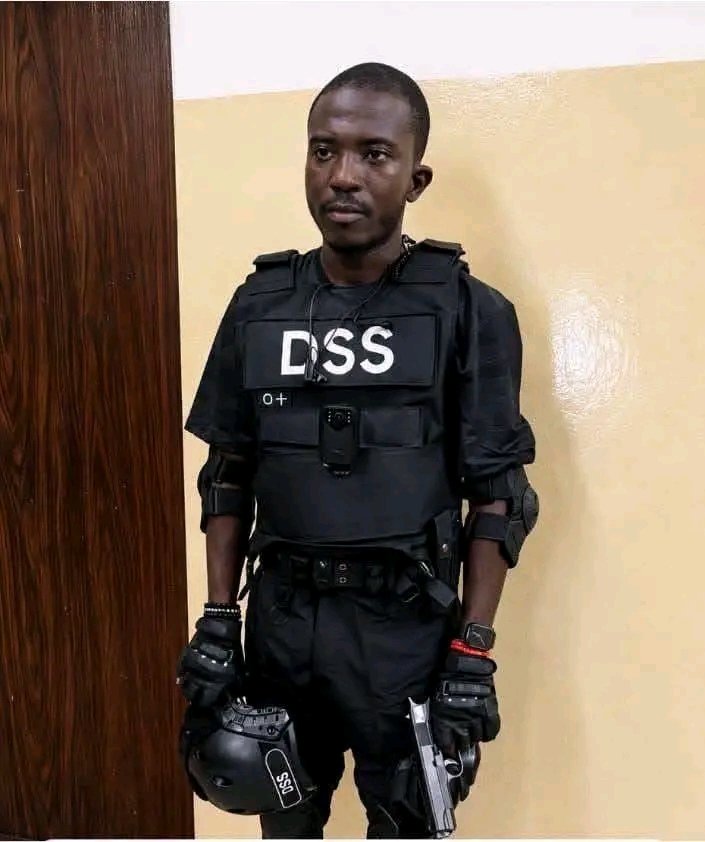
The Department of State Services (DSS), Nigeria’s secret police, has arrested a man accused of dressing up as one of its officers and using a fake gun to threaten and extort money from commuters and motorists in Abuja.
The suspect, identified as Moferewa Maiye, was arrested on Wednesday night around NITEL Junction, along Adetokunbo Ademola Way in Abuja’s Wuse II area. He was reportedly wearing a DSS tactical uniform and carrying a fake pistol when officers traced him to his hideout.
A security source said the DSS acted on credible intelligence that Maiye was using the uniform and the fake weapon to scare commuters and motorists into handing over money.
During questioning, Maiye reportedly said the items belonged to his late brother, Monday Maiye, whom he claimed had worked for the DSS before he died years ago. Investigators are checking this claim against official records. [https://theguildng.com/abuja-resident-risk-jail-for-impersonating-dss-officer/]
A Familiar Trick: Nigerians Who Fake Security Uniforms to Rob and Cheat
This is not an isolated case. Fake security operatives have been caught across Nigeria using stolen or copied uniforms to intimidate and steal from the public.
In Bauchi State in July 2026, police arrested a 40-year-old man, Mustapha Yahaya, for falsely claiming to be a DSS operative attached to the agency’s state office. Police said it was the third impersonation case the command had recorded in just one week. [https://www.tori.ng/news/324011/police-arrest-fake-dss-officer-in-bauchi.html]
In Abuja in 2022, police arrested a 61-year-old man, Olakunle Adesola, who had spent time claiming to be a senior police officer, an Assistant Inspector-General of Police, to defraud worshippers at a church.
In an earlier case in Lagos, a serving police inspector and two other men were arrested for posing as operatives of the Economic and Financial Crimes Commission (EFCC, Nigeria’s anti-corruption agency). The gang used fake ID cards, branded jackets and even a fake court order to raid a private home and carry away property.
Why Impersonation Keeps Happening, and Who It Hurts
Cases like this keep happening because a uniform alone carries enormous authority in Nigeria. Many citizens are too afraid to question anyone dressed as a security officer, even when something feels wrong, out of fear of arrest or violence.
Fake operatives also exploit weak public awareness about how to verify a real officer’s identity. Genuine security personnel carry identification cards and can be confirmed through official channels, but most Nigerians do not know how to do this on the spot, especially at night or in isolated areas. Xswq
For victims, the immediate harm is financial loss and fear, since many hand over money simply to end a frightening encounter with someone who appears to be armed and official.
At the national level, every case like this chips away at public trust in real security agencies. When Nigerians cannot easily tell a genuine DSS or police officer from an impersonator, they become more suspicious of all uniformed officers, including honest ones doing their jobs. This makes ordinary policing harder and can slow down cooperation between citizens and security agencies during real emergencies.
A DSS source acknowledged this wider concern, saying the arrest reflects growing worry over people who impersonate security personnel to intimidate the public and commit crimes.
How Nigeria Can Reduce Fake Security Officer Cases
Security agencies could set up an easy, well-publicised phone number or code the public can use to instantly confirm whether an officer is genuine, especially at checkpoints or during stops at night.
Stronger controls over how uniforms and identity kits are issued, tracked and recovered after an officer’s death or exit from service could reduce how easily these items end up in the wrong hands, as Maiye’s case suggests happened here.
Public awareness campaigns explaining Nigerians’ rights when stopped by anyone claiming to be a security officer, including the right to ask for identification, could help reduce how often people comply out of fear alone.
A Warning Nigerians Cannot Afford to Ignore
We think this case is a reminder that a uniform is not proof of authority in Nigeria today. Anyone can buy or inherit one, and that gap is exactly what people like Maiye are accused of exploiting.
We also believe the responsibility does not rest with citizens alone. Security agencies must do more to make verification simple and accessible, so that fear is no longer the main reason Nigerians comply with strangers claiming official power.
Until that trust gap closes, ordinary commuters and motorists will remain easy targets for anyone willing to put on a uniform and act with confidence.
Published by Ejoh Caleb