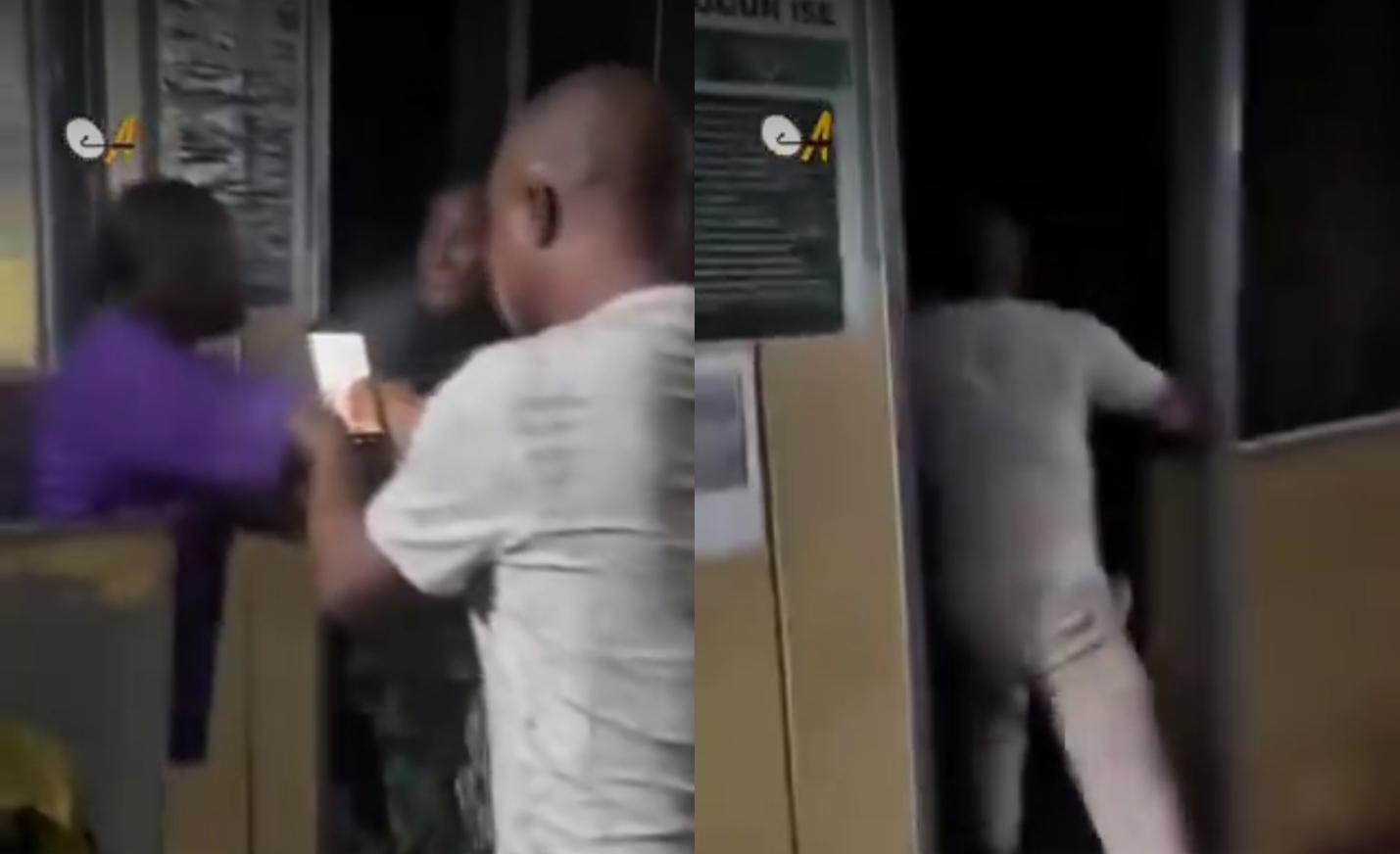
A video circulating online shows a man alleging that Adeoyo Maternity Teaching Hospital in Yemetu, Ibadan, had no doctors or nurses on duty when he rushed a family member needing emergency care to the facility at night. In the video, the man can be heard saying, in Yoruba, “kosi doctor ninu Adeoyo, to ba ku nko” — meaning “there’s no doctor in Adeoyo, what if someone dies?” — while filming a nurse who appears to be trying to avoid him as he follows her.
A quick, honest note before we go further: We have not been able to independently verify this specific video — there is no confirmed date, and the hospital has not issued a public statement addressing the claim that we could find. We are treating this as an unverified claim circulating online, not as confirmed fact. What is not in doubt, however, is that Nigeria’s public hospitals — including in Oyo State, where Adeoyo is located — have a well-documented staffing crisis.
This Isn’t a New Story: Oyo State’s Doctor Shortage Is Well Documented
Whatever the truth of this specific video, complaints about missing doctors at Oyo State’s public hospitals are not new or invented.
In October 2025, the Oyo State chairperson of the Nigerian Medical Association, Happy Adedapo, said the situation across the state’s general hospitals was “appalling and dangerous.” Of more than 20 general hospitals reviewed, six — Okaka, Iresa-Adu, Ikoyi-Ile, Sepeteri, Lanlate, and Ayete — had no doctors on ground at all, while several others had only one doctor managing hundreds of patients.
The pattern extends beyond Oyo. A Punch investigation into public hospitals nationwide found doctors in some facilities attending to around 100 patients a day, driven by a mass exodus of Nigerian doctors relocating abroad — a trend widely known in Nigeria as “japa.”
More recently, a doctor described being the only physician on call while two emergencies came in at once, forcing an impossible choice about who could be treated.
When the Worst Happens: Verified Cases of Patients Dying in Nigerian Hospitals
The fear behind the man’s words in the video — “what if someone dies?” — is not hypothetical. Nigeria has seen several documented cases where patients died after being let down by hospital staffing, equipment, or care.
In January 2026, author Chimamanda Ngozi Adichie publicly accused a Lagos hospital of negligence after the death of her 21-month-old twin son, Nkanu, who died less than 24 hours after being admitted. His parents alleged an overdose of the sedative propofol and inadequate care contributed to his death. The hospital denied negligence and said it had begun an internal investigation, while the Lagos State Government also opened its own inquiry.
In February 2026, a singer named Ifunanya Nwangene died at the Federal Medical Centre in Jabi, Abuja, after a snakebite. A member of her choir alleged that hospital staff said they had run out of the medication she needed and had to be sent to buy more from an outside pharmacy — she died before it arrived. The hospital denied being negligent or lacking anti-venom, saying she died from the severity of the snakebite itself. The case pushed the Senate to demand that hospitals be required to stock anti-venom as a condition of their licence.
Beyond individual cases, Nigerian doctors themselves have described the conditions driving such tragedies. One doctor recounted watching patients die from something as basic as a lack of oxygen or sutures, and described surgeons operating by torchlight during power cuts because hospitals lacked electricity.
Experts caution that these cases are likely only a fraction of the true picture. A community medicine professor has noted that only a portion of medical errors in Nigeria ever come to light, partly because hospitals often prioritise avoiding blame over reviewing what went wrong.
Why This Keeps Happening, and Who It Affects
Why it happens: Doctors are leaving Nigeria in large numbers. Low pay compared to what doctors can earn abroad, poor working conditions, and burnout have pushed thousands of Nigerian-trained doctors to relocate to countries like the UK, US, and Saudi Arabia.
Why it happens: Government hiring hasn’t kept pace. Even as doctors leave, many state governments — including in Oyo — have not recruited enough new doctors to replace them, leaving some hospitals with just one doctor or none at all.
Why it happens: Uneven distribution of doctors. A 2022 report showed Lagos alone had 7,385 doctors, while Oyo had 1,996 — meaning even where doctors exist nationally, they are concentrated in a handful of states and cities, leaving others badly short-staffed.
Effect on patients. When emergencies happen and no doctor is available, patients can wait hours, be turned away, or in the worst cases, die from conditions that were treatable — not because treatment was impossible, but because no one was there to give it.
Effect on health workers. The doctors and nurses who remain are often stretched across shifts meant for far more staff, sometimes working more than 48 hours straight, which endangers their own health as well as their patients’.
Effect on Nigeria as a country. Nigeria’s health system has been estimated to be performing at less than half its needed capacity. Stories like this — whether or not every detail of this particular video holds up — reflect and reinforce a broader loss of public trust in government-run hospitals, pushing more Nigerians who can afford it toward private care and adding to pressure on a health system already losing its workforce abroad.
What Could Help
Better pay and working conditions for doctors and nurses, to reduce the pace at which trained staff are leaving Nigeria.
Faster, targeted recruitment in hospitals and states currently operating with one or zero doctors.
Clear emergency-night protocols, so patients and their families know what to do if a facility genuinely has no doctor on duty.
Transparent hospital response to viral claims like this one — a public statement from Adeoyo confirming or denying what happened would serve patients better than silence.
Caution before treating unverified videos as fact — even where the broader crisis is real and well documented, specific claims still deserve to be checked.
Our Thoughts
I can’t confirm this exact night at Adeoyo happened the way the video suggests. But I also can’t pretend the underlying fear in that man’s voice comes from nowhere — Oyo State’s own medical association has said, on the record, that some of its hospitals have no doctors at all. Whether or not this specific video holds up, the crisis behind it is real, documented, and ongoing. If the hospital’s management believes the video is misleading, the right response is a public account of what actually happened that night — not silence.
Published by Ejoh Caleb