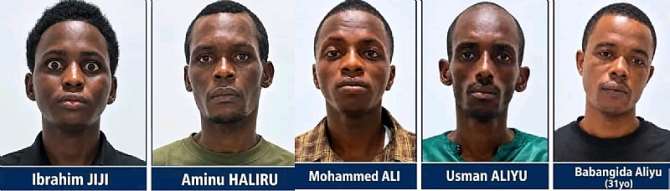
The Department of State Services (DSS) has arraigned five men before an Imo State High Court over separate kidnappings in the state, including the abduction of 20 prospective National Youth Service Corps (NYSC) members on October 1. The arraignment took place on Tuesday, October 20, 2026. Reports differ on the venue. The Voice of Nigeria and Premium Times place it in the Oru Judicial Division at Mgbidi, while Metro Daily and Kemi Filani name the Justice Oputa State High Court in Owerri.
The DSS said three of the defendants, Usman Aliyu, 25, also known as Chonge; Babangida Aliyu, 21; and Mohammed Ali, 23, alias Smallie Pepper, are charged over the abduction of the prospective corps members. The other two face charges over the kidnapping of four additional people a few days later. All five pleaded not guilty. The defendants are presumed innocent until a court rules otherwise.
What the Charges Say and What the Prosecution Claims: The Court Case So Far (The Arraignment)
According to the DSS, the three men were charged with conspiracy to commit hostage-taking under Section 6 of the Imo State Prohibition of Hostage Taking and Related Offences Law, 2009. The charge sheet also accuses them and others still at large of unlawfully possessing three AK-47 rifles, four magazines, a pistol and 81 rounds of live ammunition. Other reports describe a three-count charge covering conspiracy, hostage-taking and unlawful possession of firearms.
Prosecution counsel Ekezie Nwauzo told the court that the defendants and others at large planned and carried out the kidnapping in the early hours of October 1 along the Mgbidi axis of the Onitsha-Owerri Expressway. Two commercial buses carrying prospective corps members and other passengers from Ibadan to camps in Uyo and Bende were reportedly intercepted. The victims were freed on October 7 in a security operation at Amakohia-Ubi in Owerri West. These are prosecution claims, and the defence has not yet presented its case.
A Ransom Was Paid, the Prosecution Says: What the New Account Means for Earlier Statements (The Ransom Question)
In our earlier report, we noted that police described the victims as “rescued” and said they knew of no ransom payment, while some parents said they had paid. The arraignment brings a different official account. A DSS statement quoted by OsunDefender says the prosecution alleged that the defendants and other suspects still at large demanded and collected ₦8 million for the victims’ release. Another report quoted prosecution counsel as saying that the suspects collected ₦48 million and an undisclosed sum in US dollars from the victims’ families. Pulse reported an initial demand of ₦950 million.
The figures do not match, and we cannot say which is right. What the court filings, as reported, do suggest is that ransom was demanded and collected, which sits uneasily with an earlier police statement that the victims were rescued and that police knew of no payment. It is possible that both a security operation and a payment took place, but the authorities have not explained how they fit together. They should.
Reports also differ on who else was taken. Some say 20 corps members and one other passenger, others say four other passengers, and one outlet speaks of 24 people across two separate cases. The DSS charge sheets should settle this.
Corps Members Have Been Taken Before, and Trials Can Be Slow: Past Cases (Earlier Abductions and Prosecutions)
This is not the first time prospective corps members have been abducted. In August 2023, eight prospective corps members travelling from Akwa Ibom to Sokoto were taken in Zamfara State, and five months later concern was still growing for those in captivity. In August 2026, gunmen reportedly abducted 15 corps members in Kogi State as they returned from the Bayelsa orientation camp. The NYSC said all 16 on the bus were later recovered and that it would review its security protocols. In both cases, the public heard mostly about rescues and release. A court case like the one now beginning is less common, and it gives the public a chance to see how such crimes are tried.
Imo State has also seen other kidnap cases handled through police and the DSS, including the shuttle-bus snatching and syndicate arrests earlier this year. The Imo hostage-taking law, enacted in 2009, gives prosecutors a state-level tool, and the arraignment shows it is being used. We have not seen the penalties the law carries, and the court will decide any sentence.
Why Such Cases Matter Far Beyond the Courtroom: Effects on Victims, Families and Public Confidence (Consequences)
For the victims, a trial can mean reliving a frightening week. Prosecutors may need them as witnesses, and they should have support, privacy and protection. For their families, the ransom question may bring more stress, because those who paid may wonder whether they will get justice or answers.
For public confidence, an open trial can show that arrests lead somewhere. Many Nigerians believe kidnappers rarely face court. The SDG 16 shadow report cited earlier found that at least 7,825 people were abducted in 1,713 incidents between July 2025 and June 2026. If prosecutions are slow or end without verdicts, the public will believe the crime pays.
For the NYSC, parents’ fears about road travel to camp may deepen. For the country, it matters that serious crimes are tried openly and fairly. Hostage-taking charges carry heavy consequences, so the defendants also have a right to a proper defence.
Making Sure the Trial Delivers Justice: Practical Steps for Courts, Prosecutors and the NYSC (Possible Solutions)
First, speed with fairness. The court can set early trial dates and avoid needless adjournments, while giving the defence enough time. Prosecutors should say publicly which charges relate to which victims and publish the key facts, such as the amount of ransom alleged.
Second, victims and witnesses need protection. This includes counselling, secure ways to testify and confidentiality where appropriate. We urge the authorities to support the 20 young people.
Third, the manhunt should continue. The charge sheet names others still at large, and three suspects reportedly escaped with gunshot wounds. A conviction of a few would not end a network.
Fourth, clarity on ransom. The authorities should explain how a ransom came to be paid, whether any money has been traced or recovered, and whether families will be informed. This would also clear up the contradiction with earlier statements.
Fifth, travel safety. The NYSC has said it is reviewing its security protocols. It should tell the public what has changed, such as routes, convoys or timing. We suggest this as a way to rebuild trust.
Arrests Were a Beginning; a Fair, Open Trial Is the Test: Our Closing Reflection (Justice, Transparency and Safe Roads)
We welcome the arraignment. It is a step from announcement to accountability, and the young people who were taken deserve to see a proper process.
We also note that the defendants have pleaded not guilty and are entitled to a fair trial. The claims made in court so far come from the prosecution, and the court will decide what is proved.
At the same time, we are troubled by the shifting accounts. Ransom amounts differ across reports, and the earlier statement of a rescue with no payment now sits awkwardly beside the prosecution’s claim. We urge the DSS, the police and the NYSC to give a single clear account. We also urge the court to move the case forward fairly and promptly. We will follow the trial and report on each development.
Published by Ejoh Caleb