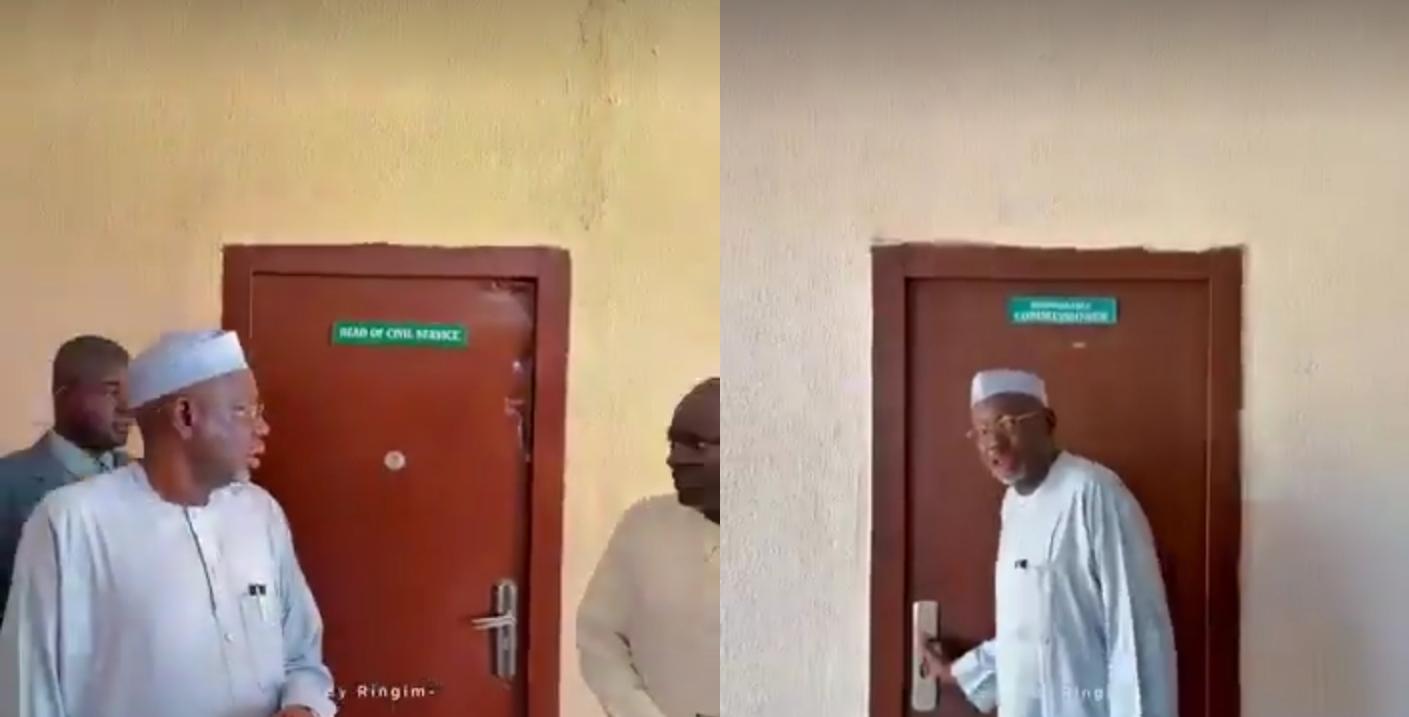
Jigawa State Governor Umar Namadi carried out an unannounced visit to the State Secretariat in Dutse to check whether civil servants were actually at their desks, and found the complex largely deserted, with several senior offices locked as late as 11 a.m.
Among those absent were the offices of the Secretary to the State Government (SSG), the Head of Service, and the Accountant-General, all of which were locked when the governor arrived. Of the state’s 18 commissioners, only the Commissioner for Works was present and working; the permanent secretaries of the Ministries of Health and Livestock Development were also at their posts, but many others were not. Only messengers and security personnel were found on duty in many ministries as the governor moved from office to office.
The governor’s Special Assistant, Garba Muhammad, confirmed the inspection was part of a wider statewide oversight tour combining administrative checks with humanitarian and infrastructure visits. Reacting to what he found, Namadi described the absenteeism as unacceptable and warned that his administration would not tolerate indiscipline or a lack of commitment in the civil service.
No Sanctions Announced Yet, Only a Warning
As of this report, no formal disciplinary decision, such as a query, suspension, or sack, has been publicly announced against any of the absent officials. Namadi stopped at issuing a verbal warning on the spot, telling staff that “commissioners and permanent secretaries must lead by example,” and cautioning that while his government remains committed to rewarding hard work, sanctions await those who fail to meet expectations.
Behind the scenes, however, the visit has reportedly unsettled the State Executive Council, with commissioners and senior officials said to be anxious about possible disciplinary measures that may still follow the governor’s findings. Whether that anxiety turns into actual sanctions, or fades the way it may have after the governor’s first surprise visit in 2023, remains to be seen.
A Recurring Governor’s Tactic Across Nigeria
This is not the first time Namadi himself has done this: he made a similar unscheduled visit to the same secretariat back in December 2023, and reportedly voiced dismay then too over poor staff turnout.
Other Nigerian governors have used the same surprise-inspection approach to confront absenteeism. In Ogun State, Governor Dapo Abiodun famously drove himself, without a chauffeur, to pay an unscheduled visit to civil servants’ offices in 2022. In Gombe State, officials have similarly warned staff against absenteeism and “truancy” during unannounced visits to government offices. The pattern suggests absenteeism in state civil services is a chronic, nationwide problem that governors keep trying to fix through spot-checks rather than through lasting structural reform.
Why Public Offices Keep Emptying Out During Work Hours
Several recurring factors are usually blamed for this kind of widespread absenteeism in Nigeria’s civil service:
Weak, inconsistent monitoring: Attendance is often tracked through registers that can be signed without the person actually being present, rather than through reliable, tamper-proof systems.
Low accountability for senior officials: Junior workers are more easily queried for lateness, while senior officials with more autonomy over their schedules often face fewer consequences.
Poor incentive structures: Where pay, promotion, and productivity are not clearly linked, some workers see little cost to being frequently absent.
Distance and logistics: In some cases, workers posted far from their homes struggle with commuting, though this does not explain absences among senior officials with official transport.
Why This Matters Beyond One Bad Morning
Widespread absenteeism, especially among senior officials responsible for approving files, releasing funds, and supervising junior staff, directly slows down government service delivery for ordinary residents who come to the secretariat for one need or another. It also damages public trust: when citizens see, via a viral video, that top officials were not even at their desks, it reinforces a belief that government pay is being drawn without matching output. Beyond Jigawa, this feeds a broader, familiar frustration Nigerians have with public service productivity nationwide.
Possible Solutions
States could introduce biometric or digital attendance systems at secretariats, which are far harder to manipulate than manual sign-in registers.
Regular, unannounced spot-checks, done routinely rather than occasionally, would keep officials from assuming absenteeism goes unnoticed between visits.
Clear, publicly known disciplinary consequences, applied consistently regardless of rank, would address the perception that senior officials face less scrutiny than junior staff.
Performance-based reviews tied to actual attendance and output could be introduced for commissioners and permanent secretaries, not just for lower-cadre workers.
Where officials have genuine competing duties (travel, official assignments), a simple, verifiable notification system would distinguish authorised absence from outright truancy.
Our Take
What strikes me most is that this is not Governor Namadi’s first surprise visit to the same secretariat; he did this back in 2023 and reportedly found the same problem, and back then too it ended in a warning rather than named consequences. That repetition is the real story here, more than the empty offices themselves. A surprise inspection makes for a strong video and a stern warning, but if the same offices are empty again next time, it means spot-checks alone are not fixing anything. Nigeria’s civil service does not need more viral moments of officials caught off guard; it needs someone to actually follow through with the sanctions that keep getting promised, so a governor’s unannounced visit stops being newsworthy at all.
Published by Ejoh Caleb