
Anger and grief have taken over parts of Minna, the Niger State capital, after 37 suspected illegal miners died while held by the Nigeria Security and Civil Defence Corps (NSCDC — a paramilitary agency that protects government buildings, pipelines, and other public assets alongside the police).
The suspects were arrested between September 15 and 16, 2026, during a raid on illegal mining sites around the Mohammed Inuwa Wushishi Housing Estate and Lukoto village, west of Minna. By the early hours of September 17, dozens of them were found dead inside the detention cell.
Niger State Governor Mohammed Umaru Bago confirmed the deaths at a press briefing, calling the incident “sad” and “tragic,” and announced three days of mourning across the state. He also postponed the planned start of campaigning for elections due in January 2027.
What the Civil Defence First Said Happened
NSCDC’s Niger State Commandant, Suberu Siyaka Aniviye, initially said the deaths followed a suspected outbreak of disease, later named as diphtheria (a bacterial infection that attacks the throat and can spread quickly in crowded spaces). He said the operation, which the corps called a “bust operation,” had led to the arrest of “scores of suspected illegal miners.”
Why Survivors and Families Are Rejecting That Account
Survivor Dauda Shehu, speaking from his hospital bed, said sixty-six people were held in a single cell, and blamed the deaths on excessive heat and overcrowding rather than illness. An intelligence report seen by AFP similarly suggested overcrowding and poor ventilation inside the facility, not disease, may have caused the deaths. Families are also asking why a sudden infection would kill dozens of young, healthy detainees overnight while sparing the guards watching over them. Some of the dead were teenagers, and several victims were reportedly internally displaced persons from Shiroro Local Government Area, who had turned to mining after being pushed from their communities by insecurity.
How Minna Reacted Overnight
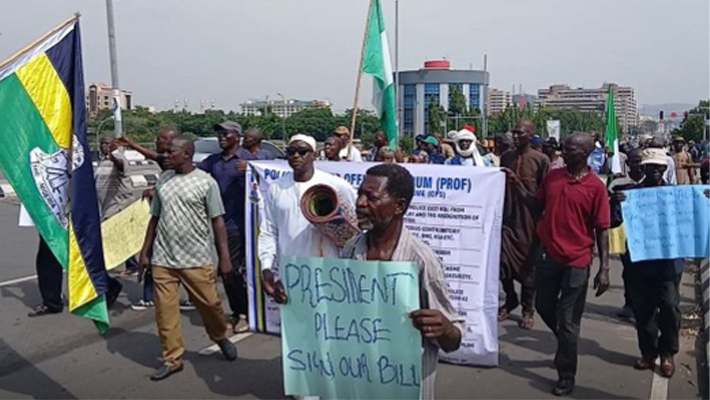
The news triggered protests in the Maitumbi, Tudun Natsira, Berger, and Tunga areas of Minna, with demonstrators blocking the road at Flamingo Junction and disrupting traffic. CNN reported that youths chanted “Justice must be done” through the night, and some vehicles were damaged.
An Echo of a Past Nigerian Custodial Tragedy
This isn’t the first time an overcrowded Nigerian holding cell has turned deadly. In 2019, five inmates were electrocuted inside a severely overcrowded cell at the Ikoyi Medium Security Custodial Centre in Lagos — a cell built for 35 people that was holding 140 at the time. That incident, like Minna, prompted an official investigation and public outrage, but rights groups say Nigeria’s detention facilities have continued to struggle with the same overcrowding problem years later.
What Officials Have Done So Far
Interior Minister Olubunmi Tunji-Ojo ordered the immediate suspension of Commandant Aniviye pending investigation. NSCDC’s national leadership also set up an internal panel to examine how the suspects were arrested, how they were held, and what medical care they received. Separately, the Niger State Police Command opened its own criminal investigation and is asking relatives of the dead to come forward with information, while the bodies have been taken to the General Hospital in Minna for autopsy.
Politicians Are Now Demanding Answers
Former Vice President Atiku Abubakar said state facilities must never become “execution centers for citizens whose rights remain protected” under the constitution. Former Anambra governor Peter Obi called it “a deeply troubling tragedy that demands urgent answers” and urged accountability for any official found negligent. Senator Rabiu Kwankwaso questioned how a one-to-two-day detention could escalate into a tragedy that claimed young lives, including minors.
How This Reaches Beyond Minna
Locally, families in Minna are burying loved ones and demanding accountability from an agency meant to protect, not endanger, people in its custody. Nationally, the tragedy adds to growing public distrust in Nigeria’s security and detention institutions at a time when the country is already grappling with widespread complaints of law-enforcement abuse — the National Human Rights Commission recorded more than 358,000 such complaints between January and June 2025 alone. It also puts a spotlight on Niger State’s gold-rich but poorly regulated artisanal mining sector, which draws thousands of young, often desperate workers into informal and risky work.
What Could Help Prevent This From Happening Again
Independent, transparent autopsy findings — so Nigerians aren’t left choosing between the agency accused of negligence and grieving families’ accounts.
Enforceable custody limits — clear legal caps on how many people a cell can hold, with real penalties for violations.
Accountability beyond suspension — families are asking for prosecutions, not just an administrative sanction, if negligence is confirmed.
Legal alternatives for artisanal miners — many of the dead were mining out of desperation, not greed; cracking down without offering safer, formal mining channels will keep pushing people into the same risky pits.
Where We Stand on This Tragedy
What happened in Minna isn’t just about illegal mining — it’s about what a government owes anyone the moment it takes them into custody, guilty or not. Thirty-seven families are now burying people who were alive days ago. Whether the final answer is disease or negligence, the state had a duty to keep those detainees alive, and it failed. We’ve seen this story before, in Ikoyi and elsewhere, and each time the promises fade once the news cycle moves on. This time, the scale of the loss — and the fact that children were among the dead — makes it much harder to look away.
Published by Ejoh Caleb