
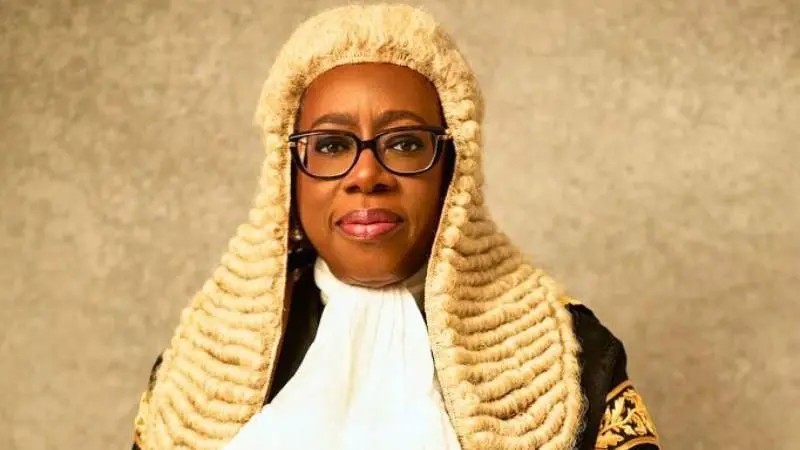
The Chief Justice of Nigeria (CJN), Kudirat Kekere-Ekun, has directed lawyers, court officials and other personnel to stop using the title “Barrister” before their names in all official engagements at the Supreme Court.
The directive was contained in a memorandum dated July 13, 2026, and signed by the Chief Registrar of the Supreme Court, Kabir Akanbi. It was addressed to litigation staff, legal practitioners, court registrars and lawyers, and it took immediate effect.
The memo said the use of “Barrister” as a prefix to names is “inappropriate and inconsistent with the standards of professionalism expected within the Supreme Court of Nigeria,” and directed officers to discontinue it in all official correspondence, records, documents, identity materials, and other official engagements. The Chief Justice also instructed heads of departments and unit heads to enforce strict compliance among the staff under their supervision.
The Nigerian Bar Association (NBA) has since acknowledged the memorandum in a notice to its members, advising lawyers to take note of the directive in their official engagements and correspondence.
This Isn’t a New Rule. It’s an Old One Being Enforced Again
What makes this directive notable is that it is not actually new law, it is the reactivation of a long-standing but widely ignored position. Nigeria’s Legal Practitioners Disciplinary Committee (LPDC) — the tribunal that hears misconduct cases against lawyers — has already ruled on this exact question. In the case of Nigerian Bar Association v. Ofomata, the Supreme Court affirmed that prefixing “Barrister” before a lawyer’s name is unprofessional and improper, stating that the practice “is unknown to our legal tradition and smacks of self-aggrandizement.”
Even before that ruling, the NBA’s National Executive Committee had already resolved, at a meeting in Port Harcourt in November 2015, that using “Barrister” as a prefix to a lawyer’s name is against the ethics of the legal profession. In a separate disciplinary case, the LPDC reprimanded a senior lawyer for persistently using the prefix, confirming that the rule has, at least on paper, been actively enforced before.
Why “Barrister” Became a Status Symbol Anyway
Despite the rulings, the title spread widely across Nigeria, appearing on business cards, car number plates, wedding invitations, and even church programmes. Legal commentators trace the appeal to how the word functions differently in Nigeria than in the legal systems it borrowed from. In countries like the United Kingdom, “barrister” describes a lawyer’s role, someone who argues cases in higher courts, rather than a title placed before a name. In Nigeria, where every lawyer is automatically enrolled as a “barrister and solicitor” of the Supreme Court upon being called to the bar, some practitioners adopted it instead as an honorific, similar to “Engr.” for engineers or “Arc.” for architects.
Legal ethics writers have argued this reflects a deeper pattern in Nigeria’s professional culture: an attachment to titles as a marker of achievement and status, sometimes described as an “obsession with vain titles” within the legal community itself.
Why the Rule Never Fully Stuck (Causes and Effects)
A few things explain why a rule that technically dates back more than a decade needed to be reissued in 2026.
First, disciplinary rulings from bodies like the LPDC often lack the visibility of a public directive from the Chief Justice herself. Many lawyers, particularly younger ones, may never have encountered the Ofomata ruling or the 2015 NBA resolution directly, even though both remain binding.
Second, enforcement has historically been inconsistent. Isolated reprimands, like the one issued against a senior lawyer in one case, did little to change a practice that had already become culturally embedded, especially outside courtrooms and official filings where no one was checking.
Third, this reflects a broader tension within Nigeria’s legal and public institutions between formal rules and informal custom. When a widely practised habit contradicts an official rule for years without consequence, it can start to feel like the informal version has quietly become the accepted standard, even when it hasn’t. For Nigeria as a country, this episode is a small but telling example of how administrative reforms can struggle to take hold unless they come with visible, top-down enforcement, a pattern that shows up well beyond the legal profession, in areas from traffic rules to tax compliance.
Possible Solutions
Consistent enforcement beyond the Supreme Court. For the directive to have lasting impact, similar guidance and enforcement would likely need to extend to the Court of Appeal, High Courts, and state Bar branches, not just apex court filings.
Clear public communication to the wider legal community. Publicising the reasoning behind the rule, not just the rule itself, could help lawyers understand it as an established ethics standard rather than an arbitrary new restriction.
Guidance on acceptable alternatives. Clarifying that terms like “Barrister-at-Law” or “Barrister and Solicitor” after a name remain acceptable, while only the prefix use is barred, could reduce confusion among practitioners adjusting their documentation.
The Bigger Picture
What I find most interesting about this story is that it isn’t really about a new rule at all, it’s about what happens when an old rule finally gets enforced. For over a decade, Nigerian lawyers technically knew, or should have known, that “Barrister” as a prefix was improper, yet the practice thrived anyway because nothing serious ever happened to those who ignored it. That says less about the legal profession’s understanding of its own ethics rules and more about how much any rule in Nigeria depends on someone powerful enough deciding, on a given day, to actually enforce it. The real test now isn’t whether the Supreme Court’s own filings comply, but whether this directive changes anything the next time a lawyer hands out a business card.
Published by Ejoh Caleb