Nigerian security operatives have shut down a suspected fake university that was operating out of a three-bedroom flat in Lagos. More than 100 young people, many of them desperate for a foreign education, were rescued from the property. The case is now raising fresh questions about how fake schools continue to trick Nigerian and West African families out of their money.
What Happened in Badagry
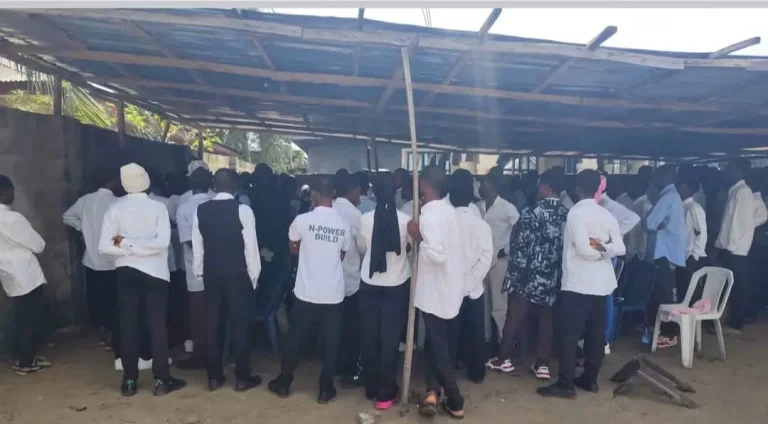
Operatives of the Nigeria Security and Civil Defence Corps (NSCDC, a federal security agency that protects government infrastructure and enforces certain laws) raided a property in Ilado, in the Olorunda area of Badagry, Lagos State, early on Monday, July 20. They rescued 106 young people who had been living and “studying” there.
According to the Badagry Area Commander, Chief Superintendent Gbenga Ekunola, the raid followed days of secret surveillance after officers received a tip about the property. The suspected owner of the institution was arrested and is now helping with investigations.
Investigators say the so-called university had no proper name, no registration, no signboard and no real campus. It reportedly advertised itself online as a distance-learning centre linked to a university abroad . Most of the rescued students were between 19 and 24 years old. Some came from Kogi, Oyo and other Nigerian states, while others had travelled from Niger Republic, Cameroon and Togo after being recruited online .
The NSCDC separately confirmed that its Lagos command raided a related fake institution in Imeke village, also in Olorunda, arresting six suspects and rescuing 107 students who had been enrolled in unaccredited courses, including nursing. The command said the operators of that scheme also pushed the students into a Ponzi scheme (an investment scam where early participants are paid using money from new recruits, not real profit).
How the Scam Worked
Investigators say victims paid between ₦200,000 and ₦1.5 million to secure “admission,” while some students from other West African countries paid between $400 and $500. Beyond the admission fees, the scheme reportedly worked like a chain-marketing or Ponzi structure: students who brought in new recruits earned commissions, and some were also made to promote unnamed products online for extra income .
Many parents reportedly did not know what their children had actually travelled to Lagos for. Officials say one parent was told her child had gone to learn a trade, not to attend a university
Fake Universities Are Not New in Nigeria
This is not an isolated case. Nigeria’s National Universities Commission (NUC, the federal body that approves and monitors universities) has repeatedly published lists of illegal institutions operating across the country. In one recent update, the NUC named 58 fake universities and “degree mills” that had been shut down for operating without approval, warning that certificates from these places would not be recognised for jobs, further studies, or the mandatory National Youth Service Corps programme.
Officials have also warned that some fraudulent schools now claim links to institutions in other countries, including Benin Republic, Ghana and Uganda, and have been known to award degrees in as little as six months, compared to the several years a real degree takes [https://tribuneonlineng.com/some-nigerian-students-now-get-ph-d-from-fake-universities-in-less-than-one-year-says-nuc-boss/].
Why This Keeps Happening
Several factors keep fuelling this kind of fraud:
Desperation for foreign education. Many young Nigerians see a foreign degree as a fast route to better jobs and a better life, which scammers exploit with fake promises.
Weak public awareness. Many families do not know how to check whether a university is genuinely accredited before paying money.
Online recruitment. Scammers now operate mostly through social media and messaging apps, making it easier to reach victims across Nigeria and neighbouring countries without ever meeting them physically.
Reward-for-recruitment schemes. Offering commissions for bringing in new “students” turns victims into recruiters, helping the scam spread quickly before it is noticed.
The Effects on Students, Families and the Country
For individual victims, the damage is direct: lost money, wasted time, and in some cases, a broken sense of trust after being separated from family for months. Some students were reportedly unaware they were even in a fraudulent scheme until the raid happened.
But the effect goes beyond the individuals involved. Cases like this damage Nigeria’s image internationally, especially given that foreign nationals from Niger, Cameroon and Togo were also victims, an indication that the fraud is now crossing borders. Each new case adds to the perception that Nigeria’s education sector is poorly monitored, which can affect how Nigerian qualifications are viewed abroad and discourage genuine investment in the country’s education system. Left unchecked, these networks also normalise fraud as a way to make money among young people, some of whom end up recruiting their own relatives and friends into the same scheme.
Possible Solutions
Stronger, more visible verification tools. The NUC already publishes a list of approved universities, but more should be done to make this list easy to find and check, including through simple SMS or WhatsApp verification services that do not require internet access.
Tougher, faster prosecution. Quickly prosecuting and publicising convictions of proprietors of fake schools would serve as a stronger deterrent than closures alone.
Cross-border cooperation. Since victims and operators are increasingly coming from different West African countries, Nigerian agencies may need to work more closely with regional bodies like ECOWAS to track these networks.
Public enlightenment campaigns. Targeted awareness campaigns, especially in secondary schools and on social media, could help young people and parents recognise warning signs before paying any money.
Our Take
What stands out most in this case is how ordinary the scam’s setup was: a rented flat, a fake website, and a promise. That simplicity is exactly why it worked on so many people. As long as getting a foreign degree remains seen as the fastest way out of hardship, fraudsters will keep finding new victims. Regulators shutting down these operations is necessary, but it is not enough on its own. Nigeria needs a culture where checking an institution’s legitimacy becomes as automatic as checking a phone number before sending money to a stranger. Until that happens, cases like the one in Badagry will keep repeating themselves, just with a different address each time.
Published by Ejoh Caleb