
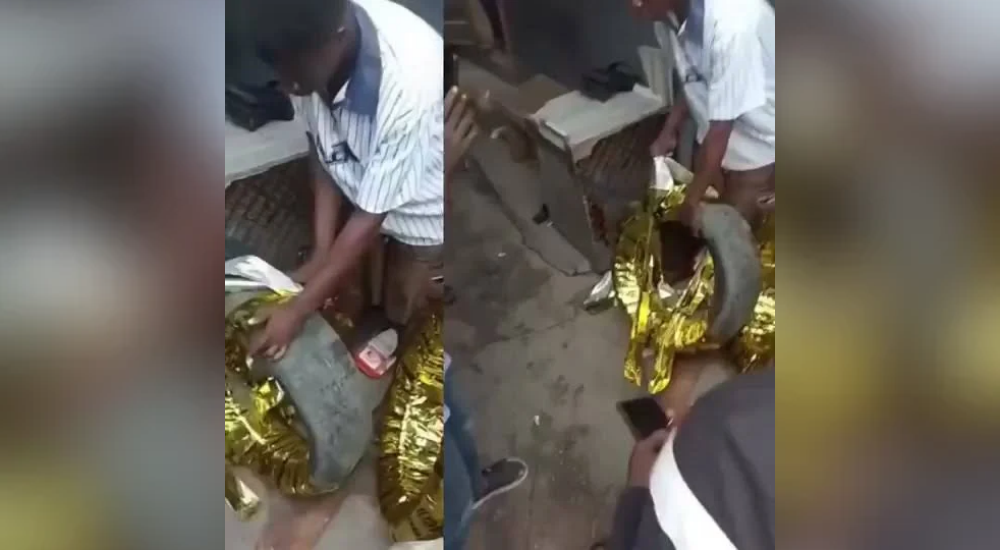
A man has reportedly been caught after trying to use old, damaged car tyres, packed in nylon to look new, to collect cash from a Point of Sale (POS) operator. According to the report, he came to the POS stand pretending to make a withdrawal. After claiming that a transfer had failed, he allegedly asked the operator to keep the “new” tyres and give him cash, saying he was in a hurry. Neighbours reportedly caught him during the negotiation.
What the report says happened (the alleged method)
The account describes a trade of goods for cash. The man allegedly said his transfer did not go through, and then offered tyres as a form of security, so the operator would hold something valuable while he went away. The report says the tyres were old and damaged, and had been wrapped to hide that. It was during the discussion that nearby residents reportedly intervened.
Tricks aimed at POS operators have a long record (past cases and outcomes)
POS operators are frequent targets of scams. In September 2026, the Plateau State Police Command paraded Jonathan Sambo Bitrus, 20, who confessed to defrauding a POS operator of ₦1,550,000 at Terminus Market in Jos. Police said he manipulated the terminal so that an earlier successful receipt appeared to be his own. He ran off with the cash, and the fraud was discovered only when the shop owner returned. The report does not say whether he has been charged or tried.
An earlier compilation described other methods. In Ekiti State, the Nigeria Security and Civil Defence Corps arrested a 36-year-old man who allegedly posed as a medical doctor and used fake alerts to cheat POS operators. In Anambra State, police arrested a man, Chisom Nweke, who allegedly gave operators plain paper cut to the size of naira notes to deposit. In Enugu, a POS agent said two young men took ₦70,000 by tricking her after an approved transaction did not show in her account, and that she later caught them and got the money back.
In these cases, the reports mostly end with an arrest, a parade or a recovery. We did not find convictions, so we cannot say how often suspects are punished.
Pressure, speed and trust (why these tricks work)
POS operators handle cash all day, often alone and in public places with long queues. A customer who claims to be in a hurry puts pressure on them to decide quickly. A story like “my transfer failed” and an offer of goods as security can sound reasonable, especially if the goods look new and valuable.
The operators’ business depends on trust, and a small margin on each transaction leaves little room for loss. One bad deal can wipe out a day’s or a week’s earnings.
Small stands, big losses (effects)
For the operator, a loss of cash is direct and hard to recover, and sometimes the cash belongs to someone else. For the suspect, if the allegation is true, there are legal risks and public shame. For the community, such incidents make operators suspicious of honest customers, which can slow service.
At the national level, the safety of small cash-handling businesses matters, because many Nigerians depend on POS stands for withdrawals, especially where banks are far away.
Checking before handing over cash (possible solutions)
Operators can avoid taking goods in place of money. If a transfer has not arrived, the safest rule is to wait for confirmation in their own account before handing over cash. Operators can also keep cameras at the stand, work near other people, and ask a neighbour to witness any unusual deal. Anyone who tries to hand over goods as security can be told to come back with the money.
Police can publish cases that end in court, so that the public sees a real consequence. Trader associations and banks can share warnings about new tricks. If a suspect is caught, the best course is to hand him to the police, not to take the law into your own hands.
A lesson in saying no to a rush (our view)
We do not know whether this man set out to cheat. The video and the report are all we have, and he is entitled to a fair hearing. But the story carries a simple lesson for anyone who handles cash for a living: pressure to decide in a hurry is a warning sign.
The operator was reportedly saved by alert neighbours. We hope the matter was handled lawfully and that the facts will be made clear. For other operators, a few seconds spent confirming money in an account, and a firm refusal to swap cash for goods, can prevent a heavy loss.
Published by Ejoh Caleb