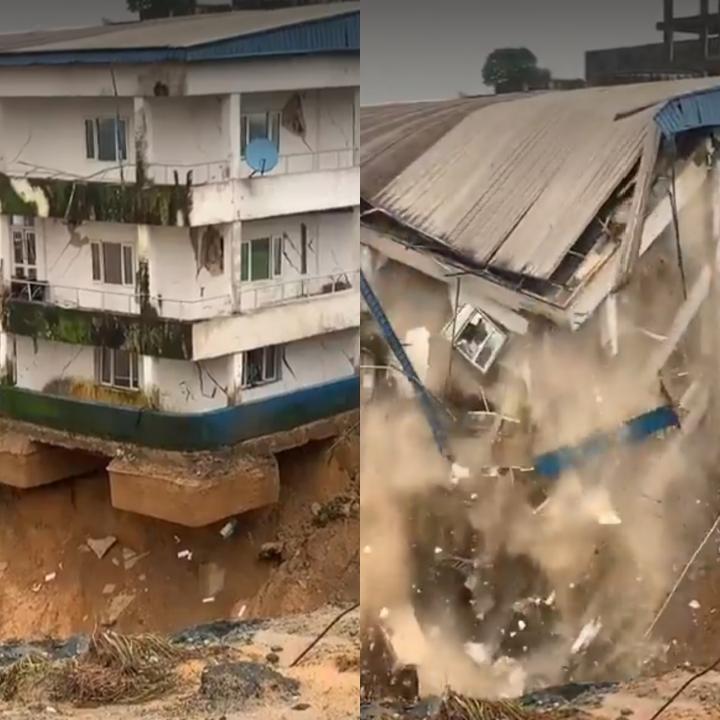
An abandoned hospital in Calabar collapsed yesterday after heavy rainfall triggered a landslide in the area. The Unicern Hospital, which had been shut down because of repeated landslides threatening the site, came down as the weakened ground beneath it finally gave way. Footage of the moment the building fell has circulated on social media. No one was reported inside the hospital when it collapsed, but the incident adds to weeks of disaster across the city.
Why This Happened: A City Sinking
Calabar has faced weeks of torrential rainfall since early July 2026. The constant downpours have loosened soil on hillsides and near the waterfront, causing landslides across multiple communities. The Unicern Hospital’s collapse is one more disaster tied to these conditions.
Similar incidents have struck Calabar repeatedly in recent weeks. In July, a landslide at Ikot Anwatim killed five people — a father and his four children — when their home collapsed on them. Another landslide at Boropit killed two girls after a building fell on them. At Diamond Hill, near the former Unicem headquarters, several houses were swept into the sea, leaving behind a gaping space where homes once stood. In total, at least 10 people have died across Calabar from the flooding and landslides since the rains began.
Experts have linked the disasters to deforestation, illegal logging, mining, and unchecked agricultural activity that has stripped the state’s forests of their natural protection. Buildings in some of these areas were also poorly sited or built without strong foundations. The Unicern Hospital had already been abandoned because of this same danger — the ground beneath it was known to be unstable.
How This Affects Nigeria
This crisis is not unique to Calabar. Heavier rainfall linked to climate change is becoming more common across Nigeria’s coastal and forest regions. Without proper planning and infrastructure, more communities elsewhere in the country face similar risks. When hospitals and other buildings collapse, people lose access to healthcare, shelter, and safe roads. Businesses cannot operate normally, and entire neighbourhoods can become cut off, as has already happened along Calabar’s waterfront.
The collapse also raises a bigger question about building safety nationwide. If an already-abandoned hospital could not withstand the pressure of this land, it highlights how many other structures — homes, schools, clinics still in use — may be sitting on equally unstable ground across Nigeria.
What Can Be Done
The Cross River State Government has called for urgent federal intervention. Deputy Governor Dr Peter Odey, speaking at the Diamond Hill landslide site, said the scale of destruction has surpassed the state’s capacity and appealed for federal technical expertise and ecological resources.
Several steps are urgent. Drainage systems across the city need to be rebuilt and properly maintained. Communities in high-risk zones need early warning systems so residents can evacuate before disaster strikes. New buildings must be constructed on stable ground, with proper foundations and enforced building codes. Protecting remaining forests and vegetation would also help hold soil in place during heavy rainfall.
The federal government sending engineers and resources quickly would make a real difference. State authorities also need to work with communities to identify unsafe structures and relocate residents before the next major rainfall.
What We Must Understand
The collapse of the Unicern Hospital is a warning sign. Calabar is not sinking overnight, but it is sinking steadily, one landslide at a time. Without urgent action, more buildings will fall, more lives will be lost, and more communities will be cut off from help.
This is not simply bad luck or an act of nature. It is the result of choices — cutting down forests, building on unstable ground, ignoring early warning signs. Nigeria can choose differently. We can enforce building codes properly. We can protect our forests. We can plan for the climate we actually face, not the one we wish we still had.
The people of Calabar deserve safety. That requires real action now, not promises for later.
Published by Ejoh Caleb