
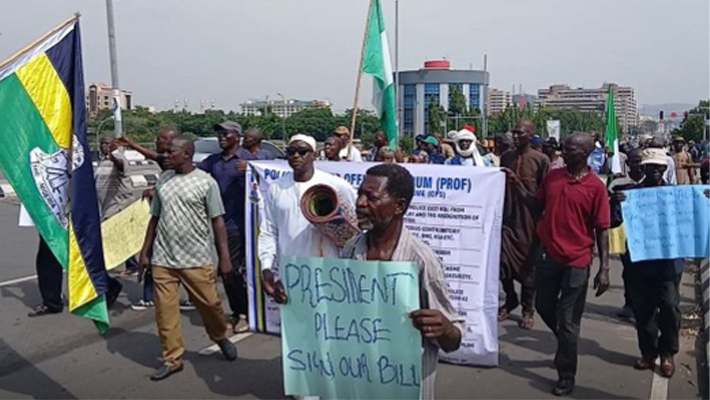
Retired Nigerian police officers, together with their wives and children, took to the streets of Abuja on Monday to demand a complete exit from the Contributory Pension Scheme (CPS). This is a system where workers and employers pay into a personal retirement account during service, and the pension is paid from that account after retirement.
One retired officer in the video said: “Nigerian soldiers, once they complain, the government will solve their problems, but the Nigerian police own is now different. We have become a liability.” He added that the nation “needs truth.”
What the retirees want (the demands)
The protest is led by the Police Retired Officers Forum of Nigeria (PROF). Its main demand is that President Bola Tinubu give assent, meaning his signature that turns a bill into law, to the Police Exit Bill. The National Assembly passed the bill on December 4, 2025, and sent it to the President on March 16, 2026. It would remove the Nigeria Police Force from the CPS.
The group’s wider demands include a move to a Defined Benefit scheme, where the government pays a set amount based on a person’s years of service and final pay. It also wants a dedicated Police Pension Board and payment of all outstanding pension rights and arrears.
A protest that has been building for over a year (the timeline)
Retired officers first took to the National Assembly and police headquarters in July 2025. By November 2025, they had spent nearly two months at the National Assembly gate, and the House of Representatives debated a motion on their plight. In the same period, the then Inspector-General of Police, Kayode Egbetokun, wrote to the Senate President asking for the law to be amended to remove the police from the scheme. He had earlier told protesters that their welfare was being addressed, but said an exit from the CPS could not be done immediately.
On April 20, 2026, retirees and their families blocked a gate to the Presidential Villa. In June, PROF said more than 30,000 retirees were appealing to the President and warned of fresh nationwide protests if the bill was not signed before June 22.
In September, the forum said it would start an indefinite protest on Tuesday, September 29. It said the President had still not signed the bill, and that feedback promised by the Inspector-General had not arrived. We found no public statement from the Presidency on the bill.
Why they say the scheme is failing them (the pension complaints)
Retirees say the pension they get is too small. One protester asked what ₦30,000 can buy in the market today, and begged to be moved to a police pension board. They also say the scheme does not reflect the dangers of police work, and they call it unfair that other security agencies have been removed from it while police remain. That point is why the officer in the video compared the treatment of soldiers and police.
The group describes the scheme in very harsh terms, calling it “contributory slavery.” These are the retirees’ own words and views.
The other side of the argument (what supporters of the scheme say)
The retirees are not the only voice. A report in August 2025 quoted experts who warned that abandoning the CPS could return the country to the chaos of the old pension system, with unpaid benefits and heavy pressure on public finances. We did not find a detailed public response from the National Pension Commission (PENCOM) in the reports we reviewed. Retirees have accused PENCOM of failing to set up a distinct pension structure for police.
A decision that has stayed on the President’s desk (why the dispute continues)
The bill has been with the Presidency since March, and the retirees’ protests continue because no answer has been given. The Constitution gives the President 30 days to sign a bill or withhold assent, but we found no public statement saying whether he has signed, declined or planned changes.
The wider cause is a clash between two aims: a pension system that protects public funds, and a promise of dignity to people who risked their lives for years. Without a clear response from the Presidency, each side is left to assume the worst.
Hardship, morale and public safety (effects)
For retired officers, the effect is daily. Their children and wives joined the protest because the loss falls on whole households, including those who need medicine, rent and school fees. Some retirees have said that they are struggling with injuries received in service.
For the country, the issue touches on the police force’s morale. Retirees argue that a force whose members expect poverty in old age may find it harder to resist corruption. That is their argument, not a proven fact. Repeated blockades near the seat of government also disrupt movement and take officers’ attention away from other work.
Ways to end the stalemate (possible solutions)
The Presidency can state clearly whether it will sign the bill, and if not, explain why and what it will do instead. Government can pay out any outstanding pension arrears quickly, because those are a debt regardless of the scheme. It can also review the size of the monthly pension for retired officers.
If a full exit is not possible, lawmakers, PENCOM and the retirees can agree on a middle path, such as a special police pension arrangement with funding that is clearly explained. An independent review of how much the police scheme would cost, and who would pay, would help both sides argue from facts. Police authorities should also allow peaceful protest and keep talking to the retirees.
A promise of dignity needs an answer (our reading of the protest)
We believe both concerns are real. Pension schemes must be sustainable, and public money must be protected. But men and women who spent their working lives on the front line have a right to know how they will be treated in old age.
What strikes us most is the silence. A bill has been waiting for months, retirees have marched for over a year, and the public still has no clear response from the Presidency. Whether the answer is yes, no or a middle path, it should come soon and in plain words. The longer the delay, the more it looks like indifference to a group that the nation relied on to keep it safe.
Published by Ejoh Caleb