A woman armed with two knives stabbed two strangers in the middle of one of the world’s busiest tourist districts on Monday afternoon, killing one of them, before New York police officers shot and killed her after she advanced toward them with the blades still in her hands.
The Attack
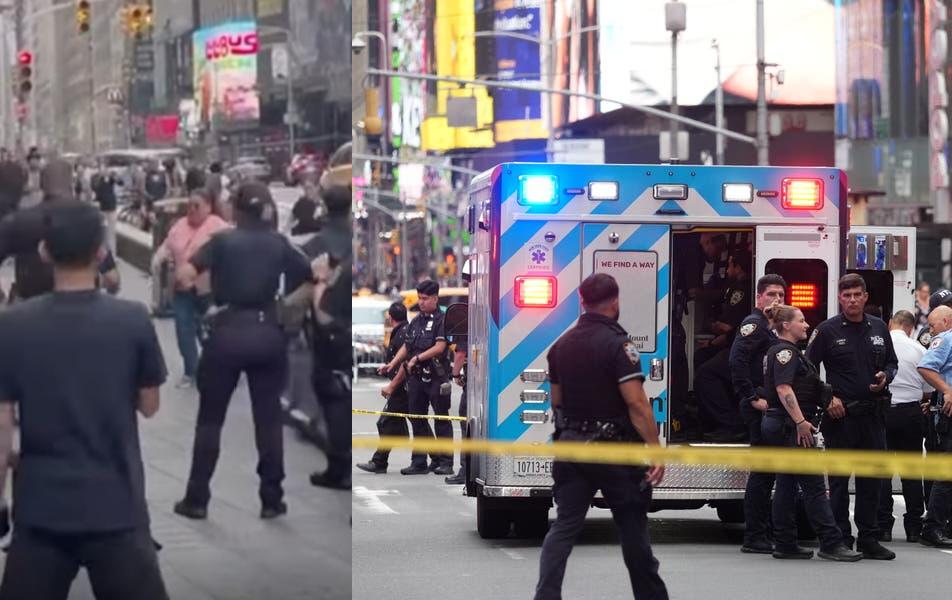
The incident began at about 4:24 p.m. near West 41st Street and Seventh Avenue in Manhattan’s Times Square. New York Police Department (NYPD) Commissioner Jessica Tisch identified the woman as 49-year-old Pamela Cisneros of Queens. Police said Cisneros approached a 68-year-old man who had just come up from the subway and stabbed him in the abdomen, then moved north and stabbed a 32-year-old woman in the abdomen as well, in what officials described as a random and unprovoked attack carried out within about 20 seconds. The female victim was taken to Bellevue Hospital, where she was later pronounced dead; the male victim remained hospitalised in stable condition.
The Confrontation
Cisneros then continued toward an NYPD substation while still carrying the knives. Officers who were flagged down by witnesses spoke with her for about four minutes, repeatedly ordering her to drop the weapons, according to Tisch. Police said Cisneros refused, telling officers, “I’m not dropping anything. I would rather kill both of you,” a threat she repeated during the standoff. Multiple officers deployed Tasers, but the shocks did not stop her, and two officers then fired their service weapons after she advanced toward them holding the knives. Cisneros was struck and taken to Bellevue Hospital, where she was pronounced dead. Authorities said she had a documented history of mental-health-related interactions with the NYPD dating back to 2018 and 2019, though no arrest history. New York City Mayor Zohran Mamdani thanked the responding officers and said the standard internal investigation into the shooting would proceed, with body-camera footage to be released publicly.
A Familiar Flashpoint for One of the World’s Busiest Squares
Random, unprovoked knife attacks are not new to Times Square, despite it being one of the most heavily policed tourist areas in the world. In May 2024, a man was filmed lunging at two women near a deli close to Times Square and stabbing one of them in an apparently unprovoked attack, before calmly returning to smoke a cigarette; the suspect reportedly had 24 prior arrests over two decades. The area has also seen other violent, high-profile incidents involving bystanders, including a shooting years earlier that injured a four-year-old girl and two women who had no connection to the dispute that caused it. Cases like Monday’s also sit within a much larger, ongoing debate in American policing over how officers should respond when a person in crisis is armed and not responding to commands, a scenario that has ended in fatal shootings in cities across the United States for years.
Why Cases Like This Keep Recurring
Mental health advocates and police reform experts have long argued that officers are often the first and only responders sent to encounters involving a person in an acute mental health crisis, despite not always having specialised training to de-escalate such situations without lethal force. At the same time, police officials point out that when a person is actively armed and has already caused serious injury, as Cisneros allegedly had, officers are forced to make split-second decisions to protect themselves and the public, particularly in a dense, crowded area like Times Square.
Weighing the Different Sides
Supporters of the officers’ actions note that Tasers were deployed first and failed to stop her, and that she had already killed one person and injured another before continuing to threaten officers directly, leaving them with what they describe as no safe alternative. Critics of how such encounters typically unfold argue that cases involving a documented mental health history call for greater investment in crisis-intervention teams and mental health co-responders, so that outcomes like this become less frequent, even while acknowledging that some situations may still end tragically regardless of the response.
The Toll on Victims, Officers, and the Wider Public
For the families involved, the human cost is immediate and permanent: one woman is dead, a man remains hospitalised, and the officers who fired their weapons will now face the standard investigation into the shooting. More broadly, incidents like this one shake public confidence in the safety of high-traffic public spaces and reignite scrutiny of how well-equipped city police departments are to handle mental health crises without more lives being lost, including the life of the person in crisis.
Looking Ahead
Advocates continue to push for expanded funding of specialised crisis-response units, better data-sharing between mental health providers and police so that officers responding to a call know a person’s history in advance, and de-escalation training that goes beyond standard use-of-force protocols. New York City’s ongoing investigation into the shooting, including the release of body-camera footage, is expected to inform whether officers followed department protocol throughout the encounter.
Closing Reflection
This was, by every account so far, a genuinely difficult situation for the responding officers — a woman who had just killed someone, refused every order, and threatened to kill again. We don’t think there’s an easy verdict to hand down here. What we do think is worth sitting with is how often stories like this trace back to a documented history of mental health crisis, and how much earlier intervention, long before a person reaches a public square with two knives, might change how these stories end.
Published by Ejoh Caleb