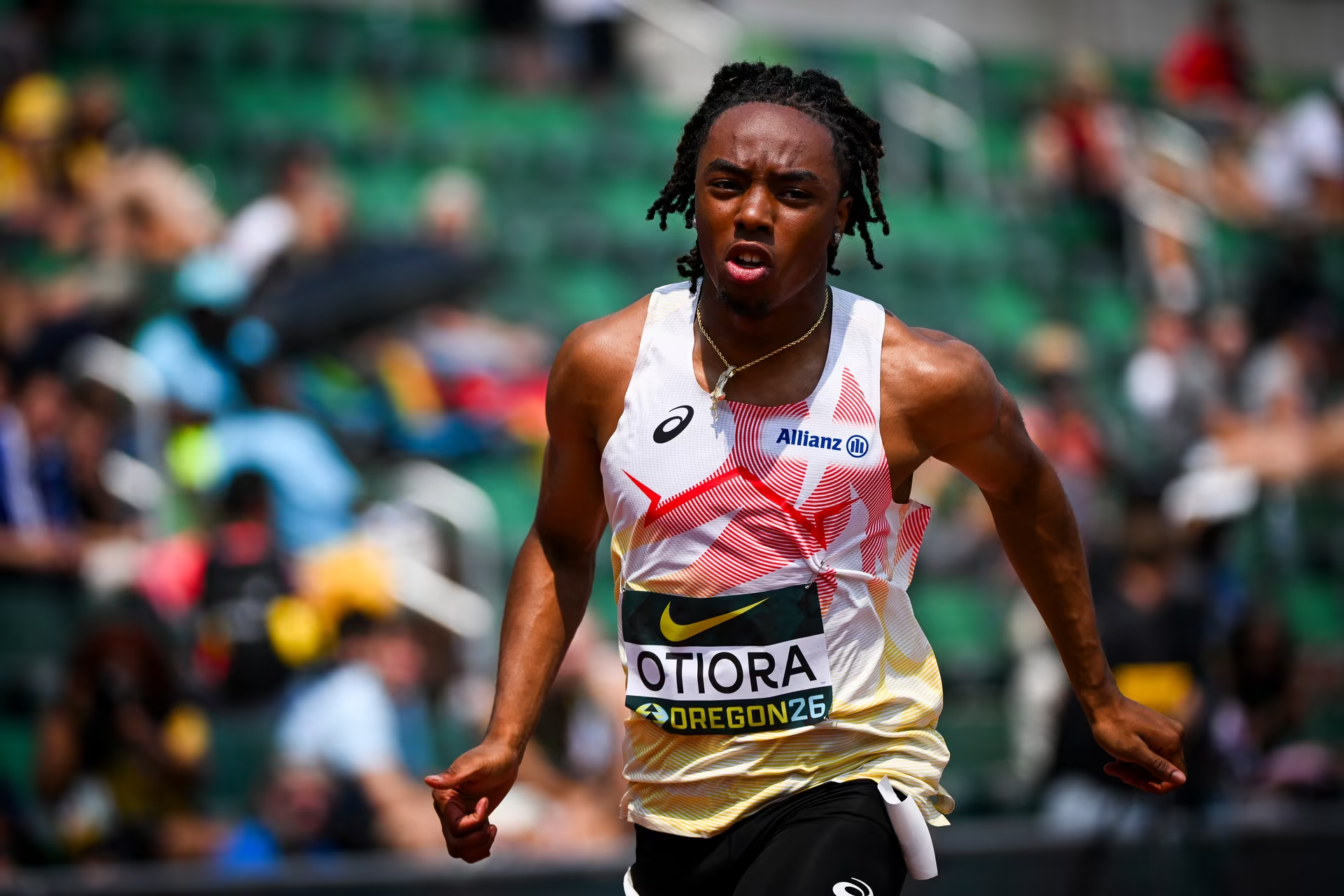
Bright Otiora, Belgium’s Under-20 100m national record holder, has explained why he could never switch allegiance to represent Nigeria, despite both his parents being Nigerian.
What he said
In the video, Otiora says that even if given the chance to represent Nigeria, he would not be able to, since he was born in Belgium and moved to London in 2014, while both his parents are Nigerian. He added that P-Square are among his favourite artists and that he has visited Nigeria twice.
Background: a rising sprinter on the global stage
Otiora, born on 6 July 2008, holds Belgium’s Under-20 national record in the 100m, having clocked 10.18 seconds in June 2026. That time earned him a place at the World U20 Championships in Eugene, Oregon, where he advanced through two rounds to reach his first global final, eventually finishing seventh, behind new U20 world champion Tate Taylor of the United States. He also competes over 200m and 60m, with personal bests of 21.24 and 6.82 seconds respectively.
Otiora is not the only Belgian athlete of Nigerian descent to reach this level. Belgian hurdler Michael Obasuyi has represented Belgium at multiple World and European Championships, as well as the Tokyo Olympics, without switching to Nigeria despite his surname’s Nigerian roots.
Why athletes like Otiora can’t simply switch nationality
World Athletics eligibility rules generally require an athlete to have competed for their birth or adopted nation at senior level before any transfer of allegiance can even be considered, and even then, transfers typically involve a waiting period and require approval from both national federations involved. For someone who has represented Belgium at a World U20 final, as Otiora has, switching to represent Nigeria would not be a simple declaration of heritage — it would require formally clearing a federation transfer process, something that becomes far more difficult, and sometimes impossible, once an athlete is established with their current national team at a senior or high-profile junior level.
This is a familiar story for many diaspora-born athletes:
Nationality and eligibility rules are not the same thing as identity. Many athletes with Nigerian parents grow up, train, and get discovered entirely within another country’s sporting system, making that country’s federation their practical, and often only, competitive pathway.
Federations compete for undiscovered diaspora talent. Nigeria has, in the past, successfully recruited diaspora-born athletes before they became established elsewhere. Once an athlete has already represented another country at a senior or major junior level, that window largely closes.
Cultural identity can remain strong even without competitive representation. Otiora’s mention of P-Square and his visits to Nigeria show that heritage and eligibility can exist on separate tracks — he can feel connected to Nigeria without ever racing in its colours.
The bigger picture: why athletes eligible for Nigeria often choose not to
Otiora’s case is about eligibility rules, but a separate, more troubling pattern explains why some athletes who could represent Nigeria choose other countries instead. Former Olympic gold medallist Chioma Ajunwa has said the exodus is not about a lack of patriotism but about the short length of an athlete’s career colliding with a Nigerian sports system that offers little insurance, welfare, or post-retirement security, leaving many to look for stability elsewhere.
Recent, concrete cases back this up. Favour Ofili, Nigeria’s 200m national record holder, cited “multiple negligence” by Nigerian sports administrators as her reason for switching to Turkey. Sprinter Favour Ashe, Nigeria’s seventh-fastest man in history, pointed to substandard track facilities and a lack of basic consideration from administrators at the National Sports Festival before applying to represent Qatar. Hammer thrower Annette Echikunwoke initially competed for Nigeria and broke the African record while doing so, but switched to the United States, where she won Olympic silver in 2024, after the Athletics Federation of Nigeria failed to arrange the mandatory anti-doping tests that would have let her compete at the Tokyo Olympics.
These are not diaspora eligibility stories like Otiora’s — these are athletes who already belonged to the Nigerian system and left it. Together, the two patterns paint a fuller picture: Nigeria loses some athletes it never really had a claim to, like Otiora, simply because federation rules got there first, and loses others it did have, like Ofili and Echikunwoke, because the system failed to hold onto them.
What this means for Nigerian athletics
Earlier scouting matters. If Nigerian athletics authorities want to convert diaspora talent before it’s “lost” to other federations, identifying and engaging promising young athletes earlier, ideally before they commit to a country at junior international level, would help.
Stronger diaspora engagement programmes could help identify young athletes with Nigerian heritage while they are still eligible to make a switch, rather than after they’ve already reached a World Championship final for another country.
Accepting dual identity without competitive claim. Nigeria doesn’t need every diaspora athlete to wear its colours to benefit from the visibility; athletes like Otiora, who publicly embrace their Nigerian heritage while competing for Belgium, still put Nigerian culture on a global stage in their own way.
Heritage doesn’t always come with a jersey
I think stories like this one say something honest about the diaspora experience that doesn’t get discussed enough. Otiora didn’t have to mention P-Square or his trips to Nigeria — nobody was asking him to prove his roots. He seems to hold both things comfortably: pride in where his family comes from, and clarity about where his career actually belongs. Nigeria doesn’t lose him by not having him on the track team. It’s just a reminder that talent raised abroad doesn’t automatically become “ours” to claim, no matter how much we might want it to be.
Published by Ejoh Caleb