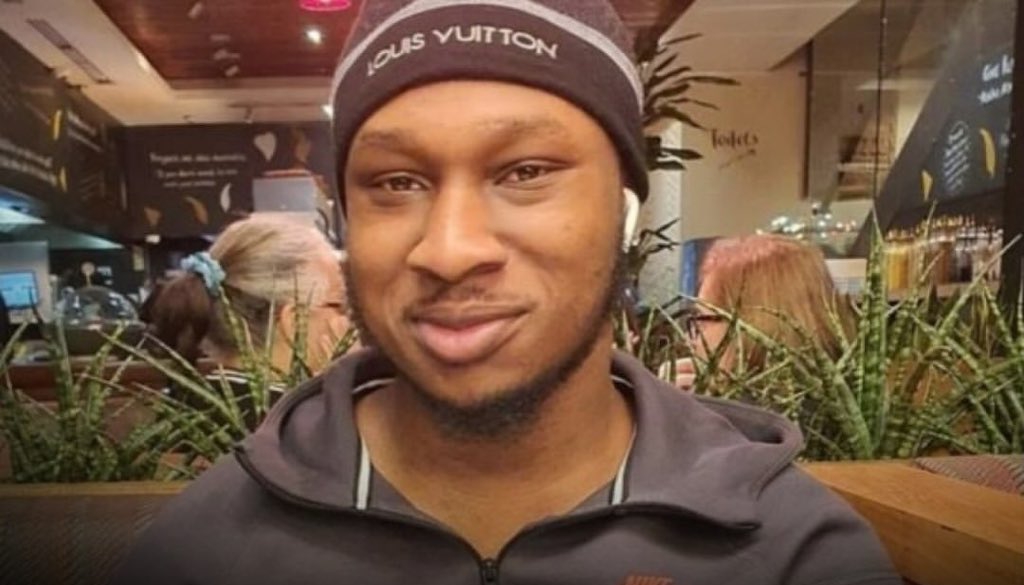
A 20-year-old Nigerian student, Khaleed Oladipo, was fatally stabbed in Leicester, England, following a dispute with a former friend over an alleged £3,000 debt and a counterfeit Rolex watch, a court has heard.
Oladipo, a Cyber Security student at De Montfort University, was attacked on Oxford Street in Leicester city centre on the evening of February 3, 2026, close to the university’s Innovation Centre, while reportedly on his way home. He collapsed in the street and never regained consciousness, despite efforts from members of the public, ambulance crews, and hospital staff to save him. A post-mortem examination found he died from a stab wound to the chest.
Harper Dennis, 18, has been charged with Oladipo’s murder, along with possession of an offensive weapon, and separately with failing to provide the PIN for his phone. His trial opened at Leicester Crown Court this week and is expected to last three weeks.
Prosecuting counsel Jane Osborne KC told the jury that Oladipo and Dennis first met through online gaming and were part of the same Snapchat group before their friendship broke down. The prosecution said the relationship deteriorated after Dennis accused Oladipo of owing him £3,000, and after Dennis reportedly took a Rolex watch, which Oladipo had supplied him, to a London jeweller to sell, only to discover it was counterfeit. Osborne told the court the perceived debt appeared to be the reason Dennis attacked Oladipo in the street, stabbing him a number of times, with one wound penetrating his heart.
Oladipo’s family, in a tribute released after his death, described him as “an extremely loved son, brother, uncle, boyfriend and friend” and said he had played football since the age of four and supported Arsenal. They said they were “struggling to understand why anyone would do this,” while thanking the strangers, paramedics, and hospital staff who tried to save him. De Montfort University’s vice-chancellor, Professor Katie Normington, said she was “devastated” by his death and confirmed the university was offering direct support to students, staff, and his family.
The trial is ongoing, and the account of events described here reflects the prosecution’s opening case; Dennis has not yet been found guilty or not guilty by the jury.
Part of a Wider, Painful Pattern for Nigerian Students Abroad
Oladipo’s death adds to a string of cases in recent years involving Nigerians, students and young professionals alike, killed in the UK, incidents that have repeatedly drawn grief and concern from Nigerian communities and families with relatives abroad.
One of the most widely followed cases involved the younger brother of former Big Brother Naija housemate and Metropolitan Police officer Khafi Kareem. Alexander Kareem, 20, was shot dead in the early hours of June 8, 2020, close to the family home in Shepherd’s Bush, West London, as he walked back from a convenience store. Witnesses said he cried out for help as he lay dying on the pavement, and a post-mortem found he died from gunshot wounds to the chest and abdomen. Police believed the shooting was a case of mistaken identity, and Khafi, who had spent a decade in policing dealing with gun and knife crime herself, said nothing had prepared her for losing her own brother the same way. She continued to publicly mourn him in the years that followed, marking his death anniversary and appealing for information that might help identify his killer.
More recently, in November 2025, Nigerian postgraduate student Uchenna “Uche” Okirie, 33, a University of East Anglia economics graduate, was stabbed to death in a corridor at his shared student accommodation in Norwich. His attacker, a Congolese neighbour named Benjamin Katabana, stabbed him repeatedly and kicked him in the head in what police described as a “violent and unprovoked attack,” before turning himself in to police. Katabana was convicted of murder at Norwich Crown Court in June 2026, after a jury rejected a diminished-responsibility defence linked to his upbringing.
These cases, spanning a shooting, a stabbing by a stranger, and now an alleged stabbing by a former friend, don’t share a single cause. But together they reflect a recurring and painful reality for Nigerian families: relatives who travel abroad for opportunity, safety, or study, only for that distance to also mean receiving devastating news they are powerless to prevent or immediately respond to.
De Montfort University itself has also seen prior violence nearby, including a 2021 street fight involving DMU students that resulted in a stabbing and multiple convictions. What distinguishes Oladipo’s case is that it did not involve strangers or random violence, but two young men who had once been close friends, brought into fatal conflict by money and a damaged sense of trust.
Why Disputes Like This Turn Violent — and Who Is Affected
Money disputes between peers can escalate quickly when unresolved. A perceived debt, especially one tied to embarrassment or a sense of betrayal, as with the counterfeit watch, can fester into resentment that isn’t addressed through any formal or mediated channel.
Weapon accessibility turns arguments into fatalities. Knife crime among young people remains a significant concern in parts of the UK, and disputes that might otherwise have ended in a fight or falling-out become fatal when a blade is involved.
International students often lack close local support networks. Students far from home, and from their usual family or community support systems, may have fewer people around them to de-escalate a personal conflict before it turns dangerous.
Online friendships can lack the depth to weather real-world disputes. Oladipo and Dennis reportedly met and bonded through online gaming; friendships formed this way don’t always carry the same conflict-resolution habits as relationships built over years in person.
The effects of a case like this extend well beyond the two young men directly involved.
For Oladipo’s family, the loss is compounded by distance, grieving a son and brother who died while studying far from home, and now having to follow a murder trial from abroad or across the country.
For Nigerian students in the UK, cases like this add to ongoing anxiety among students and their families back home about safety while studying overseas, particularly around evening travel near campus areas.
For De Montfort University and its student community, a violent death connected to the university, even one that took place off campus, affects how safe students and the wider public feel in the surrounding area, and puts pressure on the institution to visibly support affected students and staff.
What Could Help Prevent Cases Like This
Accessible, low-stigma conflict mediation for students. Universities and student unions could promote clear, confidential channels for resolving serious personal disputes among students before they escalate outside any formal system.
Targeted knife-crime prevention around university areas. Continued, visible policing and community safety initiatives in student-dense areas can help reduce the chances that an argument turns fatal.
Stronger support networks for international students. Universities could do more to connect international students, particularly those far from family, with peer networks or support staff who can help mediate personal conflicts early.
Public awareness on the real cost of small disputes. Community and student-led awareness campaigns highlighting how quickly a financial disagreement can turn violent might encourage young people to seek help or walk away rather than confront a dispute alone.
Our Honest Assessment
What strikes me most about this case is how ordinary its origins were. A £3,000 debt and a fake watch are the kind of disputes that happen between friends all the time, usually ending in an awkward falling-out, not a funeral. That gap, between how minor the trigger sounds and how final the outcome was, is what makes this so hard to sit with.
I don’t think there’s a tidy lesson here beyond the obvious one: young people need real, accessible ways to resolve conflict before it reaches a breaking point, and the presence of a knife turns an argument into a tragedy in seconds. Khaleed Oladipo went to the UK to build a future in cybersecurity. His family now has to watch a courtroom instead, and that’s the part of this story that deserves to stay with us longer than the details of the dispute itself.
Published by Ejoh Caleb