
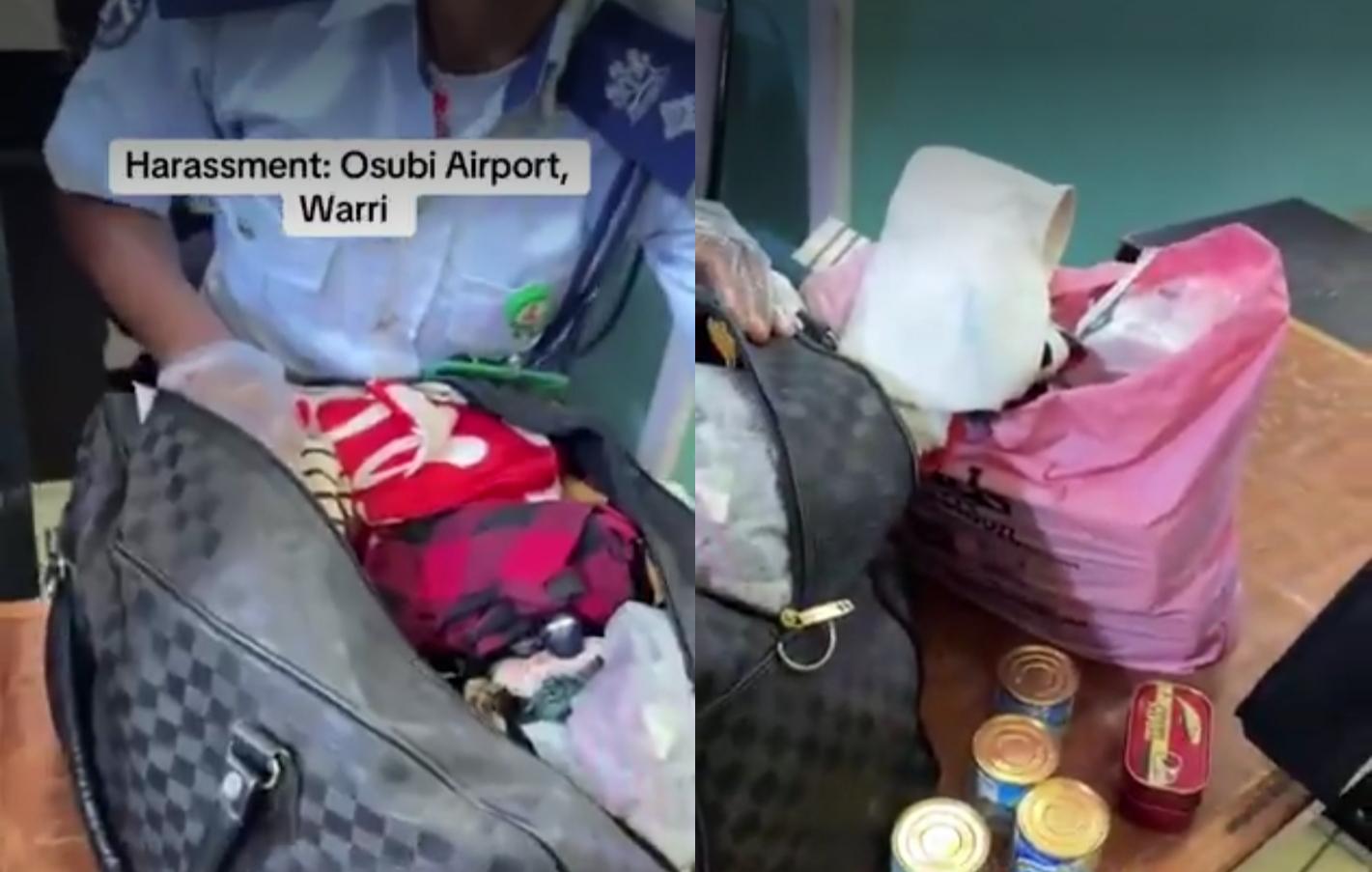
A Nigerian woman has accused an airport official at Osubi Airport in Warri, Delta State, of wrongly stopping her from travelling with tins of milk and other canned items in her luggage, in an incident she says happened on July 22, 2026. In a video she recorded and shared online, the woman described it as one of the worst airport experiences of her life.
In the video, the woman’s bag is searched manually by airport staff while she and a companion look on. She repeatedly asks the officers why she cannot travel with her tinned milk, pointing out that she has never faced this restriction at airports in Abuja or even in London. The officers do not directly answer her question. Instead, they remove the tin of milk and a tin of sardine from her bag and set them aside.
When one officer eventually tells her the items could “spill into the bag,” the woman pushes back, asking how a tightly sealed tin of milk could possibly spill. She also asks why her bag is being searched manually at all when the airport has an X-ray machine that could do the job. At one point, an officer asks her to stop recording, but she refuses, insisting she has a right to record, and continues filming the rest of the encounter.
Captions layered over the video state that an airport supervisor eventually intervened, and the woman was allowed to keep her perfumes, though the canned items were still confiscated. She also wrote that she had personally reviewed the passenger guidance published by the Federal Airports Authority of Nigeria (FAAN) and the Nigerian Civil Aviation Authority (NCAA), noting that the published restrictions mainly cover dangerous goods, weapons, explosives, flammable substances, and limits on liquids in hand luggage, and that her luggage did not violate any of these.
As of this report, there has been no official statement from FAAN, the Osubi Airport management, or the NCAA specifically addressing this incident, and it does not yet appear to have been picked up by mainstream Nigerian news outlets.
A Familiar Complaint at Nigerian Airports
This is not the first time Nigerian passengers have publicly clashed with airport staff over how their belongings are searched or handled.
In October 2024, a viral video showed a woman accusing FAAN officials at Murtala Muhammed International Airport in Lagos of extortion and physical mistreatment during a dispute at the airport. FAAN denied the allegations, saying there was no molestation or bribery request by its staff.
In December 2024, FAAN’s Managing Director, Olubunmi Kuku, publicly warned aviation security officers at the Lagos airport to stop extorting passengers, saying she had video evidence of such incidents and that the volume of complaints she had received, including from the presidency, was “insane.”
In August 2025, a widely shared video showed a female passenger being forcibly dragged off an Ibom Air flight by security personnel in an incident that exposed her body on camera, drawing public condemnation even as FAAN said the passenger had been unruly and handed her to the police.
Why Passengers and Airport Staff Keep Disagreeing Over What’s Allowed
Part of the problem, by FAAN’s own admission, is inconsistency. In November 2025, FAAN’s Managing Director acknowledged that airport and airline procedures for handling dangerous or prohibited goods do not always match, since each airline sets its own packaging and handling rules on top of FAAN’s general guidelines, creating confusion for passengers moving between different airports and airlines.
FAAN’s own published guidance focuses primarily on genuinely dangerous items, such as weapons, explosives, and flammable substances, along with standard limits on liquids, gels, and aerosols in hand luggage, generally capped at 100 millilitres per container. Solid, sealed food items like canned milk or sardines are not typically listed among internationally restricted items, which is consistent with the passenger’s own reading of the rules in this case.
Airport security staff, meanwhile, are under pressure to screen thoroughly and avoid missing anything that could pose a risk, especially after FAAN itself has flagged rising cases of passengers attempting to carry hazardous or suspicious items through Nigerian airports. This tension, between thorough screening and passengers’ sense of what is reasonable, appears to be at the heart of the Osubi Airport dispute.
How Incidents Like This Affect More Than One Passenger’s Journey
For the individual passenger, an unclear or inconsistently applied rule means wasted time, confiscated belongings, and, as in this case, a public confrontation that could have been avoided with clearer communication.
For airport staff, viral videos like this one, regardless of who is ultimately right, damage public trust and can make routine, legitimate security checks look like harassment, even when officers may be following an internal protocol the public simply is not aware of.
For Nigeria as a country, repeated viral disputes over airport screening feed into a broader narrative, especially among international travellers and returning diaspora, that Nigerian airports are inconsistent and unpredictable compared to those in other countries the passenger in this video referenced, like the United Kingdom. This can affect Nigeria’s aviation reputation at a time when the government is actively trying to attract more international flights and investment into the sector.
What Could Help Prevent the Next Airport Dispute
FAAN could publish a single, simple, widely publicised list of exactly what is and is not allowed in hand luggage across all Nigerian airports, reducing the confusion its own leadership has acknowledged exists.
Airport signage and staff explanations should clearly state the specific reason an item is being removed, rather than a vague reason passengers can visibly see does not hold up, like the “spilling” concern raised in this case.
Screening decisions should rely more consistently on available equipment, such as X-ray machines, with manual searches reserved for situations that genuinely require them, to reduce the sense that some searches are arbitrary.
FAAN could set up a clear, fast channel for passengers to question or appeal an item’s confiscation on the spot, rather than only through social media after the fact.
Airport staff should be trained to remain calm and professional when passengers record their interactions, since passengers generally have a right to do so in public spaces, and hostility toward recording tends to make a dispute look worse, not better.
Our Take
What strikes me most about this video is not necessarily who was right about the tin of milk, but how avoidable the whole confrontation looks. If canned milk genuinely is not allowed at Osubi Airport for a specific, sound reason, an officer should be able to explain that reason clearly in one sentence. If it is allowed, then a passenger should not have to argue her way through a manual search to prove it. Until FAAN closes the gap between what is written in its official guidance and what individual officers apply on the ground, Nigerian airports will keep producing videos like this one, and each one chips away a little more at public confidence in a system that is supposed to feel predictable, not personal.
Published by Ejoh Caleb