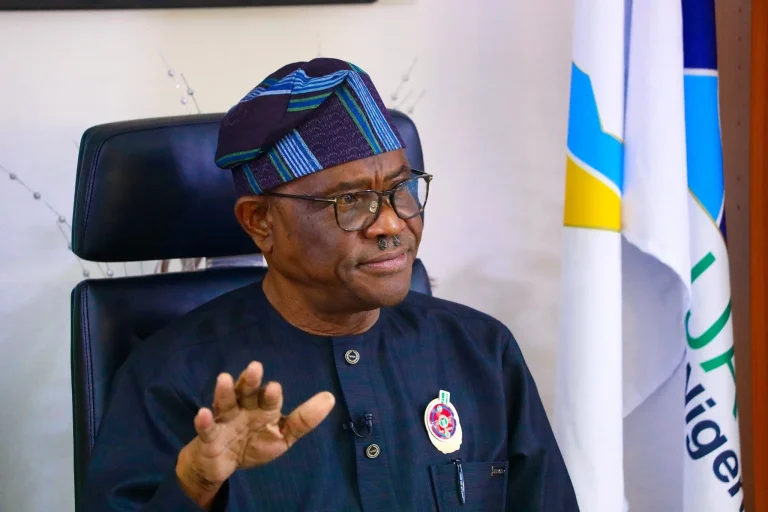
FCT Minister Nyesom Wike has dismissed concerns over being left out of the newly formed All Progressives Congress (APC) presidential campaign council, saying he does not need a title to help President Bola Tinubu win votes in the 2027 election.
Speaking on Saturday after inspecting infrastructure projects in Abuja, Wike said, “I am not a member of the APC, and I am not interested in becoming Director-General of the party’s presidential campaign council. Holding that position does not automatically translate into electoral success.”
He argued that previous campaign directors-general failed to deliver their own states in past elections despite holding prominent party roles, suggesting that titles matter less than actual results on the ground.
Wike also announced plans to publish a scorecard of infrastructure projects in the Federal Capital Territory, comparing what his administration inherited and completed against projects from the governments of Olusegun Obasanjo, Umaru Yar’Adua, Goodluck Jonathan and Muhammadu Buhari.
A Familiar Refrain From a Minister Who Won’t Join the Party
This is not the first time Wike has downplayed the importance of a formal APC position while still positioning himself as central to Tinubu’s political fortunes. Weeks earlier, in a statement issued through his special assistant, Wike similarly denied lobbying to become campaign DG, saying he did not need any position to mobilise support for Tinubu, and that his focus remained on delivering projects and boosting the president’s chances in Rivers State and the FCT.
Wike has occupied this unusual political position since 2023, serving as FCT Minister under an APC-led government while remaining officially a member of the opposition Peoples Democratic Party (PDP). President Tinubu has publicly joked about welcoming him into the APC “whenever he changes his mind,” an offer Wike has yet to take up.
His position has also put him at odds with APC officials at times. In January, Wike clashed publicly with APC National Secretary Ajibola Basiru, who argued that Wike’s support for Tinubu did not make him a member of the party and accused him of overreaching into Rivers State politics that were not his to control.
Why Wike Keeps Making This Point, and What It Means for 2027
Wike’s repeated insistence that he does not need a formal title appears designed to reframe how his political value is measured, positioning results and project delivery as more important than the party structures and titles that other politicians compete for.
It also lets him keep his unusual dual position, backing an APC president’s re-election while staying outside the party structure, which shields him from being bound by internal APC decisions while still claiming credit for the president’s political fortunes.
For Rivers State politics specifically, Wike’s remarks carry added weight given his tense relationship with Governor Siminalayi Fubara, who defected to the APC in December and has since made his own public pledges of support for Tinubu’s re-election. Wike had earlier sent a pointed message suggesting that declaring loyalty to Tinubu alone would not guarantee political tickets in the state.
At the national level, Wike’s positioning reflects a broader question hanging over the APC ahead of 2027: how power, influence and credit for electoral wins will be distributed among party loyalists, defectors and allies who backed Tinubu without formally joining his party. How that question is resolved could shape internal APC unity heading into a competitive election.
What Could Happen Next
Wike could continue in his current dual role indefinitely, supporting Tinubu publicly while remaining outside the APC, especially if his infrastructure delivery in the FCT continues to boost his political standing.
Tensions with APC structures and figures like Basiru, or with Governor Fubara in Rivers State, could escalate further if Wike continues to act independently of official party decisions while claiming influence over the president’s electoral success.
Wike could eventually join the APC formally, as Tinubu has repeatedly invited him to do, though his continued reluctance suggests he sees more political advantage in staying outside the party for now.
A Minister Playing by His Own Rules
We think Wike’s comments reflect a level of political confidence few Nigerian officials can afford. Choosing to skip a prominent campaign role, while still insisting he can deliver votes for the president, is a bet that his track record speaks louder than any title.
We also believe this arrangement raises fair questions about accountability. Wike enjoys real influence over federal and Rivers State politics while remaining outside the formal structures meant to organise and answer for that influence. As 2027 approaches, Nigerians and APC members alike may want more clarity on where that influence ends and where the party’s own decision-making begins.
Whether Wike’s confidence proves justified will likely become clear only when the actual votes are counted.
Published by Ejoh Caleb