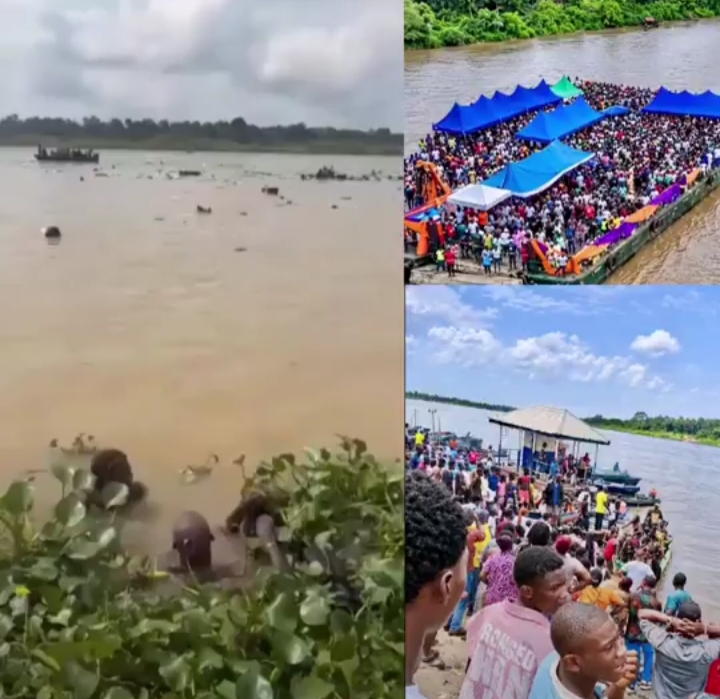
A boat carrying mourners to a burial ceremony capsized in Southern Ijaw Local Government Area of Bayelsa State on Friday, November 20, 2026. It was travelling from Ayama to Ukubie and overturned near the river junction between Oweikorogha and Otuan.
The Bayelsa State Police Command said four bodies, two adults and two children, had been recovered and taken to the Federal Medical Centre mortuary in Yenagoa. It said 24 survivors had been rescued and taken for treatment, and that search and rescue operations were continuing.
Confirmed Figures and Unconfirmed Fears (A Community Source Is a Local Person Who Gives Information but Is Not an Official)
The first reports spoke of far worse. Several outlets quoted a community source who watched passengers boarding at the jetty and said more than 30 people were dead and about 300 were missing. Police spokesman DSP Musa Mohammed said he was still working to determine the actual number of casualties.
Reuters reported that police did not say how many people were on board, but that some residents said at least 300. Another outlet noted that the authorities’ update confirmed four deaths and 24 rescued, but gave no definitive count of those unaccounted for. Until officials publish a passenger count, the true toll is not known, and families deserve accurate information over rumour.
What Went Wrong, According to the Police and Witnesses (A Mechanical Fault Means an Engine or Equipment Problem)
Police said preliminary findings suggest the boat developed a mechanical fault while on the water. They said passengers advised the operator to steer toward the riverbank, but he allegedly continued the journey, and the boat capsized shortly afterwards. Reuters reported that the driver fled and the vessel’s manager was taken into custody.
Witness accounts differ. One witness spoke of chaotic boarding and overcrowding before departure. A community member alleged the boat was overloaded, and said some passengers asked that it stop at Oweikorogha to reduce the load, which was not done. Another account said passengers were dancing when the boat hit an object in the river and began to sink. The causes remain under investigation, and none of these claims has been tested.
A Disaster Seen Before: Earlier Boat Tragedies Linked to Funerals, Weddings and Overloading (Overloading Means Carrying More People or Goods Than a Vessel Can Safely Hold)
Large gatherings have produced earlier disasters. In June 2023, more than 100 people died when an overloaded boat carrying wedding guests capsized on the River Niger near Pategi, Kwara State. Most passengers had no life jackets, and the water authority blamed overloading and turbulent winds.
In September 2025, 60 people drowned in Gausawa, Niger State, after an overloaded boat hit a tree stump, according to Vanguard. This year, a boat sank in Sokoto in August with at least 51 dead, and in January at least 26 drowned after a boat carrying people from Jigawa to Yobe capsized. The Sun counted at least 235 deaths in 10 major boat accidents across eight states between January 2025 and July 2026.
Why Water Travel Is the Only Road for Many: Dependence, Cost and Social Pressure (A Riverine Community Is One Built Along Rivers and Creeks)
For many people in Southern Ijaw, the river is the road. Residents of riverine areas rely heavily on boats to move between communities separated by rivers and creeks. Burials in Ijaw communities also often attract many relatives and friends from nearby settlements, which raises demand for water transport.
When many people want to attend one event, a single boat may be chartered for the whole group. Operators may be tempted to carry as many as possible to earn more, and passengers may feel pressure not to be left behind. Few alternatives exist. That is why safety rules matter most where choices are fewest.
The Weak Links Behind Repeated Accidents: Life Jackets, Training and Enforcement (Enforcement Means Making Sure Rules Are Actually Followed)
Investigations cited by The Sun point to overloading, poor use of life jackets, ageing boats, untrained operators, night travel and weak oversight. The National Inland Waterways Authority (NIWA) has made life jackets compulsory nationwide, but operators in other states say they do not have enough. One boat driver in Niger State told Daily Trust he owned only four life jackets given by NIWA.
There are signs that enforcement can help. NIWA reports lower accident figures in some states after sensitisation campaigns. Yet the same Daily Trust report notes an accident that happened days after such a campaign, with 29 dead. These results show that awareness alone is not enough.
The Human and National Cost: Whole Families Lost and Trust in Waterways Shaken
For families in Ukubie, Oweikorogha and Ayama, the cost is grief and uncertainty. Children were among the dead, and relatives are still waiting for news of others. A burial that was meant to honour one person has now turned into many funerals.
The wider cost reaches the nation. Repeated boat disasters weaken trust in a transport system that millions depend on. They also strain rescue teams, hospitals and state budgets, and they remind the country that safety rules exist on paper but are weakly applied in many communities. Each loss hurts local economies, since the dead are often workers and parents.
Making Boat Travel Safer: Passenger Lists, Life Jackets and Local Enforcement
The simplest steps are known. Operators can keep a passenger manifest, which is a list of everyone on board, and refuse to sail beyond the safe limit. Every passenger can wear a life jacket, and boats can carry enough for all. Communities that charter boats for funerals can plan more trips, with smaller loads.
Authorities can inspect boats and engines before large events, train operators and punish those who ignore rules. The Bayelsa police reiterated the importance of complying with safety regulations and warned against overloading. State and local governments can also place patrols at busy jetties on days when big gatherings are expected.
Grief, Questions and Duty: Our Reading of a Weekend of Loss
We offer our deepest sympathy to the families who lost loved ones, and to the communities of Ukubie and Oweikorogha. We thank the divers, volunteers and security teams who joined the search.
We do not know how many people were on the boat or how many are still missing. We urge the police and the state government to publish a clear and verified count, so that families are not left with rumours. We also note the allegations about overloading and an ignored warning. They are serious, and the investigation must test them fairly, including the roles of the driver, the manager and any organisers.
Above all, we urge Nigerians to treat water safety as a shared duty. A burial should not cost more lives than it mourns. If a boat is full, the right choice is to wait for the next one.
Published by Ejoh Caleb