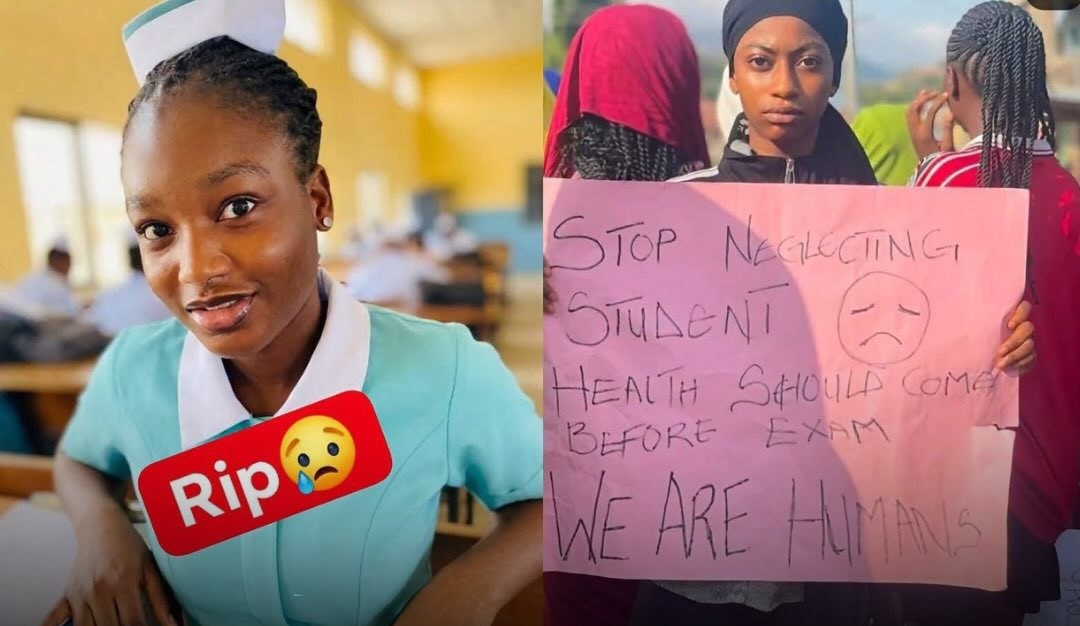
Students of the Kogi State College of Nursing and Midwifery, Obangede, shut the college’s main gate on Monday, November 16, 2026. They were protesting the death of a 300-level student, Olamide Gift, aged 20. They accuse the school management of negligence. Reports say these allegations and the circumstances of her death could not be independently established.
The Claims, the Denial and the Facts Still Missing
According to a source quoted by Chronicle, Olamide fell ill on Monday, November 9, the day her exams began. She reportedly kept writing papers until Wednesday, when she collapsed in the examination hall and was taken to the school sick bay. The source alleged that an invigilator took her question paper to her sickbed and warned that she would fail the paper if she did not write. The source also claimed that on Thursday she had blood clots, and that no emergency referral was made that day. An alumnus told Daily Trust that the sick bay lacked essential drugs, so students had to buy medicine outside. Another source claimed four students had died earlier in similar circumstances. None of these claims has been verified.
A source told Daily Trust that the school contacted her parents when her condition worsened. The parents reportedly travelled from Lagos and took her to the Confluence University of Science and Technology Teaching Hospital, Okene, before she was moved to the Federal Teaching Hospital, Lokoja, where she died. Mr Abdulmalik said the death was not caused by negligence by management or the government, and he urged students to use dialogue. His statement is his view, and it is not the result of an investigation. The Elegant Nurses Forum called for an independent, transparent investigation. It also asked the college to preserve medical records, sickbay registers, exam documents and referral papers.
We do not know the cause of death, what the sick bay did, or what the college’s policy on sick students says.
Earlier Student Deaths Linked to Campus Health Care and Disputed Claims
Protests over medical care have happened before, and in each case the institution disputed the claims. In June 2026, students at the University of Osun protested the death of a 400-level student, Grace Osunlakin. They alleged that the campus lacked functional healthcare. The university said she was never taken to its medical centre on the day of her death. In April 2025, the Federal University Oye-Ekiti denied negligence after a student died, saying its clinic runs around the clock and that she was sent to a referral hospital by ambulance.
In April 2024, a student of Federal Polytechnic Ilaro died in the school clinic. Student bodies alleged negligence and the school denied it, with its medical director describing the steps taken. These cases show that the truth can be hard to establish. They also show that grieving students and institutions often give very different accounts.
Exams, Sick Bays and Referral Gaps: What May Be at the Root
Several problems could lie behind a case like this, if the claims prove true. Examination rules may not allow easy medical deferment (a delay with permission). A student who fears failing may keep going when she should rest. Sick bays in some training colleges are small, with few drugs and no ambulance, so serious cases need quick referral. If staff are unsure when to refer, hours can be lost.
The protesters also named water, power, safety and fees. A student who studies in poor conditions may reach a crisis sooner. We cannot say whether any of this contributed to Olamide’s death. That is for investigators to find out.
The National Cost of Weak Student Health Services in Training Institutions
Nursing students are training to care for patients. Tribune noted the irony of an institution that trains people to preserve life facing questions about its own care for students. If students do not trust their schools to help in a medical emergency, confidence in the training system suffers.
The issue reaches the whole country. Nigeria needs trained health workers, and students who fear for their safety may leave or avoid such schools. Families may also hesitate to send their children. The Elegant Nurses Forum asked the Nursing and Midwifery Council of Nigeria, the state government and rights groups to step in.
Protest, Process and Fair Hearing: Balancing Anger With Due Process
Protest has value. It draws attention, and in this case it brought a call for an independent probe and a reaction from a local official. Students have a right to speak when a colleague dies and they believe something went wrong.
But fairness also matters. The college and its staff have not been heard in full, and the allegations are unproven. A staff member should not be blamed publicly before facts are established. Protesters should keep it peaceful, and officials should answer questions honestly. The family deserves privacy and answers more than anyone. If the claims prove true, accountability must follow. If they prove false, the record should be put right.
Practical Steps for Investigation, Reform and Student Safety
The state government and the regulator can set up an independent panel that includes health professionals, and the college should keep all records, as the Elegant Nurses Forum asked. The family should be kept informed and, if they agree, medical findings should be shared. The panel should publish its findings.
Colleges can also adopt clear rules that let a seriously ill student defer or retake an exam without penalty. Sick bays should have basic drugs, trained staff and a written referral process, with an ambulance and an agreement with a nearby hospital. Students can be told how to report an emergency. Authorities should also respond to the other complaints, such as water, power and safety.
A Young Life, Unanswered Questions and a Duty to Learn
We offer our sincere condolences to Olamide’s family, friends and classmates. A 20-year-old has died, and her loved ones deserve more than slogans or denials. They deserve facts.
We do not know whether anyone failed her. We also cannot ignore the questions raised, because they are serious. We believe the right path is a fair, open investigation that hears the students, the staff and the doctors. If it finds fault, those responsible should answer for it. If it finds none, it should still point to ways to make care safer. Our nursing schools should be places where no student must choose between her health and her future.
Published by Ejoh Caleb