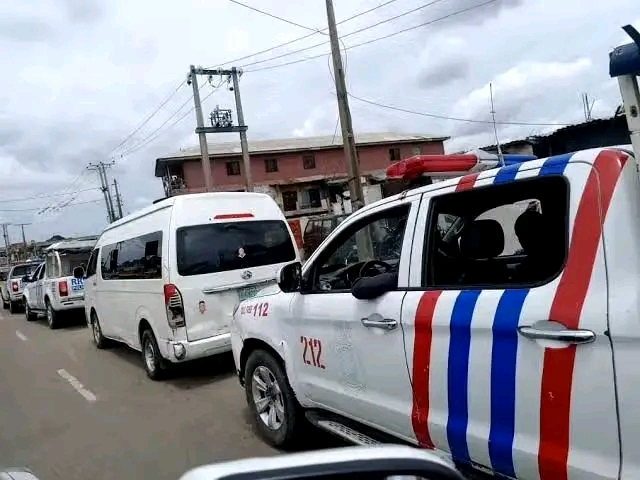
A video shared online shows an ambulance blaring its siren while stuck in heavy traffic, as its driver tries to squeeze through the gridlock beside other motorists. The man who shared it said sirens are widely abused, and that this makes it hard for people to tell a real emergency from a show of status. We do not know where or when the video was filmed, or whether the ambulance was carrying a patient. Still, the scene points to a real and wider problem.
What the Video Shows and What Remains Unknown
The video shows the ambulance trying to get through congestion with its siren on. It does not show how long the vehicle waited, whether it reached its destination, or what the driver’s task was. We found no report about this specific case. So we cannot say whether anyone was harmed, and we make no claim that any particular driver did wrong.
What the footage does show is a familiar picture on Nigerian roads. Sirens and flashing lights are meant to tell drivers to give way. If drivers stop believing them, the signal loses its force.
Earlier Cases Where Emergency Vehicles Lost Precious Minutes in Gridlock
Ambulance delays in traffic have been reported before. On March 12, 2022, an ambulance from NISA Premier Hospital was stuck in a fuel-queue jam on Airport Road, Abuja. Reports say drivers did not move despite the siren, so doctors got out to ask motorists for passage. On May 22, 2022, another ambulance carrying a patient to the Lagos State University Teaching Hospital was reportedly stuck for over two hours on a trip that should have taken under 40 minutes.
Ambulance drivers have also shared their experiences. Some told Punch’s health desk that patients had died in their vehicles while they were trapped in Lagos traffic, and that many motorists do not understand they should give way. One driver said he used his lights and siren without success. These are drivers’ accounts, and we did not independently check each case. But they show how common the problem is believed to be.
Who May Use a Siren: What the Law Says and How It Is Enforced
The National Road Traffic Regulations limit sirens, flashers and beacon lights on public roads to specific government officials and emergency vehicles. Military and paramilitary agencies, police, fire services and ambulances may use them during emergencies or rescue operations. A driver who knowingly obstructs such a vehicle without a good reason commits an offence. The listed penalty is a fine of ₦2,000, six months in prison, or both. The Federal Road Safety Corps (FRSC) schedule also lists a fine of ₦2,000 and three penalty points for using sirens without authority.
In June 2026, the Plateau State Police Command banned unauthorised sirens and covered number plates. It said the Police Act 2020 regulates sirens and revolving lights. It added that no state command can grant permits for sirens, and that applications must go to the Inspector-General of Police. Even so, the Guardian reported that the House of Representatives had urged the FRSC and police to enforce the law, and that abuse had not stopped.
Cheap Devices, Status Symbols and Weak Enforcement: How Sirens Lost Their Meaning
Several things feed the problem. Sirens are easy and cheap to buy and fit. Some people use them to dodge traffic or to look important. Penalties are small, so there is little fear of being caught. Police said the practice also helps criminals, because a siren can hide a vehicle’s real purpose.
There is a second cause. When too many cars blare sirens, drivers begin to ignore all of them. Real ambulances then pay the price. Road conditions add to this. Some roads are narrow or in poor repair, leaving drivers with little room to move over, even when they want to. So the abuse of sirens is not the only reason for delays, but it makes them worse.
The Hidden Toll on Emergency Care, Road Safety and Public Trust
Delays can cost lives. In an emergency such as a crash, a heart attack or a difficult birth, minutes can matter. The FRSC recorded 10,446 crashes and 5,289 deaths nationwide in 2025. Fast transport is part of the answer to such emergencies.
There are broader effects too. If people think the rules apply only to ordinary drivers, trust in law enforcement weakens. Rules that are broken without penalty teach others to break them. A country with strong health services needs roads where an ambulance can get through.
Stricter Rules and Their Trade-Offs for Patients, Drivers and Officials
Stricter enforcement has clear benefits. Fewer fake sirens would let real ones stand out. Patients would get help faster, and officers could more easily spot vehicles that hide behind sirens to commit crime. Higher fines would also show that the rule is serious.
But there are trade-offs. Officers need clear guidance, so that they do not harass drivers of genuine emergency vehicles or take bribes from violators. Ordinary motorists may be stuck in jams with nowhere to go, and they should not be punished for it. Some people also object that privileged officials and convoys use sirens routinely. If enforcement targets only small offenders, it will look unfair. Clear, equal enforcement would answer this concern.
Practical Ways to Restore Respect for Emergency Signals
Police and the FRSC can enforce the existing rules and publish arrests, so that the public sees results. Government can also review the very low fines. Sellers and installers of siren devices could be required to check authority before fitting them.
Cities can plan emergency routes or lanes, and can use traffic officers to clear a path for ambulances. Ambulance operators can display clear contact numbers on their vehicles, and can train drivers on safe driving in traffic. Drivers can learn to move aside safely when they hear a siren, without stopping in the middle of the road or following the ambulance. Public education should repeat this message. Anyone who sees a vehicle misusing a siren can report it to the authorities.
When Every Siren Means Urgency, Every Driver Can Help Save a Life
We do not know the full story behind this video. But we know it touches a real problem. Sirens are tools for saving lives, and when they are misused, they lose their power.
We believe this is a shared duty. Authorities must enforce the law fairly and keep the rules strong. Drivers must give way when they hear a real emergency and must not fake one for convenience. If we do both, the next ambulance stuck in traffic will find a clearer road. Our roads can be places where a person in need gets help in time.
Published by Ejoh Caleb