
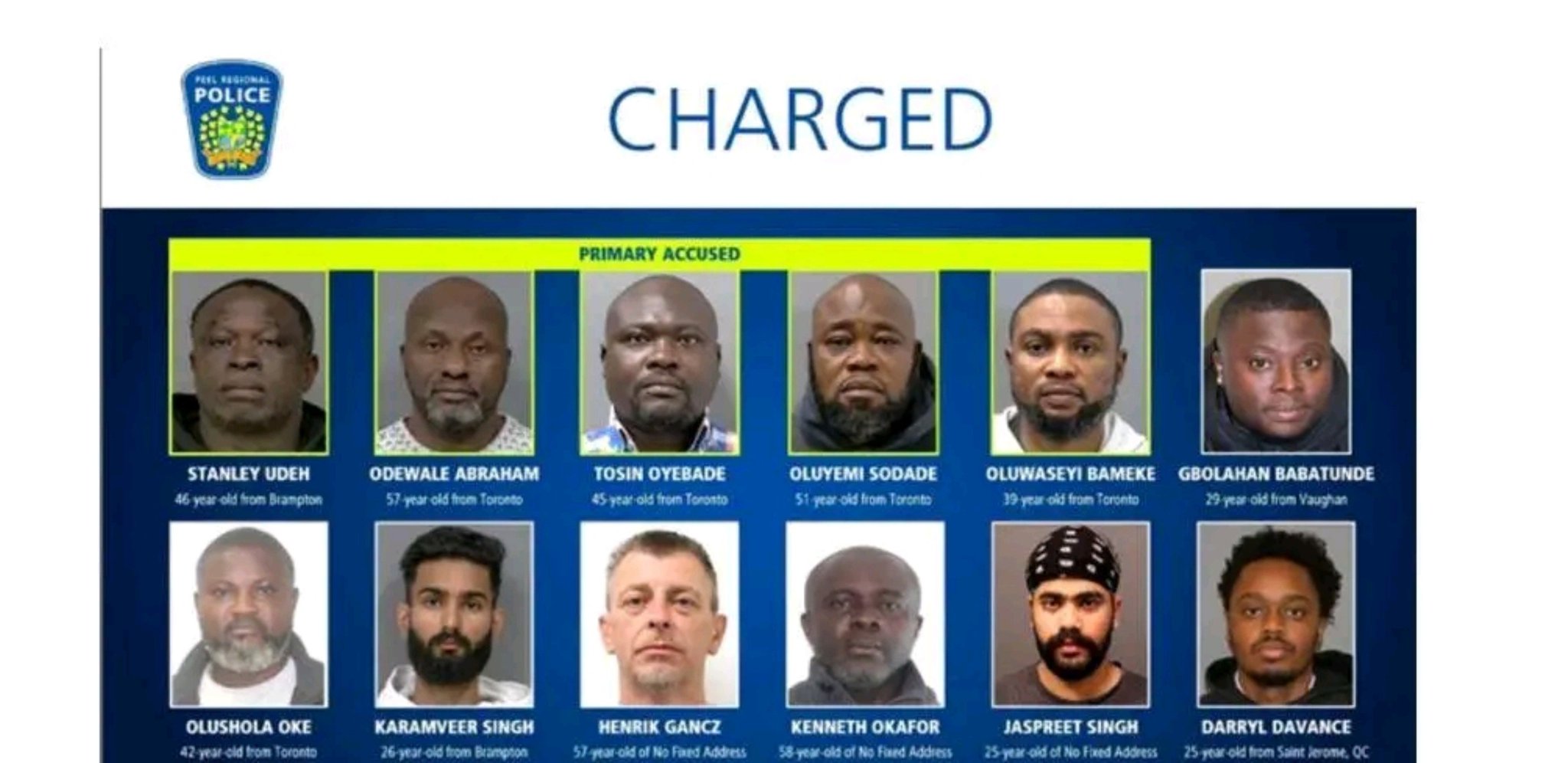
Canadian police have charged 12 people, including eight Nigerians according to the BBC, over an alleged international car theft operation. Peel Regional Police in Ontario announced the results of Project Cadetta on Monday, November 16, 2026. They said officers recovered 96 stolen vehicles worth about C$4.5 million and laid 231 charges. The vehicles were allegedly hidden in shipping containers headed to West Africa. The accused have not been convicted, and the charges are allegations.
A Months-Long Investigation Ends in a Major Seizure
The investigation began in March 2026, when police identified a warehouse on Cadetta Road in Brampton. They allege it was used to store, load and export stolen vehicles. They worked with the Canada Border Services Agency, whose officers examined containers and found vehicles hidden inside. The vehicles included luxury SUVs and pickup trucks. Police said they were stolen from driveways, parking lots and dealerships in Mississauga and Brampton.
Police said the stolen vehicles had been “re-VINed”. This means their vehicle identification numbers, the unique codes that identify each car, were allegedly changed to disguise them. They allege the 12 men played roles in getting, storing, moving, documenting and exporting the vehicles. They also say five of the 12 were the key organisers.
What Police Say, What Reports Add and What Is Still Unproven
Police say two other suspects are still wanted and that more charges are expected. According to one report, all 12 people were released while their cases go through court. Police also said some of the accused could face immigration proceedings that may lead to removal from Canada. The BBC reported that this could happen after the criminal proceedings end. The nationality figure of eight Nigerians comes from that reporting.
We do not yet know the names, roles or pleas of the accused, how much each person is alleged to have done, or whether anyone will be deported. Those questions will be answered in court.
Earlier Busts Show an Established Route From Canadian Streets to West African Markets
This is not the first case. In 2022, Peel police’s Project Myra recovered 214 stolen vehicles worth over C$12 million and charged 28 people. In December 2025, the Ontario Provincial Police said 306 stolen vehicles worth about C$25 million, headed to the Middle East and West Africa, had been recovered. Twenty people were charged. In October 2025, Canadian police dismantled a ring accused of altering vehicle numbers on cars bound for countries including Nigeria.
Nigeria has been part of the response. On May 4, 2026, the Nigeria Customs Service handed seven stolen luxury vehicles, traced to Canada, to Canada’s Deputy High Commissioner at Tin Can Island Port in Lagos. Customs said the recovery followed months of intelligence sharing with the Royal Canadian Mounted Police. This shows both the problem and the cooperation.
Demand, Technology and Disguised Identities: How Stolen Cars Move Overseas
Stolen vehicles are shipped abroad because there are buyers for expensive cars overseas. A Peel police deputy chief said roughly 75 percent of stolen vehicles intercepted at the Port of Montreal for export come from Ontario. The Équité Association, Canada’s insurance crime body, said in the 2025 case that the thefts were all technology-based. It noted that there are weaknesses in vehicle systems that thieves can use.
Changing vehicle numbers and making paperwork look legitimate help the cars pass port checks. Criminal groups also rely on many people at different stages, from thieves to drivers to people who handle shipping documents. Police say this is why such cases involve large teams.
The Effects on the Country’s Image, Ports and Car Buyers
Cases like this matter to Nigeria for several reasons. If stolen cars end up in the country, they harm its reputation and strain its ports and customs systems. The May 2026 Lagos handover shows how this can lead to months of investigation.
Ordinary Nigerians can also be hurt. A buyer who unknowingly purchases a stolen vehicle may lose both the car and the money. Honest Nigerians living abroad may face more suspicion when headlines highlight nationality. Eight of 12 accused is a fact in this case, not a statement about all Nigerians. If suspects are removed after conviction, there will also be consequences for families and for Nigeria’s relations with Canada.
Fair Treatment for the Accused and Care for Communities Caught in the Spotlight
There are benefits to this enforcement. It protects owners whose cars were stolen, and it shows that countries can work together against organised crime. Peel police say thefts in the region have fallen by more than 50 percent from the 2023 peak.
There are also risks. Public attention on nationality can feed stereotypes against immigrant communities, including law-abiding Nigerians in Canada. Immigration consequences should follow the evidence and the law, not headlines. Each suspect is entitled to a fair hearing, and removal from Canada, if it happens, should come only through the proper process. Both victims and accused deserve fair treatment.
Practical Steps to Break the Chain From Theft to Sale
Canadian authorities can keep inspecting containers and sharing information with partners overseas. Carmakers can strengthen vehicle security against technology-based theft. Nigeria’s customs and port agencies can keep checking vehicle numbers and papers against international records, and can keep working with Canadian and other partners.
Nigerian buyers can check a vehicle’s history and documents before paying, and can avoid deals that seem too cheap. Dealers can be required to show proof of lawful import. The Nigerian community abroad can report suspicious activity and encourage young people toward lawful work. The media can report nationality only where it matters to the facts.
Trust Is Rebuilt When the Law Is Applied Evenly and the Facts Lead
We take stolen vehicles seriously. A car taken from a driveway is a real loss for a family, and crime that crosses borders needs cross-border answers. If the charges are proven, those responsible should face the law.
But we also hold to fairness. Twelve people have been charged, and the court will decide what is true. We believe the case should not be used to judge a whole nation or community. Nigerians abroad work, study and build lives lawfully, and many suffer when headlines paint them with one brush. We hope the courts act on evidence, and that Nigeria and Canada keep working together.
Published by Ejoh Caleb