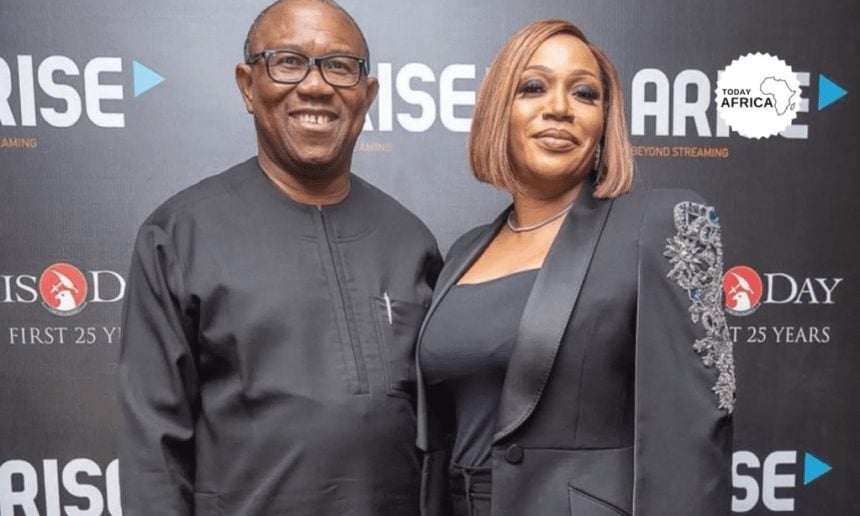
A viral video showing Margaret Obi, wife of Nigeria Democratic Congress (NDC) presidential candidate Peter Obi, carrying a luxury handbag has ignited a fresh debate over the former Anambra State governor’s long-cultivated image as a frugal, prudent politician.
The bag, identified by commentators as a Hermès Kelly 35 in Malachite and listed on Hermès’ official website at £131,938.81, or roughly N250 million at current exchange rates, was spotted in footage that spread rapidly across Nigerian social media. It is worth noting, however, that no confirmed evidence exists that the bag was bought at that price, or bought at all; the widely shared figure is based only on the item’s official retail listing.
Lere Olayinka, an aide to Federal Capital Territory Minister Nyesom Wike, was among the most vocal critics, accusing Obi of “lying and presenting himself as a PRUDENT person” while his family lived an extravagant lifestyle. He contrasted the reported cost of the bag with Obi’s past appeals for small campaign donations, asking, “You want the people to donate N1,000 to fund your campaign, but your wife is using one bag that will take the contribution of N1,000 by 250,000 Nigerians to buy?” Media personality Daddy Freeze took a more measured position, saying he had no issue with the bag itself since Obi built his wealth before entering politics, but questioned why Obi still claims to own only one wristwatch and one pair of shoes.
Obi Responds: “What Is My Business?”
Responding to the backlash, Obi said his wife runs her own business and has her own income, arguing that her personal spending has nothing to do with his handling of public funds. “My wife has her own business and her own money, so what is my business if she buys expensive items with her money? The bags and shoes my wife wears, I don’t even know how much they cost,” he said, adding that she had actually dressed more expensively before he became governor.
Separately, in an interview addressing his personal wealth, Obi confirmed he is a billionaire, but clarified this is in naira rather than dollars. He has pointed to his business career, including in pharmaceuticals and banking, which predates his entry into politics in 2006, as the source of his fortune.
Not the First Time a Political Family’s Wealth Has Drawn Scrutiny
Nigerian political spouses have faced this kind of scrutiny before, though not always over the same kind of claim. Former First Lady Patience Jonathan faced a far more serious form of examination in 2016, when the Economic and Financial Crimes Commission placed a “No Debit Order” on four bank accounts linked to her, following scrutiny of funds she could not fully account for. That case involved an actual regulatory investigation into specific accounts, unlike the current controversy around Margaret Obi, which so far remains a dispute over public image and has not produced any formal allegation or investigation into the source of her money.
The broader pattern of Nigerian politicians branding themselves as modest and prudent, only to face public scrutiny over their family’s visible wealth, is also not new. Former President Muhammadu Buhari built much of his political appeal around a reputation for personal austerity, including flying economy class and living in a modest home, a contrast his supporters frequently held up against the perceived excesses of the political class.
Why the Timing Matters, Locally and Nationally
The controversy lands at a politically sensitive moment. Obi is positioning himself as the leading opposition challenger to President Bola Tinubu ahead of the 2027 election, and his brand has been built heavily on the “we no dey give shishi” message of frugality and accountable leadership that energised the youth-led “Obidient” movement during his 2023 run. Any perceived contradiction between that branding and his family’s visible lifestyle is therefore more than a celebrity gossip story; it goes to the core argument he is making to voters about honesty and restraint in public life.
Politically, the episode has also given opponents, particularly aides linked to rival camps, a ready-made talking point to question Obi’s authenticity ahead of the election, while his supporters have pushed back that a successful businessman’s wife spending her own money is not evidence of wrongdoing. Nationally, the debate feeds into a long-running Nigerian conversation about the gap between the personal wealth of the political class and the everyday hardship faced by most citizens.
Separating the Optics Debate From Unproven Claims
It is worth being precise about what is actually being alleged here. Critics like Olayinka have framed their argument around hypocrisy and inconsistency, that Obi cannot credibly claim extreme personal modesty while his household enjoys a visibly expensive lifestyle, and have speculated, without evidence, about what public funds might be spent on if Obi becomes president. No formal allegation of embezzlement, and no investigation into Obi’s finances as a former governor, has accompanied this specific controversy. Supporters, meanwhile, point out that Obi has a documented business career going back decades before he held any public office, which they argue is sufficient explanation for his family’s wealth.
What Would Actually Settle This Debate
Since Obi’s core defence rests on his wife having an independent source of income, more public clarity about the nature of her business, without necessarily disclosing private financial details, would go a long way toward addressing the specific hypocrisy charge being made against him. On the other side, critics who wish to be taken seriously beyond social media point-scoring would need to move from speculation about “what she would buy with public funds” to concrete, verifiable claims, since Obi has not yet held the office of president and no public money has been shown to be involved.
Our Take: A Debate About Image, Not Yet About Evidence
We think Nigerians are right to hold any politician who campaigns on personal modesty to that standard, and Obi’s “one wristwatch” branding invited exactly this kind of scrutiny the moment it became a defining part of his public image. At the same time, we do not think a handbag, however expensive, is proof of embezzlement or wrongdoing on its own, and we think it is important to say clearly that no such formal allegation has actually been established here. What this controversy really tests is not Obi’s bank account, but whether his political brand can survive contact with his family’s private life. That is a fair question for voters to weigh as 2027 approaches, but it is a different question from asking whether a crime has been committed, and readers deserve to know the difference.
Published by Ejoh Caleb