
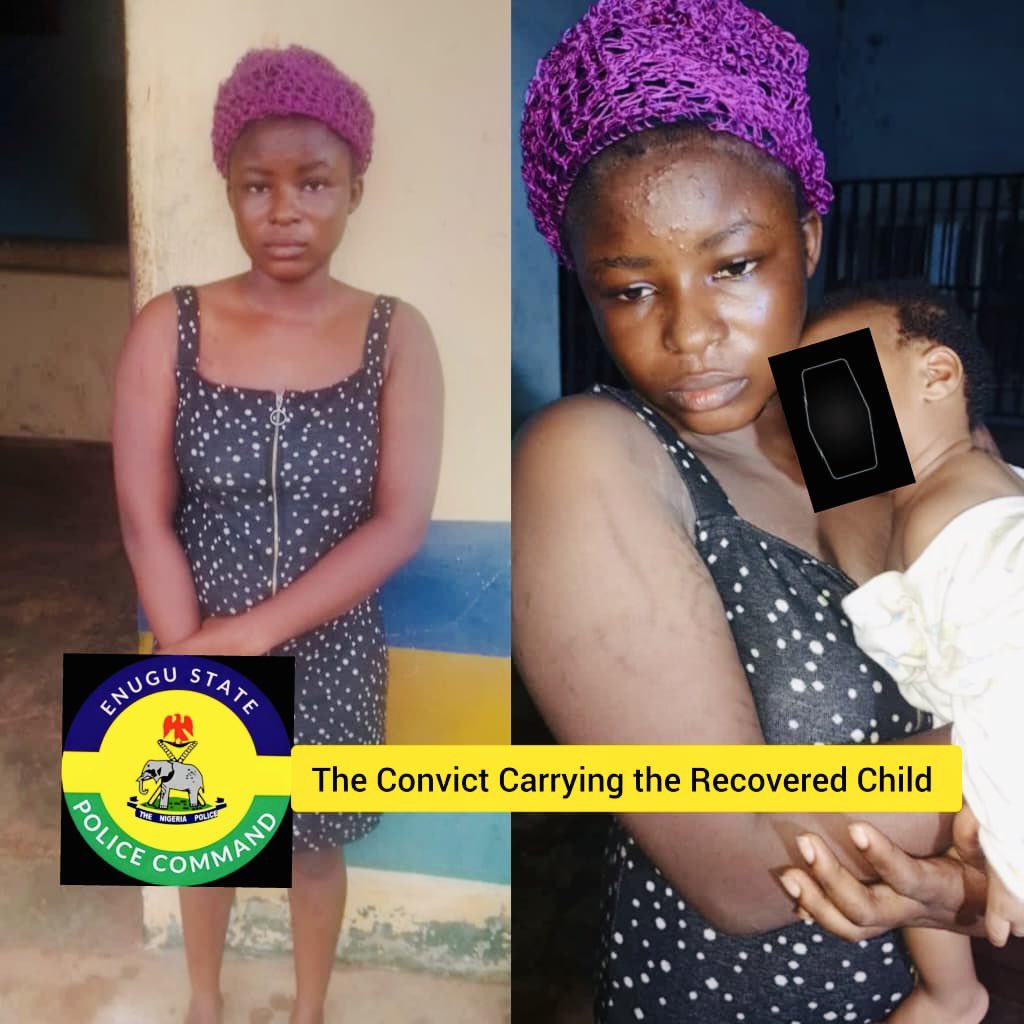
A magistrate court in Enugu has convicted 23-year-old Rejoice Odoh of conspiracy and child stealing. It sentenced her to two concurrent three-year prison terms. Concurrent means she will serve both terms together, so the total is three years, not six.
Police said she stole a four-month-old baby boy at Oye-Emene Market in Emene, Enugu, on October 20, 2026, at about 9:00 a.m. She was convicted on Thursday, October 29, after pleading guilty.
How the Theft Happened, According to the Police (A Pretext Is a False Reason Used to Hide the Real Purpose)
Police said Odoh had earlier posed as a customer to the baby’s mother. She then offered to help carry the child while going to buy something from a nearby shop. Instead, she ran away with the baby. She later switched off her phone and, with her younger sister, took the baby to relatives in Ubahu, Nkanu East Local Government Area, and presented him as her own child. The sister is still at large.
Police did not say why she took the child, and no report we found gives a motive. We will not guess. The case shows how a small act of trust, handing a baby to someone who seems friendly, can have a terrifying result.
Four Days, One Rescue: How Detectives Found the Child
Detectives from the State Intelligence Department, working with the Amechi-Idodo Police Division and the Neighbourhood Watch Group, used the mother’s report and technical intelligence to find the suspect. They arrested her and recovered the baby at Idume, Amankanu, in Nkanu East on October 24 at about 10:30 p.m. The child was returned to his parents.
Commissioner of Police Mamman Bitrus Giwa praised the officers, the Neighbourhood Watch members and the prosecutors. The case took nine days from theft to conviction, which is fast by Nigerian standards. A guilty plea helped, and so did the quick start of the search.
A Troubling Trend: Earlier Child-Stealing and Baby-Selling Cases Across Nigeria
In many other cases, child theft has been linked to selling children. In September, Oyo police arrested a woman, Adejoke Popoola, who said in a video that she had stolen at least 19 children and was paid between ₦80,000 and ₦120,000 for each. Police said the case began with a petition and uncovered a wider network.
In July, Anambra police arrested three women over an alleged child trafficking syndicate. They are accused of selling a four-year-old boy for ₦2 million. In an older case, Ondo police rescued 14 stolen children, including four babies, who were allegedly sold for about ₦1 million each.
We must be careful. Police have not linked the Enugu case to any selling network. But these cases show why child stealing is treated as a very serious crime.
The Fear Behind a Crowded Market: What Makes Babies Easy Targets (Vulnerable Means Easy to Harm or Exploit)
Markets are busy, noisy and full of strangers. A mother who is selling goods may have to carry a baby and serve customers at the same time. She may welcome a helpful hand, especially from someone who has been a regular customer.
A young baby cannot call for help or tell anyone who took him. Offenders know that a short time is enough to disappear. A switched-off phone and a quick move to a village or relative’s house can make tracing harder. In this case, presenting the child as one’s own also made the family at the destination part of the story, and it is not clear what they knew.
What a Stolen Child Costs a Family and a Nation
For the parents, four days of not knowing where their baby was must have been terrifying. A child who is taken from his mother may also face harm, hunger or illness without proper care, even if the carer says it is her own child.
The harm reaches the nation as well. Every case like this makes parents more afraid in public places and weakens trust between neighbours. It also drains police time and public funds, and it adds to a wider crime problem that includes child trafficking and illegal adoption. If such crimes spread, the safety of the youngest Nigerians is at risk.
Was Three Years Enough? Weighing a Guilty Plea Against the Harm (Mitigation Means Reasons a Court May Reduce a Sentence)
Some may find three years a light sentence for taking a baby. Others will note that she pleaded guilty, which courts often treat as a sign of remorse, and that the baby was recovered unharmed in four days. Concurrent terms are common when offences arise from the same act.
We do not have the court’s reasoning, so we cannot judge. The larger question is whether sentencing in child-theft cases sends a strong enough message. Even more important is whether the second suspect, the sister, will also face trial. Her case remains open.
Protecting Babies in Public: Habits, Neighbourhood Networks and Fast Reporting
Parents and traders can use a few simple habits. They can avoid handing a baby to anyone they do not know well, even for a short time. Traders can arrange for trusted family members or neighbours to watch their shops and children. Market associations can add security checks and use camera systems where possible.
Fast reporting matters most. The Enugu police acted quickly on the mother’s report, and Neighbourhood Watch members helped. Residents who notice a woman with a baby who seems out of place can alert the police. The police should keep encouraging the public to share information.
A Verdict for One Baby, A Warning for Many: Our Reading of a Quick Conviction
We commend the Enugu police, the Neighbourhood Watch and the prosecutors for acting fast. A mother has her son back, and a court has held the offender responsible.
Our reading goes beyond this case. We know that child theft is a crime that preys on trust. We urge parents to guard their babies in public, and we urge the police to find the sister who is still at large.
We also ask the police to learn all they can about why the baby was taken, and to find out whether anyone else was involved. If there is no wider network, the public deserves to know that. If there is one, it must be stopped. Every baby deserves to stay with the person who gave him life.
Published by Ejoh Caleb