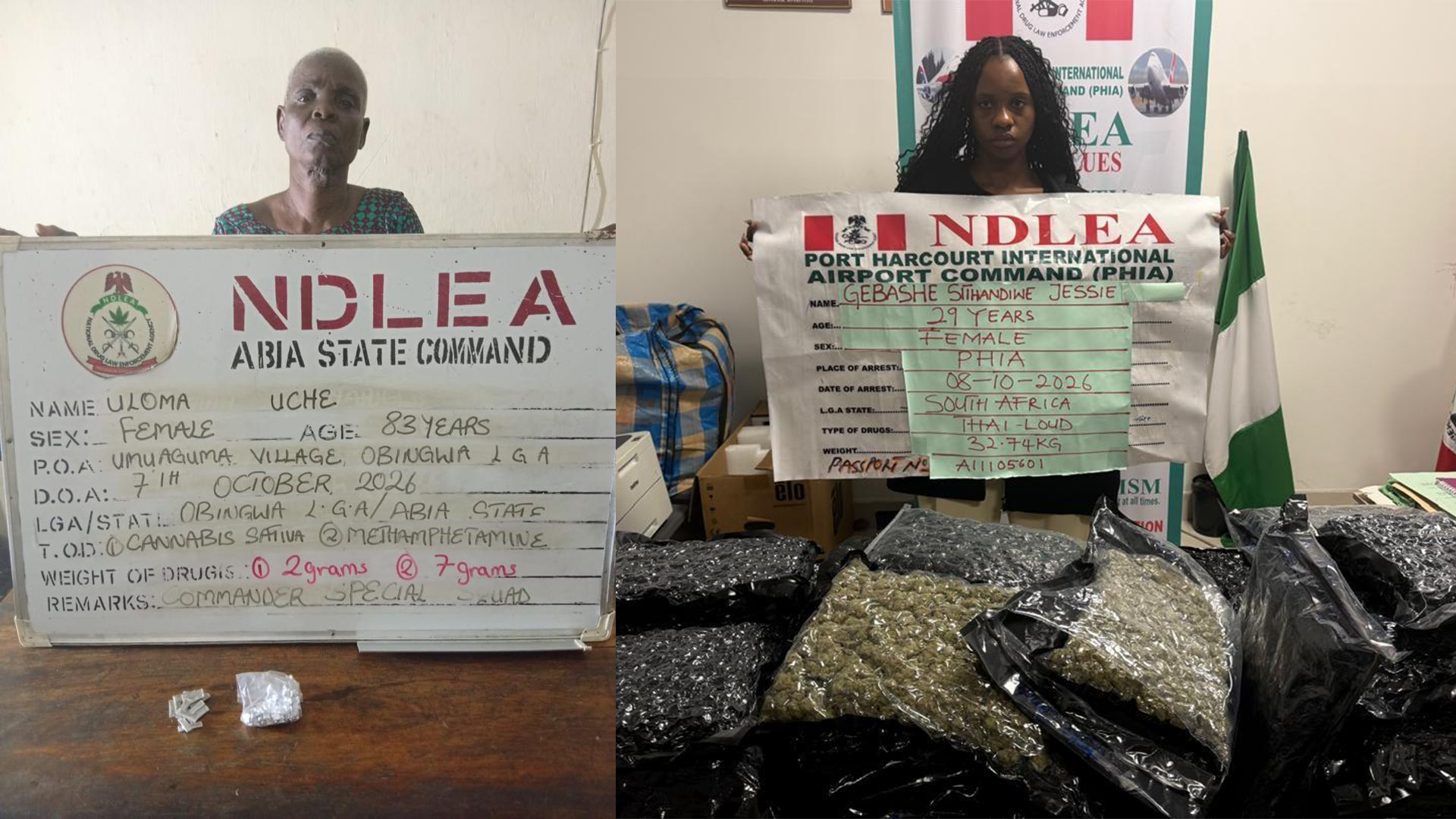
The National Drug Law Enforcement Agency (NDLEA) says it has rearrested an 83-year-old woman, Uloma Uchechi Sunday, in Abia State. The agency says she had methamphetamine and Colorado tied around her waist with a wrapper. She was arrested at her home in Ite-Uzo, Umuaguma, Obingwa Local Government Area, on October 7. NDLEA spokesman Femi Babafemi said the arrest followed intelligence that she runs a drug joint (a place where drugs are sold and used) that harbours criminals who terrorise the community. Colorado is a street name for a group of strong synthetic cannabinoids (man-made chemicals that imitate cannabis). The claims are the agency’s, and the suspect’s side has not been reported.
The agency also announced a wider sweep. At the Port Harcourt International Airport in Omagwa, it says it arrested a South African woman, Gebashe Sithandiwe Jessie, with 30 parcels of a cannabis type called Thai Loud, weighing 32.74 kilograms, in two travelling bags. She reportedly told officers she had trafficked through other African countries and was now widening her route to Port Harcourt. NDLEA also said officers recovered rifles and ammunition during a raid in Jos, Plateau State, where a 45-year-old man was arrested with 47 grams of methamphetamine, two pump-action rifles, a locally made gun and 199 live cartridges. The video behind this report is here.
A Pattern of Second Chances That Were Not Taken: Past Cases of Repeat Drug Offenders (Recidivism in Drug Crimes)
This is not the grandmother’s first brush with the law. NDLEA says she was first arrested on May 17, 2025, with her 32-year-old daughter, Chisom Uchechi, and 50 grams of methamphetamine, 522 grams of skunk, 260 grams of cannabis leaves and 12 grams of tramadol. Both pleaded guilty and were sentenced to 12 months in prison or a ₦200,000 fine each. They paid the fines and were released. After the first arrest, the agency reported that she admitted taking over the trade with her daughter after her son, who started the business, died two years earlier. That detail suggests a family business passed down, not a one-time mistake.
Her case is part of a pattern. In May 2025, NDLEA arrested an 80-year-old man, Ayuba Ashiru, in Kaduna State, who had already served a 10-year prison term for drug dealing between 2014 and 2024. In April 2026, the agency announced the arrest of another 83-year-old suspect in Aba, Abia State, and a 78-year-old in Ekiti State. These cases show that older Nigerians are being used, or are choosing to work, in the trade. They also show that an arrest or conviction does not always end it.
What Keeps the Trade Alive: Money, Family Ties and Easy Routes (Causes of Persistent Drug Trafficking)
The first cause is that the punishment may not hurt enough. A sentence with a ₦200,000 fine option lets a dealer pay and walk free. The agency itself says the woman “promptly returned to the criminal trade” and expanded it. If the profit from dealing is far bigger than the fine, the fine becomes a cost of doing business. We cannot say the court was wrong, but the gap deserves attention.
The second cause is hardship and family ties. We do not know why this woman returned to dealing, but the earlier report shows the business passed from a deceased son to his family. In places with few jobs, drugs can look like a way to earn quickly, and a quiet village home can serve as a base.
The third cause is open routes. The same NDLEA statement describes foreign shipments arriving at airports. Officers say they found 354,000 tablets of Tapentadol (a strong painkiller that is widely abused) weighing 307.20 kilograms in cargo from Pakistan at the Lagos airport. At the same airport, a shipment from the United Kingdom held 75.90 kilograms of Colorado in six Ghana-Must-Go bags. The drugs come from abroad, and they are sent to local people to collect them. Some suspects said UK-based associates sent the packages. Those claims have not been tested in court.
The agency also reported huge local hauls, including 1,100 kilograms of cannabis in Cross River State and 1,027 kilograms of skunk (a strong cannabis type) on the Zaria-Kaduna expressway. Supply is clearly large and moves across many states.
Harm That Spreads Far Beyond the Dealer: How Drugs Hurt Health, Safety and the Nation (Effects of the Drug Trade)
The first harm is to health. A Nigerian doctor quoted by Zikoko lists the risks of synthetic cannabinoids like Colorado. They include confusion, aggression, anxiety, paranoia, memory loss, seizures, heart problems and even death. NDLEA has also warned that these strains are linked to psychosis (a serious mental illness in which a person loses touch with reality). Young people are the most exposed.
The second harm is to community safety. The agency says the woman’s alleged drug joint attracted criminals who terrorise the area. In the Jos raid, officers found guns and ammunition together with drugs. When drugs and weapons meet, neighbours can end up living in fear.
The third harm is to the country. Nigeria has to spend money on police, courts, jails, hospitals and rehab to deal with the trade. Its airports and ports are being used as entry points, which can damage the country’s image with foreign partners. Families lose productive young people to addiction and prison. A nation that cannot protect its youth from drugs weakens its own future.
Closing the Gaps That Traffickers Use: Practical Steps for Government and Communities (Possible Solutions)
The first step is tougher handling of repeat offenders. Courts and lawmakers could consider whether fine options should apply to people already convicted of similar offences, and whether jail terms should rise sharply for a second offence. We do not claim to know the right penalty, but the current cycle suggests the question should be asked.
Airports and ports need stronger checks. The Lagos and Port Harcourt arrests show that intelligence work and cooperation with customs can work. More scanners, trained officers and monitoring of cargo that arrives from risky routes would help.
Communities have a role. NDLEA asks the public to report people involved in the illegal trade to the nearest NDLEA office. The agency’s chairman, Brig.-Gen. Mohamed Marwa (rtd), also said NDLEA would keep a balanced approach that mixes enforcement and prevention. Families should talk to their children early about the dangers of Colorado and similar drugs, and help addicted loved ones find treatment instead of hiding them.
Finally, the state should address hardship that pushes people into the trade. Skills training, small loans and jobs for young people and widows would cut into the supply of willing hands.
Enforcement Without Prevention Will Keep Chasing Its Own Tail: Our Parting Thoughts (Justice, Deterrence and Responsibility)
We believe the arrest of an 83-year-old is not a story about age. It is a story about whether our system can stop a trade once it has caught someone. If a convicted dealer can be back at work within about 17 months of her first arrest, the system needs to look hard at itself. We should add that she is presumed innocent on the new charge until a court decides.
We also commend the officers who intercepted the large shipments, and we do not downplay their work. But arrests alone will not end the problem while profits are high and punishments are light. We urge lawmakers, courts and NDLEA to review how repeat offenders are handled, and we urge families and leaders to speak openly about drugs. We will update this story when the court process moves forward.
Published by Ejoh Caleb