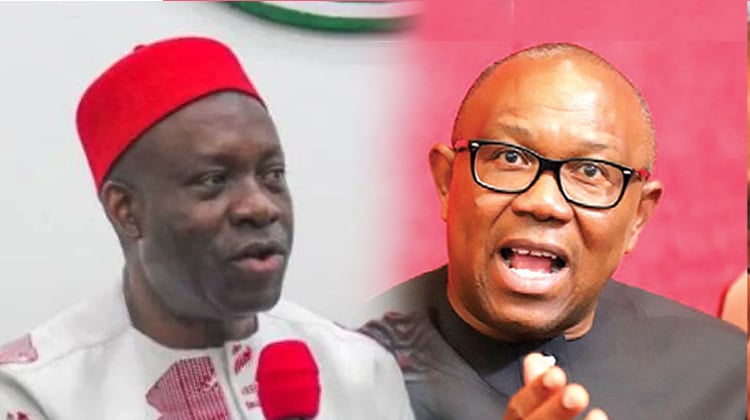
There is another important question arising from the eight development-financing facilities listed by the Anambra Government.
Were these simply eight ordinary loans independently negotiated and contracted by Peter Obi’s administration with foreign lenders?
The World Bank documentation suggests that the answer is no.
For most of these programmes, the Federal Republic of Nigeria was the borrower. The Federal Government negotiated the external financing with the World Bank, while participating States received funds through subsidiary financing arrangements. The World Bank expressly describes this Federal-State structure.
Take SEPIP, one of the largest facilities listed against Anambra.
The World Bank describes it as a US$150 million credit to the Federal Government of Nigeria, with the money subsequently made available to Anambra, Bauchi and Ekiti through subsidiary financing arrangements.
The financing was for education development — not general government spending — and carried highly concessional terms, including a long maturity and grace period.
The same basic distinction applies to the other programmes listed by Soludo — Fadama, Malaria Control, CSDP, NEWMAP, VCDP and the health programme. These were development programmes negotiated within the Federal Government’s international development-finance framework and implemented through participating States.
That does not mean that the programmes created no obligations for Anambra.
It means that it is misleading to present them simply as eight ordinary loans taken by Peter Obi from foreign lenders.
And this is particularly important in considering Obi’s statement that he carried out his infrastructure programmes without borrowing.
He was not raising commercial State bonds at 14%, 15% or 20% interest to finance his government.
He was participating in concessionary development-financing programmes made available to Anambra through a Federal Government/World Bank or IFAD framework.
Indeed, some of these facilities had exceptionally long maturities and substantial grace periods. NEWMAP, for example, involved IDA financing on highly concessional terms, including long maturity periods and a 10-year grace period on principal.
That is a fundamentally different financial proposition from commercial borrowing.
So the mere existence of these development-finance facilities cannot reasonably be presented as proof that Obi’s claim of running his government without borrowing is false.
The real issue is the nature of the borrowing, its cost, its structure and what it was used to finance.
There is another significant fact.
The official SEC register of State and Local Government bonds contains numerous bond issues by other States during the relevant period — Lagos, Delta, Ekiti, Niger, Gombe, Ondo, Osun, Ebonyi, Edo, Imo and others.
Anambra does not appear as a State bond issuer during Peter Obi’s tenure.
That distinction matters.
A concessionary World Bank development programme is not the same thing as going into the capital market to borrow billions of naira at commercial interest rates.
And it is certainly not enough, without more, to establish that Peter Obi left Anambra with the kind of commercial debt burden that Soludo’s presentation appears designed to suggest.
The eight facilities therefore require context, not simply aggregation.
Calling every development-financing facility a “loan” may be technically convenient. But it does not, by itself, disprove Peter Obi’s claim about how he financed his government.
Published by Chuks Nwachuku