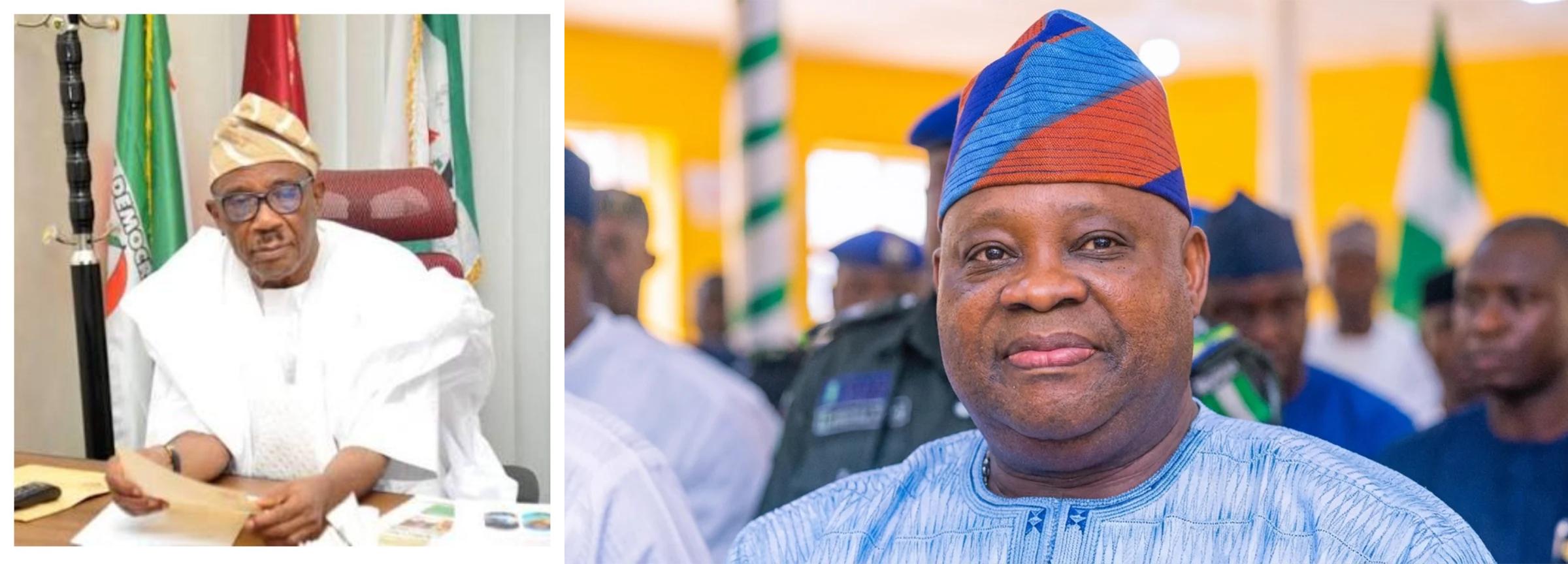
Osun State Governor Ademola Adeleke used an emergency press briefing in Osogbo on Tuesday, August 11, to raise two separate, serious allegations just days ahead of Saturday’s governorship election.
The first concerned a viral video appearing to show Senator Francis Fadahunsi, who represents Osun East Senatorial District and belongs to the All Progressives Congress (APC), addressing a crowd in Yoruba near the palace of the Owa Obokun of Ijesaland. In the video, Fadahunsi was heard making a remark that many listeners interpreted as a call to kill Accord Party leaders, supporters, and their family members. Adeleke, addressing journalists, described the remarks as going beyond politics into “a national security threat” requiring the attention of the President through the Office of the National Security Adviser, and said he had personally raised the matter with Inspector-General of Police Olatunji Disu, demanding Fadahunsi’s investigation and arrest.
Adeleke’s second allegation was that a police signal had reportedly arrived in Osun directing the immediate arrest of Accord Party leaders across the state, with instructions that they be transferred to Abuja and detained until Monday, the day after the election. “We have a credible report that a police signal has arrived in Osun State, directing the arrest of Accord Party leaders, their transfer to Abuja, and detention until Monday, after the governorship election,” Adeleke said. He described such an operation, if confirmed, as an attempt to use the police to help the APC influence the election outcome, and separately claimed that more than 62 Accord Party members were already being held in police custody without formal charges.
Adeleke called on the police and the Department of State Services to act, and asked the IGP to publicly confirm that no such arrest order had been issued. As of this report, the police have not issued a public statement responding directly to the alleged arrest signal.
Fadahunsi’s Response and His Questioning by Police
Fadahunsi rejected the allegation that he called for killing Accord Party members, saying in a signed statement that the video had been “deliberately edited” to distort what he actually said. He said Davido and lawyer Pelumi Olajengbesi circulated a clip of under two minutes taken from a speech that lasted about 24 to 38 minutes, and that his actual comment was about defeating the Accord Party through votes, not physical violence. “What I said was that if the alleged killing of our party members by Accord Party thugs does not stop, our party will retaliate,” Fadahunsi said, adding that he was referring to reported violence against APC members in Ilesa, including a claim that 12 APC members had been killed within 24 hours.
The Osun State Police Command summoned Fadahunsi over the video, with the Commissioner of Police in charge of election security, Samuel Etaifo, confirming the invitation. Fadahunsi arrived at the State Criminal Investigation Department in Osogbo on Wednesday, August 12, accompanied by the Commissioner, and was questioned for close to two hours. Speaking to journalists afterward, he maintained his account, saying: “We have met, and I have told them what I said, not the one manipulated by mischievous interpreters of our language.” He was released following the questioning, with police saying his explanation would help determine any further action.
Amnesty International also weighed in, calling on authorities to hold Fadahunsi accountable, describing his remarks as “deliberate and solely aimed at inciting a bloody poll in Osun State.”
A separate video also circulated showing Francis Eniade, the APC’s 2027 candidate for the Ifelodun/Boripe/Odo Otin Federal Constituency, warning that no Accord Party member should turn out to vote in Odo Otin Local Government Area on election day, adding further tension to the days leading up to the poll.
An Election Already Defined by Mutual Accusations
Saturday’s governorship election pits Adeleke, seeking re-election on the Accord Party platform, against APC challengers, in a contest that has grown increasingly tense in its final days.
Both camps have accused each other of violence and intimidation ahead of the vote. Adeleke’s Imole Campaign Council has separately reported that police detained a House of Representatives candidate along with three other party members, and has petitioned the National Human Rights Commission over the arrests, describing the crackdown as a coordinated effort to weaken Accord Party structures before voters go to the polls. Fadahunsi, for his part, has alleged that more than 40 APC members have been killed in his senatorial district over the past year, and that his remarks were a response to that violence, not an incitement to further it.
Neither Adeleke’s claim of an arrest signal nor Fadahunsi’s claim that the video was edited to misrepresent him has been independently verified by the police or a neutral third party as of this report. Both remain contested claims made by opposing sides of a closely fought election.
What This Standoff Reflects About Nigeria’s Election Security Concerns
Allegations of police bias resurface around closely contested elections. Claims that security agencies are being used to target one party’s supporters are a recurring feature of tense Nigerian elections, regardless of which party raises them, and they are difficult for the public to verify in the moment they’re made.
Video evidence is powerful, but easily disputed. As with many viral political clips, the underlying video here is being interpreted very differently by each side, a Yoruba phrase understood by critics as a literal threat, and by Fadahunsi as a metaphor about defeating a party through votes.
Real, prior violence shapes how new allegations are read. Both sides point to actual attacks on their members before the events at the centre of this story, which means neither allegation is happening in a vacuum, and each accusation lands against a backdrop of genuine, unresolved insecurity in the state.
Election-eve controversies carry outsized weight. With voting just days away, allegations like these are especially likely to shape turnout, public trust in the process, and how results are received once they’re announced, regardless of how they’re eventually resolved.
The stakes extend well beyond the two men at the centre of the dispute.
For Accord Party supporters, unresolved claims of mass, uncharged detentions and a possible targeted arrest order raise genuine fears about safety and freedom to campaign or vote without fear of interference.
For APC supporters and Fadahunsi specifically, an unresolved viral video accusing him of incitement to violence, amplified by a rights organisation’s public statement, puts him under significant public and possibly legal pressure regardless of the video’s original context.
For Osun voters generally, a climate of dueling accusations just before polls open makes it harder to separate genuine security concerns from political messaging, at exactly the moment clarity matters most.
What Would Help Before Saturday’s Vote
A prompt, public statement from the police. Confirming or denying the existence of the alleged arrest signal, and clarifying the status of the 62 Accord Party members reportedly in custody, would address one of the most serious claims in this dispute directly.
Independent review of the full, unedited video. Since both the alleged threat and the “edited video” defence hinge on context, an independent, full-length review by a neutral party, rather than partial clips, would help the public judge the claim fairly.
Transparent reporting on any arrests made this week. Clear, verifiable information on who has been arrested, on what charges, and under what authority would help distinguish legitimate law enforcement from alleged political targeting.
Visible, neutral security deployment on election day. A visible commitment to nonpartisan security arrangements at polling units could help reassure supporters of both parties ahead of a vote already shadowed by mutual distrust.
Where This Leaves Things
We think the most responsible reading of this story, right now, is that neither central claim has been independently confirmed. Adeleke’s allegation of a politically motivated arrest signal is serious, and deserves a direct answer from the police, not silence. Fadahunsi’s claim that his remarks were taken out of context is a defence he’s entitled to make and one police apparently found worth investigating rather than dismissing outright, given they questioned him for nearly two hours before releasing him.
What’s clear is that Osun’s election is unfolding under real, mutual distrust, with both sides pointing to actual violence against their own supporters as the backdrop for their accusations. Whatever the truth of either specific claim turns out to be, we believe voters deserve official clarity from the police well before Saturday, not competing press statements left to stand unresolved on election day itself.
Published by Ejoh Caleb