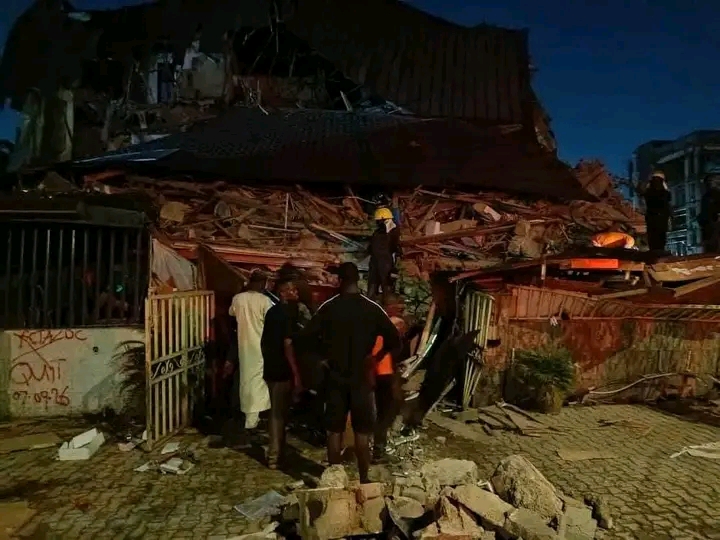
A three-storey commercial building collapsed near Zone 4 in Wuse, Abuja, on Monday evening, triggering a search-and-rescue operation by emergency responders. The FCT Emergency Management Department (FEMD) said it received a distress call about the incident at approximately 7:20 p.m. and immediately mobilised personnel to the scene.
Timeline: How the Day Unfolded
According to reports, officials of the FCTA’s Department of Development Control visited the building earlier on Monday, sealed it over safety concerns, and ordered occupants to vacate the premises. Hours later, at around 7:00 p.m., the structure gave way. The FCT Fire Service and three ambulances were deployed to the site, and responders awaited the arrival of an excavator to help assess the rubble. FEMD said initial eyewitness accounts indicated no casualties, though search and rescue operations continued into the night as officials worked to confirm whether anyone remained trapped.
The Question Investigators Will Need to Answer
The sequence of events raises an obvious question: if the building was already known to be unsafe enough to be sealed that same day, why did it still collapse before anyone could act on the danger, and could earlier intervention have prevented it entirely? The circumstances surrounding the collapse, including the building’s condition before the sealing order and what specifically triggered its failure hours later, are expected to form part of the investigation into the incident.
A Recurring Danger Across Abuja and Nigeria
This is not an isolated case. Just over a week earlier, on August 28, a one-storey residential building comprising six blocks of flats collapsed in the Kubwa 2/2 area of Abuja, trapping two residents in a ground-floor apartment who were later rescued and taken to Kubwa General Hospital in stable condition. In an earlier, more severe incident, a four-storey hotel building under construction in Dape, Life Camp, Abuja, collapsed while workers were on site, trapping more than 20 people and prompting a rescue operation by the National Emergency Management Agency (NEMA).
By the Numbers: How Common Are Building Collapses in Nigeria?
Building collapses remain a nationwide, and remarkably frequent, problem. The Building Collapse Prevention Guild recorded 47 building collapses across 14 states in a single recent year. Research into the causes behind these collapses has found that substandard construction materials account for roughly a third of cases, with poor supervision, faulty structural design, and unauthorised alterations to approved building plans making up most of the remainder.
Why Buildings Keep Falling, and Who Bears the Cost
Researchers and industry experts consistently point to a handful of recurring causes: the use of substandard construction materials, poor or absent structural design, construction by unqualified builders, and unauthorised alterations made after a building has already been approved, such as adding extra floors without redesigning the structure to carry the load. Weak enforcement compounds the problem: a former federal minister noted that almost every collapsed building had a designer, a builder and an approving officer attached to it, yet in most cases, nobody was disciplined or delicensed afterward. Analysts have also flagged allegations of corruption within inspection processes, where dangerous buildings are allowed to remain standing, or even continue construction, because inspections can reportedly be influenced by bribes.
For occupants and nearby residents, a collapse like this means immediate danger to life, lost businesses or homes, and the trauma of not knowing who might be trapped underneath. At a national level, each new collapse chips away at public confidence in Nigeria’s building approval and inspection systems, and adds pressure on the federal government to follow through on stronger oversight, since study after study has found that most of these collapses are preventable rather than accidental.
How Nigeria’s Building Safety System Is Supposed to Work, and Where It Breaks Down
In theory, Nigeria’s building safety process already has the tools to catch a structure like this one before it fails: development control agencies are meant to inspect buildings, flag structural risk, and seal or demolish anything found unsafe well before it reaches the point of collapse. What this case appears to show is that even when that system functions as intended, sealing a genuinely dangerous building, the gap between identification and consequence can still be measured in hours, not days or weeks, which may be too slow to matter once a structure is already failing.
What Could Help Stop the Next Collapse
Building industry experts have repeatedly called for stricter enforcement of building codes, independent quality-assurance inspections, and real sanctions for developers and contractors who violate construction standards, rather than the informal warnings that have often followed past collapses. The federal government’s proposed National Housing Industry Regulatory Commission, if implemented, could help enforce licensing requirements for developers and improve professional accountability across the sector.
For cases like this one, where a building was sealed hours before it collapsed, authorities could also consider immediate physical barriers, continuous on-site monitoring, or emergency demolition for structures deemed critically unsafe, rather than relying solely on a vacate order and occupant compliance to prevent a building already on the verge of failing from harming anyone nearby.
A Warning That Came Just Hours Too Late to Matter
We find it striking, and troubling, that officials had already identified this building as dangerous and ordered everyone out before it came down. That the system worked well enough to catch the risk, but not fast enough to prevent the collapse itself, says a lot about the gap between identifying unsafe buildings in Nigeria and actually neutralising the danger they pose. We’re relieved that no casualties have been reported so far, but we don’t think Nigeria can keep treating each new collapse as an isolated tragedy when the underlying causes, substandard materials, weak enforcement, unpunished violations, are so well documented and so rarely acted on. If this collapse becomes just another entry in next year’s building collapse report, it won’t be for lack of warning.
Published by Ejoh Caleb