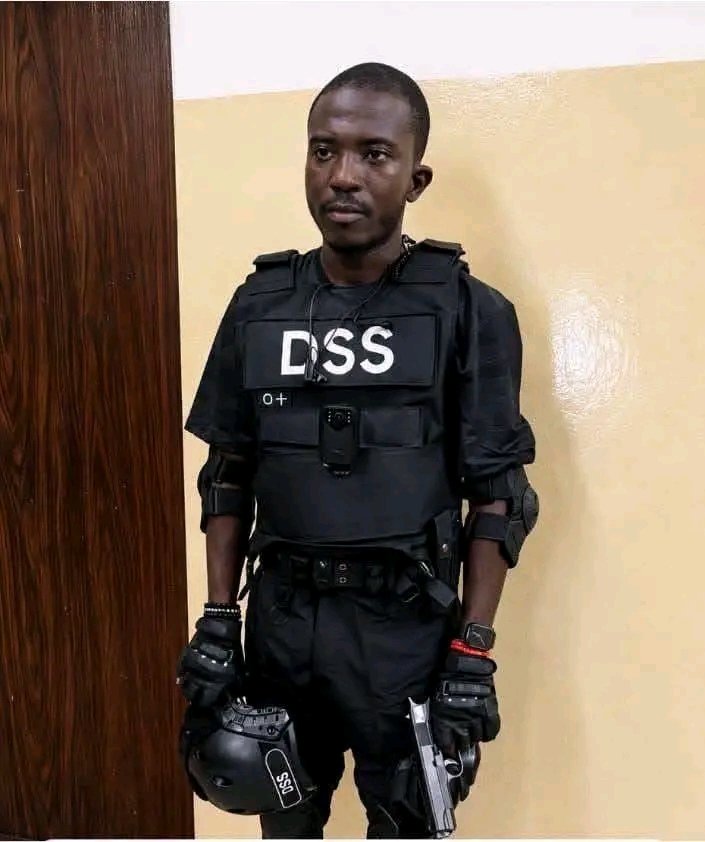
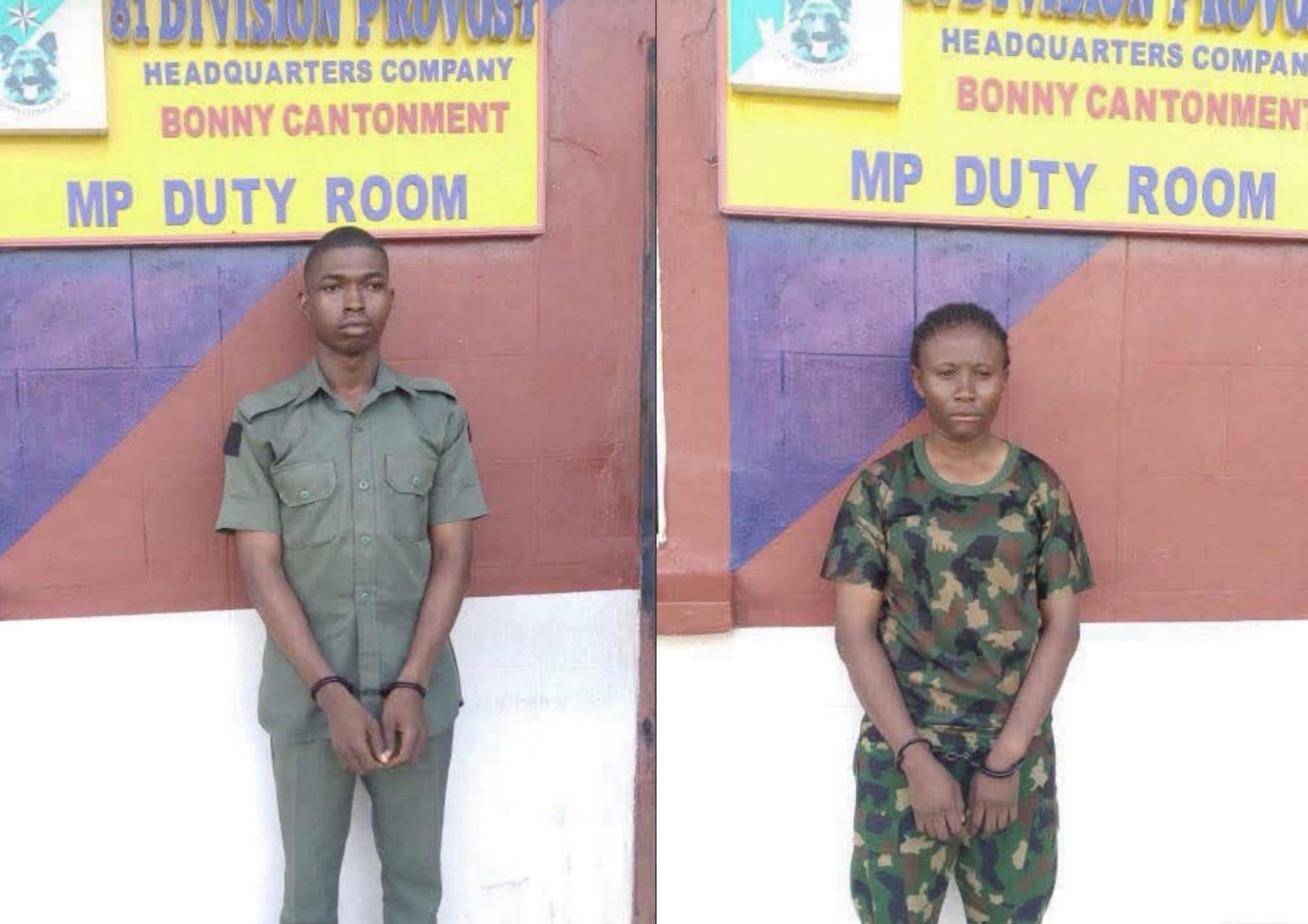
The Nigerian Army has arrested two of its own soldiers for allegedly abandoning their duty post to work as private security at a celebrity wedding. The soldiers, both attached to the 81 Division Medical Services and Hospital (81DMSH) in Obalende, Lagos, were picked up on Tuesday morning after videos showed them in uniform, escorting guests and controlling access at the wedding of TikTok stars Habeeb Hamzat (“Peller”) and Elizabeth Amadou (“Jarvis”) in Lekki.
The two personnel have been named as Private Onasanya Ifeoluwa and Private Ukpai Onyinyechi. A military source said the arrests followed credible intelligence that the soldiers took part in an unauthorised deployment at the event. One clip that spread widely online allegedly showed a soldier acting as a bouncer for TikTok personality Ivanna, walking her through the crowd. Lt.-Col Musa Yahaya, spokesman for the 81 Division, confirmed to The Nation that the soldiers were arrested and are in custody, with investigations ongoing to determine the full extent of their involvement and whether anyone else, including a superior officer, arranged the job for them.
A Pattern Nigeria Keeps Confronting: Soldiers Used as Private Muscle for the Rich and Famous
This is not the first time uniformed soldiers have shown up somewhere they should not be. In December 2025, four policemen were arrested by military authorities for continuing to provide unauthorised VIP escort duty, defying a presidential order that had already withdrawn police personnel from that kind of private protection work; some of the officers reportedly wore altered uniforms to avoid being identified. That same month, the Army opened an internal inquiry after soldiers were spotted providing security at a political event linked to a former state governor in Ogun State — something the Army says breaks its rule that personnel must stay neutral and off unauthorised jobs. In March 2026, videos also showed armed soldiers and police stationed alongside a politically-connected figure as he took over a transport union office in Lagos, raising similar questions about who really controls how soldiers are deployed.
Uniformed personnel have also turned up on the wrong side of land disputes. In July 2026, police in Ondo State investigating a violent clash over a farmland disagreement said three of the men involved were alleged to be soldiers backing one side of the fight; the men fled the scene and remain at large. Separately, residents of the Tungamaje community have accused Army personnel of forcibly evicting farmers from disputed land and then renting the same land back out to new occupants, using their uniforms to enforce claims that were never legally settled.
The problem is old enough that a northern civil society coalition, the Arewa Coalition for Security and Human Rights, publicly called on the Federal Government, the National Security Adviser and the Chief of Army Staff to stop wealthy and influential Nigerians from using armed soldiers as personal escorts, citing cases of harassment and intimidation linked to the practice. Researchers have also documented a wider “guns for hire” culture in Nigeria, where police and, at times, soldiers are informally paid by private citizens for protection duties that were never meant to be for sale.
Why This Keeps Happening — and Who Pays the Price
The likely causes. Low pay and poor welfare push some rank-and-file soldiers toward informal side jobs that offer quick cash. The scale of the wedding, and the fact that it involved two of Nigeria’s most-followed TikTok stars, made military-style security look attractive to organisers who wanted control over a large, unruly crowd of fans. Weak monitoring of where junior personnel go once they leave base also makes this kind of unauthorised outing possible in the first place.
The effects on the soldiers and the public. For Privates Onasanya and Ukpai, the immediate consequence is a possible court martial (a military trial for soldiers) and a damaged service record. For the public, the videos add to growing unease about who is really controlling Nigeria’s men in uniform, and on whose orders.
The effect on Nigeria as a country. Beyond this one wedding, incidents like this chip away at public trust in the Army at a time when the institution is already fighting insurgents, kidnappers and armed bandits across the country. When soldiers can be hired out like private guards, it becomes harder for ordinary Nigerians to tell the difference between a real security operation and a paid-for show — and it feeds public suspicion that some officers may look the other way, or worse, profit from letting personnel and equipment be used off the books. A soldier was separately arrested in July 2026 on suspicion of supplying uniforms to criminal groups, a case that has reignited fears about how loosely military identity and equipment can move outside official channels.
Curbing the Trend: What Could Stop Soldiers From Renting Out Their Uniforms
Faster, public accountability. This case shows intelligence-led arrests can work quickly when the Army chooses to act — that same urgency needs to apply every time, not just when a case goes viral.
A clear ban on private hire of military personnel, as civil society groups have already demanded, backed by real penalties for both the soldier and whoever paid them.
Better tracking of personnel movement, so units know immediately when soldiers leave their post without authorisation, instead of relying on viral videos to find out.
Improved welfare and pay, to reduce the financial pressure that makes risky side jobs tempting in the first place.
Shared responsibility up the chain of command. Investigators say they are still trying to establish whether a superior officer arranged or was paid for this deployment. If low-ranking privates end up punished alone while any senior officer involved walks free, it would be hard to call that fair, and it would do little to stop the next case.
My Reading of This Saga
I think this story is bigger than two soldiers and a wedding. It is a small window into how easily Nigeria’s security institutions can be pulled into private, commercial use when oversight is weak and pay is low. The Army deserves credit for moving fast once the videos went viral — but speed alone is not the same as a fix. If only two privates face punishment while whoever hired and paid them stays in the shadows, the lesson other soldiers will take from this is simply: don’t get caught on camera. Real change means the Army following its own investigation all the way up the chain, and being just as public about what it finds there as it was about this arrest.
Published by Ejoh Caleb