
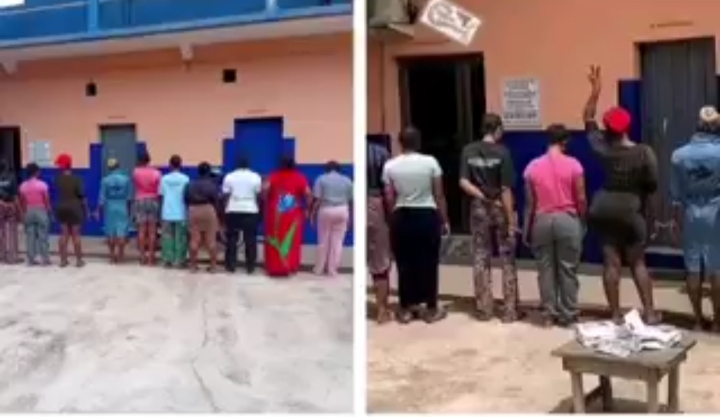
The Ebonyi State Government has arrested 30 suspected commercial sex workers in Abakaliki and sealed a guest house over alleged security concerns, the discovery of suspected hard drugs and building approval violations. The operation took place on Tuesday, October 20, 2026, and was led by the Commissioner for Capital City Development and Urban Planning, Richard Ugo Idike. He worked with the Commissioner for Internal Security, Prince Etta Uka Ude, security operatives and members of the ministry’s task force. Channels reported “more than 30” arrests, while ThePoint put the figure at “over 20,” so the exact number is unclear.
Officials said they recovered suspected hard drugs, including wrappers of substances known locally as “Colos” and Indian hemp, and ordered the indefinite sealing of the guest house pending compliance with the ministry’s requirements. The commissioner described the building as unapproved, and cited the presence of people “reportedly drawn from different states” in an unapproved facility as a security and public safety concern. The arrested individuals were reportedly taken to police custody for investigation, and the owner had not been found. These are the officials’ claims. We do not know whether anyone has been charged, what offences are alleged against the women, or whether the substances were tested.
Similar Raids Have Reached the Courts Before: Past Cases of Mass Arrests of Women (Earlier Raids and Rulings)
The best-known case is from Abuja. Between April 17 and 26, 2019, a joint task force of the army, police, civil defence corps and Abuja city agencies arrested 71 women in public places, according to a later court judgment. A coalition of 72 women’s organisations and rights groups condemned what it called raids, public humiliation, assault and sexual harassment of over 100 women. The Nigeria Human Rights Commission suspended the raids to investigate the allegations after protests. Some women were later given one-month suspended prison sentences and fines of ₦3,000 each for prostitution.
The courts have sided with the women in several rulings. On August 5, 2021, the Federal High Court in Abuja declared the task force’s arrests unlawful and in violation of the women’s rights to liberty, freedom of movement and freedom from cruel, inhuman and degrading treatment. It restrained law enforcement agencies from arresting women in similar circumstances without a court order. In an earlier case, a Federal High Court held that the Abuja Environmental Protection Board acted beyond its powers when it tried to arrest people it called prostitutes, and awarded damages of ₦2 million to ₦4 million. In December 2019, another judge ruled that breaking in and arresting women in apartments violated their right to privacy.
Other states have carried out similar operations. In 2021, the FCT’s social development secretariat said it arrested over 27 women in brothel raids, and in 2022, Jigawa’s Hisbah board said it arrested over 44 commercial sex workers. These cases involved different agencies and laws, and the Ebonyi operation may rest on different legal grounds, which officials have not explained.
Why Governments Launch Such Raids: Security, Drugs and Urban Planning Concerns (Causes Behind the Operation)
Officials give three reasons. The first is security. The internal security commissioner said the government would not allow any facility to become a centre for criminal activities, and urged residents to give credible information to security agencies. The second is drugs. Colos is a street name for strong synthetic cannabis-like drugs. The Nigerian drug agency has warned that these strains are linked to psychosis, a serious mental illness. A doctor quoted by Zikoko listed confusion, aggression, seizures and heart problems among the risks.
The third reason is planning rules. The commissioner stressed the government’s zero-tolerance policy on unauthorised structures and said all properties in the capital must follow approved master plans and serve lawful purposes. Sealing a building that lacks approval is a standard enforcement tool, and it is separate from the arrests.
Broader factors, not mentioned by officials, also shape such cases. The African Court on Human and Peoples’ Rights noted in 2020 that many poor and marginalised women across Africa earn a living through activities that put them at constant risk of arrest under vagrancy laws. We have no information on why these women were at the guest house.
Two Sides of the Same Crackdown: What Supporters and Critics Might Say (Balanced Pros and Cons)
Supporters of the operation can point to real concerns. Drug use and trade are serious problems, and a building where hard drugs are found can attract crime. Enforcing planning rules also protects residents from unsafe or unlicensed buildings. An official in the Abuja case called prostitution a crime under the law and a lifeline for violent criminals. Ebonyi’s leaders say they are acting to protect lives and property.
Critics raise different concerns. Past court rulings found that arresting women for who they appear to be, without cause, and without following legal procedure, violated their rights. Rights groups documented abuse and harassment of women during raids in Abuja. The legal position is also disputed. News reports have described prostitution as illegal in Nigeria, while one 2019 headline reported a judge ruling that sex work is not a crime, though her actual finding was that the arrests violated privacy and procedure.
There is another concern. The official remark about people from different states raises a question, because where someone comes from is not itself evidence of a crime. We do not know how that point figured in the arrests, and we note it only because courts have stressed freedom of movement.
What Happens to the Women, the Owner and the Neighbourhood: Effects of the Operation (Consequences)
For the arrested women, the effects can be serious. They face detention, possible charges, the stigma of public exposure and the loss of income. In past raids, some women were released only after making payments, according to reports. Some may also be victims of trafficking or exploitation, which is why careful screening is important. We have no information on whether that applies here.
For the owner and workers of the guest house, an indefinite seal means lost business until the building meets the ministry’s requirements. The owner has been told to explain the circumstances.
For the community, removing a place linked to drugs may bring relief. But if arrests are seen as unfair, trust between residents and the authorities can suffer. For the state, how the case is handled will show whether enforcement follows the rule of law.
Enforcement That Is Lawful, Fair and Effective: Practical Steps Forward (Possible Solutions)
First, the authorities should be open about the facts. They should say how many people were arrested, what each is accused of, whether the suspected drugs were tested and whether the owner has been questioned. Women who are not charged should be released promptly.
Second, due process must be followed. Past judgments stress that arrests must follow the procedures set out in law, and that detainees must have access to lawyers and humane treatment. Drug allegations and planning violations should be handled through the proper agencies, such as the drug agency and the planning ministry, with evidence.
Third, vulnerable people need protection. Officers should check for signs of trafficking or coercion and refer victims to support services. This is our suggestion, and relevant agencies would need to design it.
Fourth, planning enforcement should be consistent. If the guest house lacked approval, the owner should be held to the rules, and other unapproved buildings should face the same treatment. The government has said it wants all structures in Abakaliki to follow approved plans.
Fifth, the state can consult civil society and health groups on safer alternatives, such as outreach, health services and skills programmes. The Abuja raids showed how pressure from rights groups and the Human Rights Commission can shape the response.
Protecting the Public Without Trampling the Powerless: Our Closing Reflection (Security, Dignity and the Rule of Law)
We understand the government’s wish to protect residents from drugs and crime. Hard drugs such as Colos are dangerous, and a building that breaks planning rules should be dealt with. Officials are right to expect businesses to follow the law.
But we believe the way a crackdown is carried out matters as much as the goal. The women arrested are suspects and have not been convicted of anything. Nigerian courts have repeatedly warned that arrests must follow the law and respect women’s dignity. We also note that the owner, who bears responsibility for the building, had not been found when the reports were filed.
We urge the Ebonyi State Government to publish clear facts, treat those in custody humanely, prosecute those who break the law and avoid targeting people because of who they are or where they come from. We will update this story when the police and the government share more.
Published by Ejoh Caleb