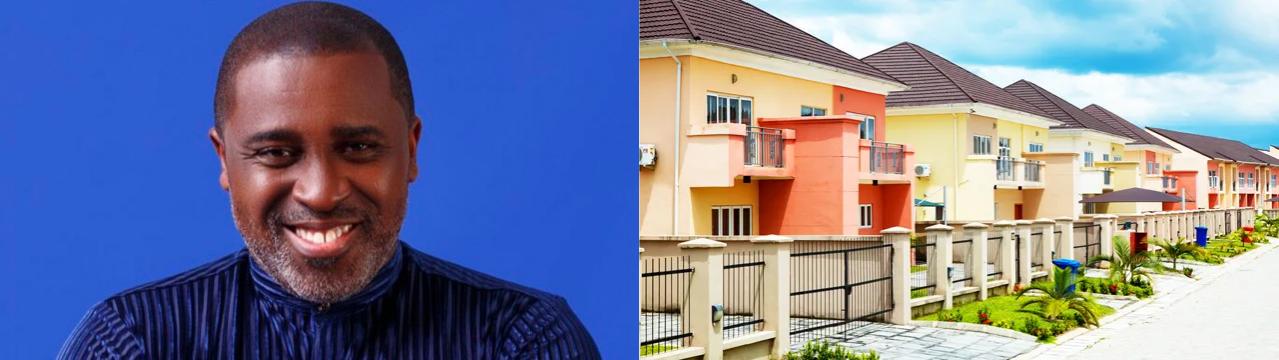
Nigerian broadcaster and former “Who Wants To Be A Millionaire” host, Frank Edoho, has criticised the pricing of homes in Lagos, describing the real estate industry as “armed robbery.” He compared the cost of a mansion in Osapa, an area in Lekki, Lagos, to the price of an entire island owned by Hollywood actor Leonardo DiCaprio in the United States.
“Leonardo DiCaprio owns an island. The cost of the whole island is $1.7 million. There is a house in Osapa, they call it a mansion, that is $1.5 million. Osapa that has no drainage. What are we talking about? It’s armed robbery,” Edoho said.
He went further to question who is actually buying these expensive properties, pointing out that Nigeria’s minimum wage remains far below what would be needed to afford such homes, and linking the situation to the continued fall in the value of the naira.
A Housing Crisis That Has Been Building for Years
Edoho’s comments echo a housing affordability problem that experts have been documenting in Lagos for a while. A comparison of Lagos government housing shows that affordability has fallen sharply over time: in the 1980s, a three-bedroom government flat cost about 77 months of the minimum wage, but a similar flat today costs about 143 months of the current minimum wage, an 84 percent decline in affordability.
Even government-backed “low-cost” housing schemes, meant to help ordinary residents, have been found to be out of reach for the very low-income earners they were designed for, with monthly payments in some cases exceeding an entire minimum wage salary.
Rents have followed the same pattern. Reports show that basic two-bedroom flats in Lagos now cost between ₦1.5 million and ₦4 million a year, with total move-in costs sometimes reaching ₦6 million once agent fees and deposits are added, an amount many workers earning at or near minimum wage cannot realistically raise.
Why Housing Prices in Lagos Keep Climbing Out of Reach
Several factors are driving up the cost of housing in Lagos. Land is limited because the city is built partly on reclaimed land and islands, which pushes up prices as demand grows. The continued fall in the value of the naira also means that developers, many of whom price materials and profits against the dollar, keep raising prices in naira terms. On top of this, Lagos’ population keeps growing rapidly as people move there from other parts of the country in search of work, adding more pressure on limited housing supply.
How the Housing Crisis Affects Ordinary Nigerians and the Country’s Future
On a personal level, many Nigerians, including graduates and mid-level workers, now find it nearly impossible to own or even rent a decent home in Lagos without external help, forcing some into overcrowded housing or long commutes from cheaper, distant areas.
On a national level, if the trend continues, experts warn that even the average Lagos resident may struggle to afford rent within the next few years, which could deepen inequality and social tension in Nigeria’s commercial capital. A housing market this disconnected from local incomes also raises questions internationally about who Nigeria’s economy is actually serving, especially when luxury developments continue to rise in the same city where basic infrastructure, like drainage, is often missing.
Possible Solutions to Nigeria’s Housing Affordability Crisis
Experts have suggested several ways to close the gap between wages and housing costs, including building smaller, more affordable units suited to young single earners instead of only large family homes, simplifying the strict documentation requirements that shut out informal workers from housing schemes, and expanding mortgage financing options with longer repayment periods so buyers are not forced to pay such large amounts upfront.
Stepping Back
What strikes me most about Edoho’s comparison is how it captures a very real contradiction: a mansion without drainage in Lagos can cost almost as much as an entire private island abroad. That is not just a pricing issue, it is a sign of how disconnected Nigeria’s housing market has become from the value it is actually offering, and from what ordinary Nigerians earn. Until wages, infrastructure, and housing prices are brought back into some kind of balance, homeownership in cities like Lagos will keep drifting further out of reach for the very people who live and work there.
Published by Ejoh Caleb