A distressed mother has sparked widespread reactions online after revealing that doctors reportedly diagnosed her 17-year-old daughter with Mayer-Rokitansky-Küster-Hauser (MRKH) syndrome, a rare congenital condition in which a female is born without a fully developed uterus.
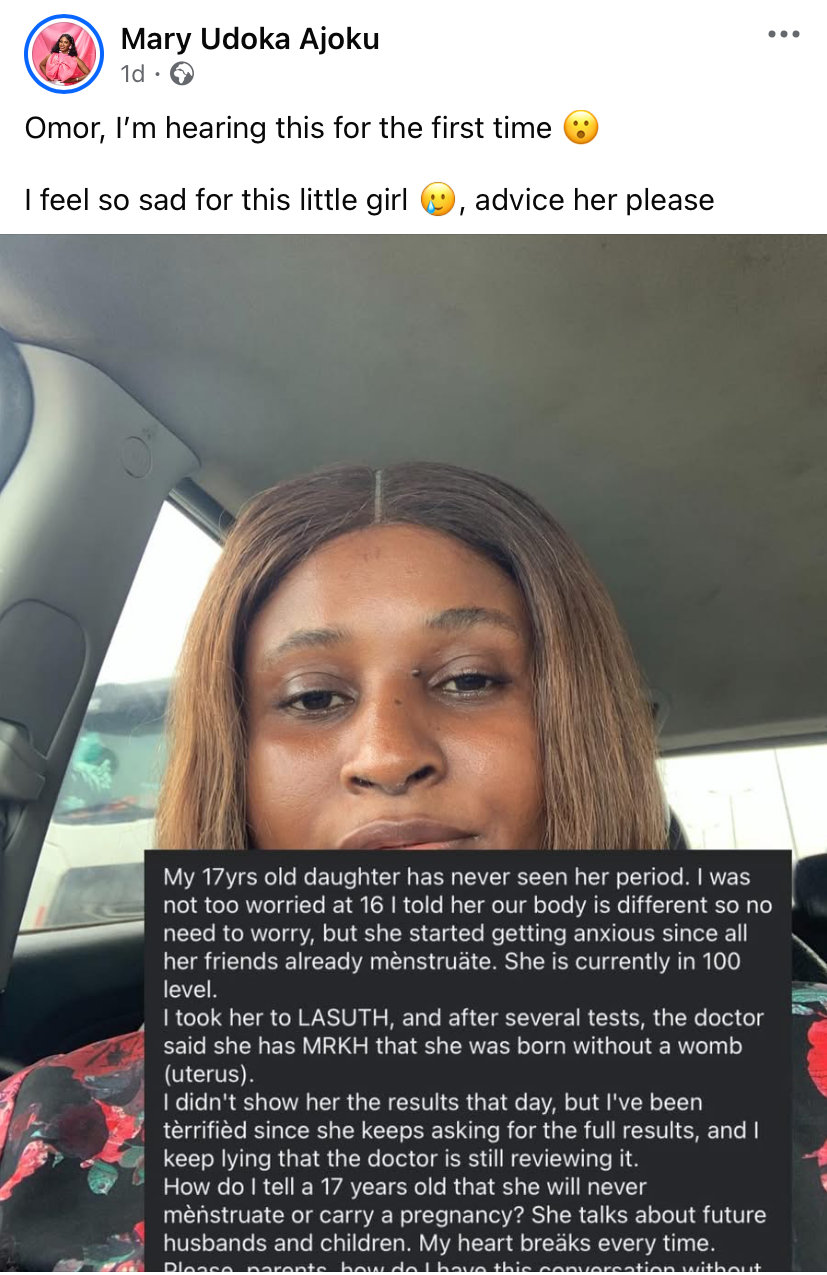
According to the emotional account shared on social media, the mother became concerned when her daughter had not started menstruating by age 17, despite already being in university.
Initially, she believed her daughter’s development might simply be delayed, but growing anxiety from the teenager prompted medical consultation at LASUTH, where doctors reportedly confirmed the diagnosis after several tests.
In her words, the mother expressed deep fear over how to explain such life-changing news to her daughter:
“How do I tell a 17-year-old that she will never menstruate or carry a pregnancy? She talks about future husbands and children. My heart breaks every time.”
Understanding MRKH Syndrome
MRKH syndrome affects the reproductive system, particularly the uterus and sometimes the vaginal canal, though affected individuals usually have:
- Normal external female anatomy
- Normal hormone levels
- Functional ovaries
- Typical breast development and puberty changes
Fertility possibilities
While natural pregnancy may not be possible without a uterus, medical experts note that some individuals with MRKH may still have biological children through:
- IVF with their own eggs
- Gestational surrogacy (where legally available)
- Adoption or fostering
Emotional support is critical
Experts and online commenters strongly encouraged:
- Professional counseling
- Honest but sensitive communication
- Psychological support for both mother and daughter
- Connection with MRKH support groups
Public reactions
Many social media users shared words of encouragement, emphasizing that the diagnosis does not define the girl’s worth, femininity, or future happiness.
The story has highlighted the importance of reproductive health awareness, early medical consultation, and compassionate family support when dealing with rare diagnoses.
See below;
Published by Ejoh Caleb