By Ejoh Caleb | Visiotalks
Published: November 23, 2026
Key Takeaways
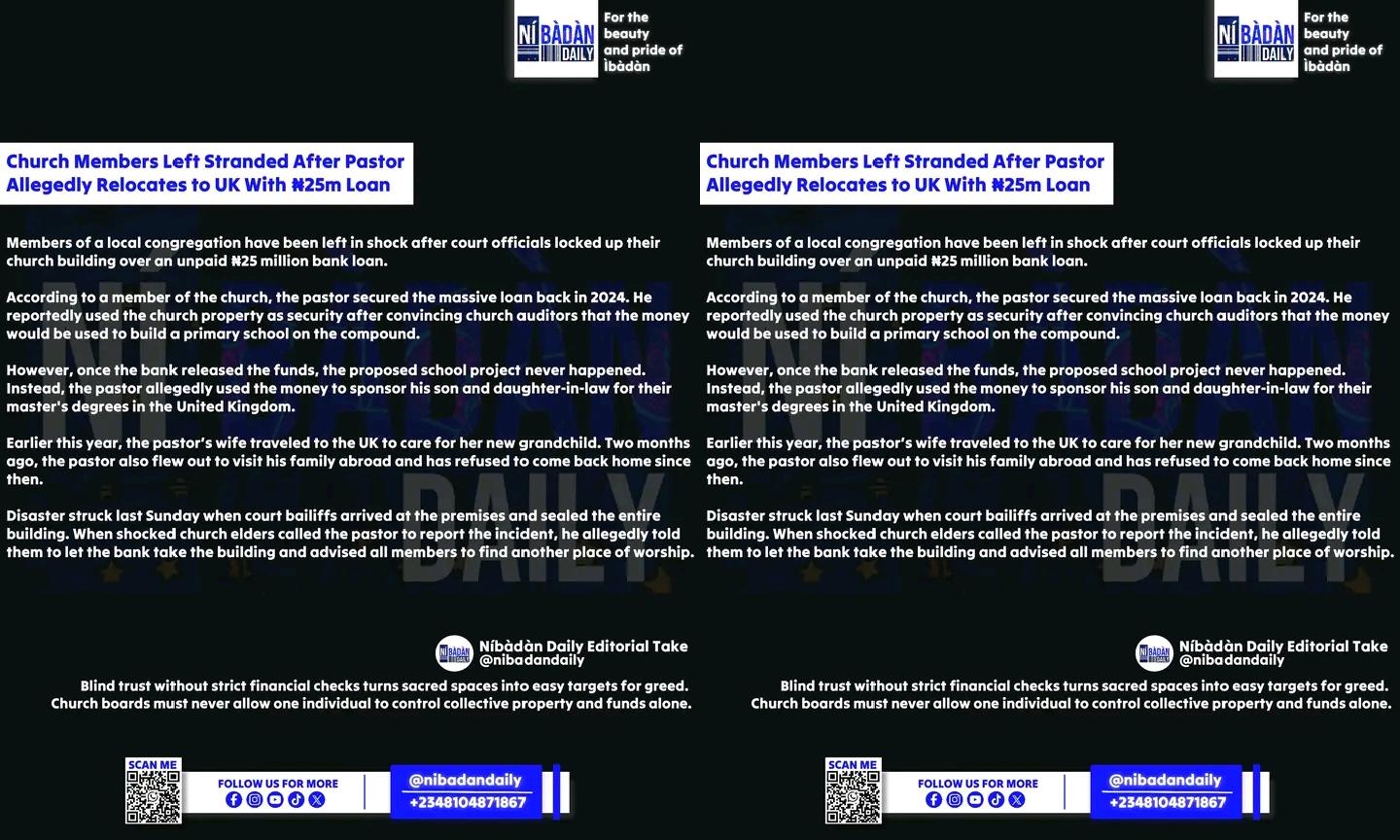
- A social media user claims a pastor took a ₦25 million loan in 2024, using the church building as collateral, and then stopped returning to the church.
- The user says court officials sealed the building last Sunday. We found no report, court record or response from the pastor or church to confirm this.
- Neither the pastor, the church nor the lender has been named. Everything here is an unverified claim.
- The case raises a real question: who has the legal power to pledge a church’s property, and who protects members if a loan goes wrong?
- A social media user has claimed that a pastor left his church and congregation after using the church building as security for a ₦25 million loan. We have not been able to confirm any part of the story. The user did not name the church or the pastor, and we found no news report, court record or statement from either side.
What the Account Alleges, Step by Step, and What Is Unverified
The user says the loan was taken in 2024, after the pastor proposed building a primary school on the church premises. The user says the church auditors supported the plan. After the loan was paid out, the pastor allegedly sent his son and daughter-in-law to the UK for master’s degrees. The user also says that earlier this year the pastor’s wife travelled abroad for omugwo (traditional care for a new mother and baby, usually given by the mother’s relatives). The user says she returned and then travelled again. The pastor allegedly followed two months ago and has not come back.
The account then says court officials arrived at the church last Sunday and sealed the building over the loan. It says that when the elders called the pastor, he told them to let the building be taken and to find another church. The claim that the loan was used to fund his family’s move abroad is the user’s own conclusion. We do not know the pastor’s side, the lender, the loan terms or whether any court order exists.
To be clear about status, none of these claims has been verified: the ₦25 million loan in 2024, the use of the church building as collateral, the school project with auditor support, the children’s travel after the loan, the pastor’s two months abroad, the sealing of the church last Sunday, and the pastor’s alleged message to the elders.
Church Property, Trustees and Loans: Earlier Rulings and Comparable Disputes
Nigerian law gives some guidance, though not on this case. In Owodunni v Registered Trustees of Celestial Church of Christ, the Supreme Court held that a successor chosen by trustees was invalid because the church’s constitution was not followed. In Registered Trustees of the Presbyterian Church of Nigeria v Ukeni (2020), the appellant argued that registered trustees hold the power to deal with a church’s property and that no one else can. These cases show that who has authority matters.
Similar disputes have happened abroad. In Miami, a church faced an auction of three buildings after a former pastor took mortgages pledging church properties. The church says it never held a congregation meeting on the loan. The pastor’s lawyer says the congregation knew. In a Michigan case, a church officer testified that a pastor in that denomination lacked authority to take such a loan without conference approval. These are foreign cases, and each depends on its own facts.
Big Plans, Thin Oversight and Silence: How Church Debt Problems Begin
Churches often take on large projects, such as schools, halls or clinics, with limited cash. Borrowing against a building can look like the only route. Problems arise when only a few people understand the terms, when members are not told, or when no one tracks repayment.
Silence makes things worse. If leaders stop explaining what is happening, members fill the gap with rumours. In Nigeria, many churches are small and run informally, with few outside checks. That is a risk even when the leaders mean well.
The Wider Cost to Believers, Lenders and Public Trust in Faith Groups
Churches serve millions of Nigerians through worship, schools and charity. A lost building can end services, scatter a community and leave members with nowhere to go. Lenders can also lose money if loans are made without clear authority.
The regulatory gap is also part of the picture. In September 2026, the Court of Appeal in Abuja upheld a ruling striking down CAMA 2020 sections that gave the Corporate Affairs Commission power over incorporated trustees, including churches. Supporters see it as protection for religious freedom. Others worry that fewer checks leave members more exposed. Both views are fair, and the debate is not settled.
Care for Vulnerable Members and Fairness to the Accused Pastor
The people most affected in a story like this are ordinary members. Elderly worshippers, low-income families and children in any church school depend on the building. They did not sign the loan, and they may know nothing about it. Their needs come first.
At the same time, the pastor is accused through a single account and has not spoken. He may have a different explanation. The church may have approved the loan properly, or the sealing may not have happened as described. Borrowing for a school is not wrong in itself, and many church schools serve their communities well. The risk lies in pledging a worship building without clear approval and open records.
Visiotalks Analysis: Five Checks Before Believing or Sharing a Church Story
Viral stories about churches spread fast because they involve trust and money. We suggest five checks.
- Is the church named and registered? Real stories usually name the church so it can be checked against its registration.
- Is there a paper trail? A loan agreement, a trustees’ resolution or a court order can be confirmed. A claim without documents cannot.
- Has the other side responded? A fair story includes the pastor, the elders and the lender.
- Does the sequence make sense? Collateral claims should explain who authorised the loan and what default notices followed.
- Is the storyteller close to the facts? A member, a lender and a bailiff each know different parts of the story.
This story fails the first three checks so far. That does not mean it is false. It means it is not yet ready to be treated as fact.
Frequently Asked Questions
Is this story confirmed? No. It comes from one social media user, and we found no supporting report.
Can a pastor use a church building as collateral in Nigeria? Church property is generally held by its trustees, so a pledge would normally need their authority and follow the church’s own rules. The exact answer depends on the documents. A lawyer should confirm.
Can a lender seal a church? Lenders normally need to follow legal steps, such as notice of default and a court order. We do not know what happened here.
Is it wrong for a church to borrow money for a school? No. The question is who approved the loan, what was pledged and whether members were told.
What can members do if they fear for their church building? Ask for the loan documents, ask for a meeting of the trustees and seek independent legal advice.
Practical Steps for Congregations, Pastors and Lenders
Churches should require a written trustees’ resolution before pledging any property, and members should be told the amount, purpose and repayment plan. Independent auditors and lawyers should review big loans. Pastors should avoid sole control over such decisions.
Lenders should check that the people signing have authority, and that the property is correctly registered. Congregations can keep minutes and ask for regular reports. In a dispute, mediation by respected elders may protect a community better than a public fight.
Trust in the Pews Is Protected by Open Books and Fair Process
We take the claims seriously, but we do not treat them as proven. If the account is true, it describes a painful loss for a congregation. If it is not, it could harm a pastor and a church unfairly.
We believe the right path is to find the facts. Congregations deserve to know what is pledged in their name, and accused people deserve to be heard. A church building belongs to the faithful who gather in it. Open books, shared decisions and calm communication are the best protection for that trust. Our faith communities will be stronger when we insist on them.