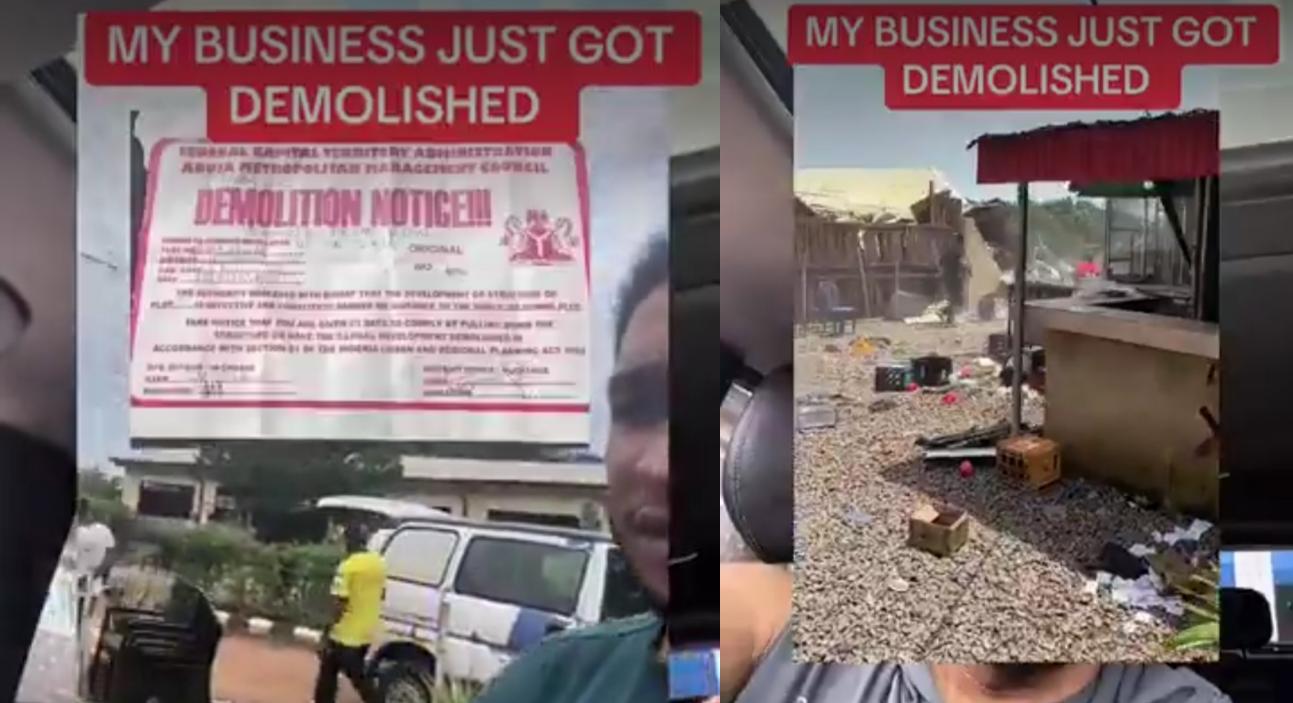
A young entrepreneur has cried out after he said his business, Barbados Nightlife in Lokogoma, Abuja, was demolished less than 10 months after it opened.
According to him, officials from the Abuja Development Control Department — the arm of the Federal Capital Territory Administration (FCTA) responsible for enforcing building and land-use rules — gave him only 24 hours to leave the premises. He said that by the time he arrived at the site on Monday morning, bulldozers were already tearing the building down.
He said he had invested millions of naira into the business, which employed more than 30 staff members.
Barbados Was Not Demolished Alone
Barbados Nightlife appears to be one of several businesses brought down in the same Lokogoma demolition wave. Charles Avwenagha, owner of the nearby Stopover Bar and Grill, said his own business was pulled down without formal notice around the same time, and listed other affected outlets in the area, including Barbados, Amalashita, RM’s Gym, Hunter’s and Ari’s. Avwenagha said the demolition alone left roughly 300 people in the area jobless, and that he was considering leaving Nigeria permanently after the loss.
Staff members at the affected businesses described similar scenes: workers evacuating equipment as bulldozers moved in, some losing years of income overnight. One kitchen staff member, who said she had worked at Stopover Bar and Grill for six years, said the job supported her family and that she now had no idea where her next income would come from.
A Pattern of Short-Notice Demolitions in Abuja
This is not an isolated incident. The FCT Administration has carried out repeated demolition exercises across Abuja in recent months, targeting structures officials say were built illegally on government land.
In one earlier case, FCT officials confirmed serving a 24-hour demolition notice on around 500 structures in a single exercise, saying the buildings had become a traffic and environmental hazard. FCT Minister Nyesom Wike has consistently defended the wider demolition campaign as necessary to protect lives and property and restore the original Abuja Master Plan, the city’s official development blueprint.
In December 2024, the Senate urged the Federal Capital Development Authority to suspend further demolitions unless they were backed by a court order, reflecting concern in the National Assembly itself over how these exercises were being carried out.
Why Short-Notice Demolitions Keep Happening, and Who They Hurt (Causes and Effects)
A few factors keep driving this pattern.
First, much of Abuja’s rapid growth has happened faster than land documentation can keep up with. Many business owners occupy land through informal leases, verbal agreements, or documents that were never properly finalised, which authorities can later use to justify demolition as removal of “illegal structures.”
Second, enforcement is often disconnected from the people it affects. Business owners frequently say they only hear rumours of an impending demolition, rather than receiving direct, formal notice, leaving them with little time to salvage equipment or relocate operations.
Third, the effects go beyond one business owner. Each demolition can wipe out dozens of jobs at once, along with the savings, loans, and years of work behind a business. For Nigeria as a country, repeated short-notice demolitions like this send a discouraging signal to investors, including Nigerians in the diaspora who are being actively encouraged to bring money home. When an entrepreneur who followed the process still loses everything overnight, it raises doubts about whether investing in property-based businesses in Nigeria is safe at all.
Possible Solutions
Longer, verifiable notice periods. Even where a demolition is legally justified, giving business owners more than 24 hours, and confirming that notice reached them directly, would reduce the scale of last-minute losses.
A public, searchable land-status registry. If business owners could easily check whether their land carries any dispute or planning issue before investing, many of these losses could be avoided entirely.
Compensation or relocation support for verified tenants. Even when a structure is illegal, business owners who can show they paid rent or fees in good faith could be offered a grace period or an alternative site, rather than losing their investment entirely.
Independent review before large-scale demolitions. An independent body reviewing demolition orders, separate from the enforcing agency, could help ensure decisions are consistent and not applied unevenly.
The Bigger Picture
What troubles me most about stories like this is how familiar they have become. An entrepreneur builds something, hires people, and follows the rules as far as he understands them, only to watch it flattened in an afternoon with barely enough warning to move a chair. Whether or not the land dispute behind a demolition is legitimate, the way it is carried out matters just as much as the decision itself. A country that wants its citizens and its diaspora to keep investing at home cannot keep treating a business’s destruction as routine. Until notice periods, documentation, and accountability catch up with how fast Abuja is enforcing its rules, more entrepreneurs will keep learning this lesson the same painful way.
Published by Ejoh Caleb