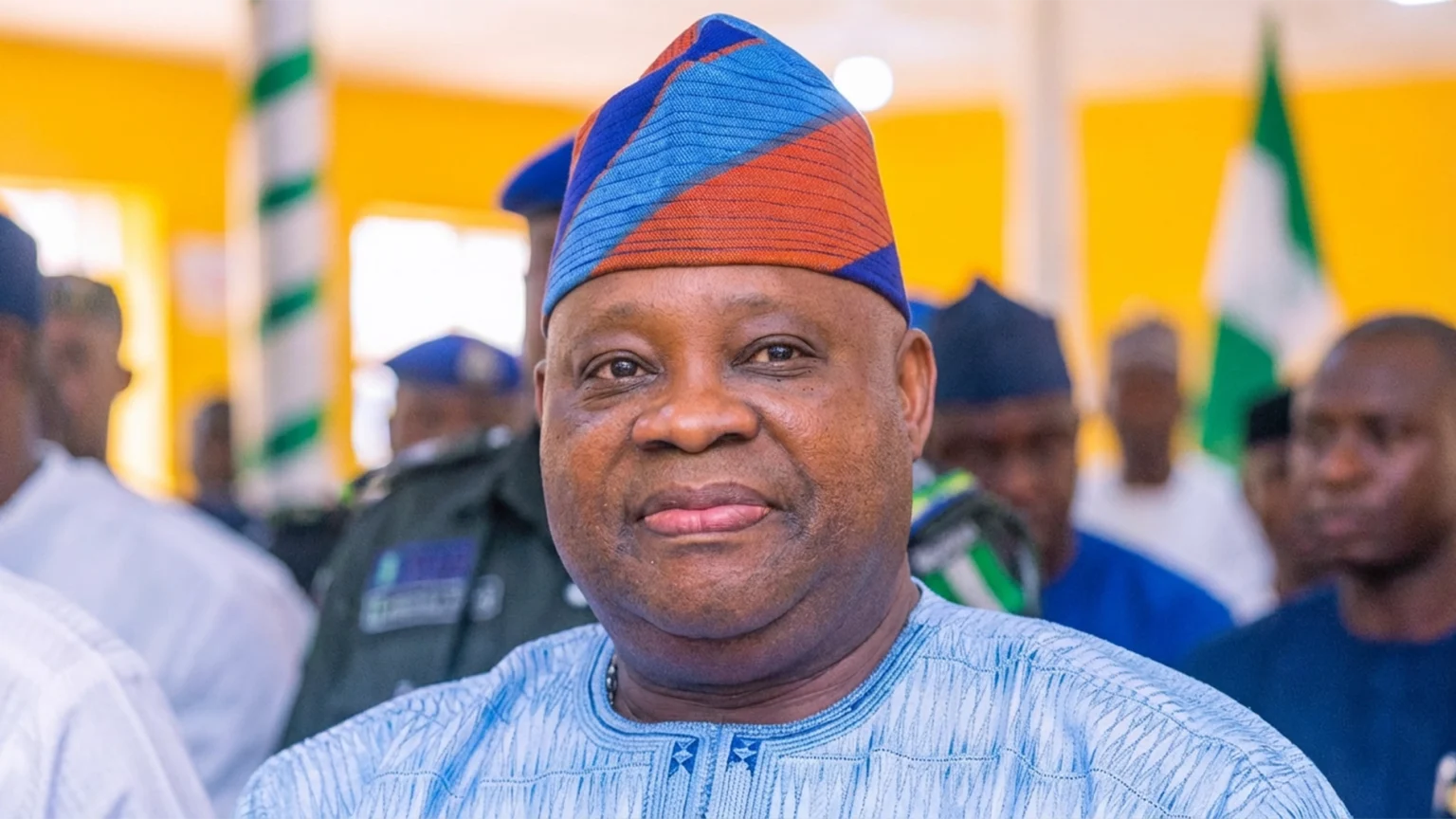
Governor Ademola Adeleke has been declared winner of the Osun State governorship election, securing a second term in office. The Independent National Electoral Commission (INEC) announced the result on Sunday morning at its Osogbo headquarters, with the Returning Officer, Prof. Joshua Olalekan Ogunwale, confirming Adeleke had met the constitutional requirements to be declared winner.
Adeleke, who ran under the Accord Party after previously serving under the PDP, polled 511,067 votes to defeat his closest rival, Bola Oyebamiji of the All Progressives Congress (APC), who scored 444,815 votes. Najeem Salaam of the African Democratic Congress (ADC) came third with 17,180 votes. Fifteen political parties contested the election in total.
Adeleke won in 19 of the state’s 30 local government areas, while Oyebamiji claimed victory in the remaining 11. Out of 2,339,544 registered voters, only 1,010,684 were accredited to vote, with 985,097 valid votes recorded and 20,721 ballots rejected.
Jubilation broke out in Osogbo following the announcement, with Adeleke’s supporters taking to the streets with victory songs. A resident, Taiwo Oloyede, commended INEC for what he called a well-run process, while another resident, Odunola Omojola, said Adeleke deserved a second term given his handling of workers’ welfare.
Background: An Election Shadowed by Controversy
The declaration comes after a campaign period marked by serious allegations of vote-buying, with APC and Accord Party agents accused of offering voters between ₦10,000 and ₦20,000 in the days before the poll, in some cases starting nearly a week ahead of the election. Pre-election violence also cast a long shadow, with at least eight people reportedly killed in Ilesa and Esa-Oke ahead of the vote, prompting the deployment of soldiers to flashpoints across the state.
This is not the first time an Osun governorship result has been contested. Adeleke first won the seat in 2022, but the result was overturned by the Election Petitions Tribunal in early 2023 following an APC petition alleging over-voting, only for the Court of Appeal to reverse that ruling and restore him to office, a decision the Supreme Court upheld in March 2023 after Oyetola escalated the matter. Adeleke had described the tribunal’s initial ruling against him as “a miscarriage of justice.”
Tensions ran high again this election cycle even before voting began. A federal lawmaker representing Osun East, Senator Francis Fadahunsi, and an APC candidate came under fire days before the poll after a video circulated showing Fadahunsi warning that any Accord Party member seen in Ilesa before election day would be killed. Adeleke had also publicly appealed to President Bola Tinubu to intervene against alleged killings targeting his supporters, while the APC accused the governor of inflammatory rhetoric driven by fear of defeat.
Concerns also emerged during collation itself. A resident, David Adesina, alleged in a video shared on X that a National Youth Service Corps member recording results at his polling unit mistakenly wrote the Accord Party’s vote count as “012” instead of “212,” a discrepancy he said was noticed and corrected on the spot before the result sheet was signed. The incident fed into broader anxiety over the collation process, with Accord Party’s David Adeleke, popularly known as Davido, separately raising alarm that INEC’s uploading of results to its IReV portal had been slow and alleging attempts to delay or interfere with collation, and repeatedly urging voters and party agents to remain at polling units until results were uploaded. In response, many residents and party agents stayed back at their polling units well after voting ended, keeping watch over the counting and collation process to guard against any manipulation of the results before they were officially recorded and uploaded.
Why This Election Mattered
Osun was widely regarded as one of the last major governorship tests before Nigeria’s 2027 general elections, making the result closely watched by national party strategists across the political divide. The outcome offers an early signal of political momentum in the South-West ahead of the presidential race, particularly given that Adeleke had endorsed President Tinubu for re-election in 2027 despite contesting this governorship race outside the APC.
What Happens Next
Given Osun’s history, both major parties are expected to consider legal challenges regardless of the declared outcome, with election petition tribunals having become a near-standard feature of the state’s politics since 2018. The vote-buying and violence allegations that preceded the election are also likely to draw continued scrutiny, with the Human Rights Writers Association of Nigeria (HURIWA) having already called for investigation and prosecution of those responsible for financing and organising the alleged cash payments to voters.
A Mandate Worth Questioning
A clear declaration is not the same as a clean election. Adeleke’s victory gives him a fresh mandate, but it arrives alongside credible allegations of cash payments to voters and violence that claimed lives before a single vote was cast. Osun’s electorate has shown before, through years of tribunal battles stretching back to 2018, that a declared winner is often only the first chapter of the story. Whether this result holds, and whether anyone is ever held accountable for the vote-buying and killings that shadowed this campaign, will say more about the health of Nigeria’s democracy than the final tally itself.
Published by Ejoh Caleb