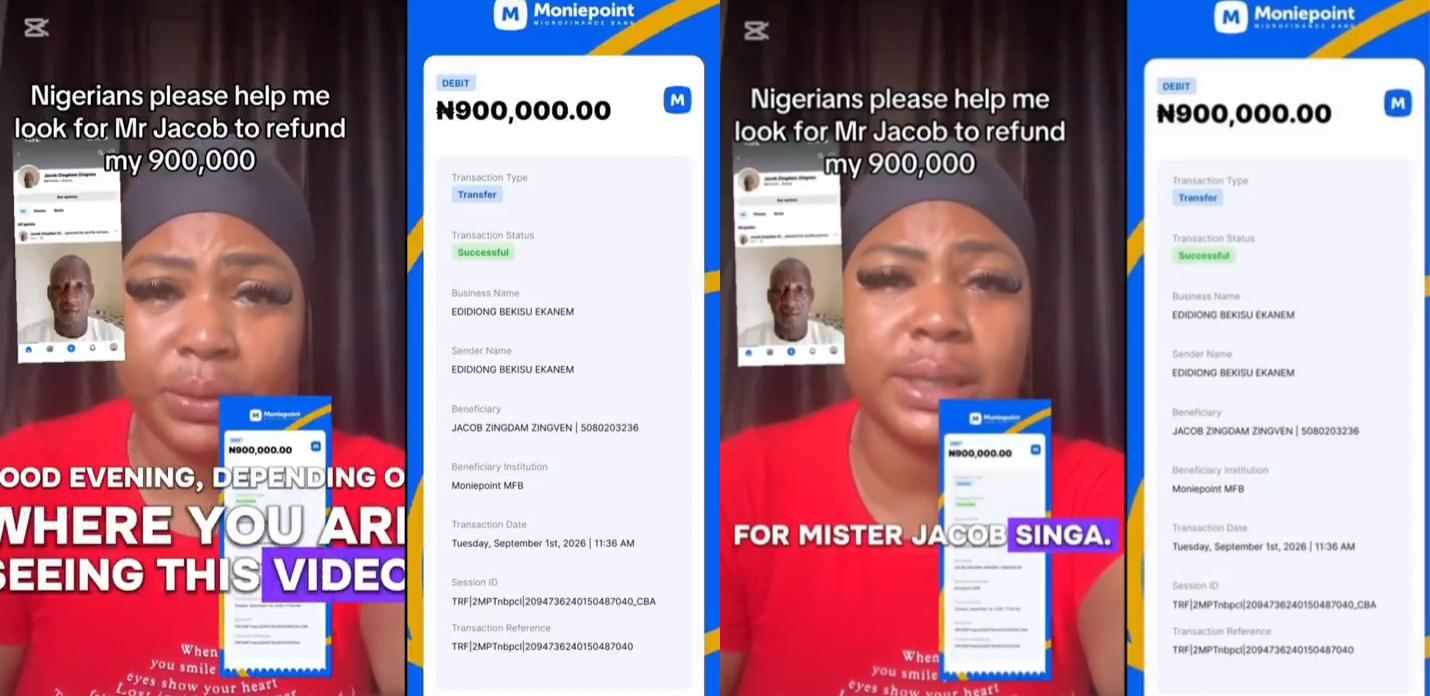
A woman has publicly appealed for help, claiming a man refuses to return ₦900,000 she sent to him by mistake. She says she made the transfer on September 1, 2026, to a man she identified as Mr Jacob Zingdan. According to her, she immediately contacted her agent, who called the man. He reportedly agreed to refund the money and asked for her account details. However, she alleges that when she called him hours later, he told her not to disturb him, and that he has since refused to answer her calls and messages. These are her claims. We could not reach the man, and we found no police or bank statement. We do not know whether he received the money or has a different account of events.
Courts Have Treated Refusal to Return Mistaken Money as a Crime: Past Cases of Wrongly Credited Funds (Earlier Cases Involving Erroneous Transfers)
Nigerian courts have dealt with many cases like this. In January 2026, an Edo State High Court in Benin City convicted Ojo Eghosa Kingsley after he pleaded guilty to stealing more than ₦1.3 billion that First Bank wrongly credited to his account because of a system glitch. Prosecutors said he moved the money to accounts belonging to his mother and sister, and the court ordered him to refund the remaining ₦272,252,193.59. That case involved a bank error, but it shows that spending money paid in error can lead to a criminal conviction.
Individuals have faced charges too. In January 2021, a Kwara State High Court sentenced a driver to two years in prison with a ₦200,000 fine for spending ₦2 million that a woman had sent to his account by mistake. The court ordered him to repay the money to the complainant before he finished his term. In 2019, the Economic and Financial Crimes Commission (EFCC) secured the conviction of a tailor in Makurdi who kept ₦99,000 that a cash-point operator had mistakenly sent. He had spent it on a motorcycle, was given two years with an option of a ₦50,000 fine, and lost the motorcycle to the government.
Cases are still going through the courts. In July 2026, a 51-year-old man appeared in an Ibadan magistrates’ court over the alleged theft of ₦1.2 million mistakenly transferred to his account. Police said he confirmed receiving it after being contacted but refused to return it. He pleaded not guilty. That case has not been decided, and we cite it only as an example of how such complaints are handled. A report on the Kingsley case also noted that under Nigerian law, refusing to return funds paid in error can amount to fraudulent conversion or stealing.
What the Rules Say About Getting the Money Back: The Banking Route and the Court Route (Legal Remedies for Wrong Transfers)
The Central Bank of Nigeria (CBN) has rules for this. Under its regulation on instant inter-bank transfers, when a sender transfers money in error, for example to a wrong account or in a wrong amount, and requests reversal in writing within 14 working days, the receiving bank must reverse it within one business day if the funds are available. If the money is already gone, the bank must tell its customer and refund as soon as funds are available. Lawyers writing on the regulation say the receiving bank must also warn the customer within 24 hours that he can be watch-listed in the banking industry and credit bureau and reported to law enforcement if he does not refund within seven days.
Not all legal writers agree on what a victim can do. One article argues that victims of erroneous transfers do not need court orders under this regulation. Another says that when money goes to the wrong beneficiary account, the only safe path to recovery is a court order, because banks cannot reverse such transfers without the recipient’s consent or a court order. A bank-based fintech guide also notes that if the recipient provides evidence that the money was for a transaction, a different process applies. We are not lawyers, and a person in this situation should seek legal advice on which route fits.
The timing is also important. The woman says she made the transfer on September 1, and the CBN rule refers to a 14-working-day window for reversal requests. We do not know when she reported the matter to her bank, so we cannot say whether that route is still open to her.
Why a Wrong Transfer Becomes a Dispute: Causes Behind Stand-Offs Over Refunds (Mistakes, Temptation and Mistrust)
The first cause is the mistake itself: a wrong digit, a rushed transaction or a mix-up between accounts. In this case, she says she contacted her agent immediately, which suggests she noticed quickly.
The second is temptation and fear. A recipient who first agrees to refund may later change his mind, perhaps out of greed, doubt about the sender’s claim or worry about how the money will look in his account. We do not know his reasons, and he has not spoken publicly.
The third is mistrust. A fintech guide warns that some senders falsely claim a legitimate payment was a mistake, so recipients are sometimes cautious. A recipient who is unsure may prefer that the bank, not the sender, handle the reversal. That is a possible explanation, not a defence for ignoring calls.
The fourth is slow or unclear procedures. When people do not know how banks handle wrong transfers, disputes drift to social media, where an accusation can spread before the facts are known.
Money, Reputation and Trust Are All at Risk: Effects of a Refused Refund (Consequences for Both Sides)
For the sender, ₦900,000 is a large sum. Losing it could mean missed rent, unpaid school fees or a failed business payment. The stress of chasing it, and of making a public plea, can be heavy.
For the recipient, there are risks as well. If the account holder keeps money that was not meant for him, he may face the consequences the CBN rule lists, including watch-listing and reports to law enforcement, and possible charges. Cases above show that courts have ordered restitution (returning money to the person it was taken from) and imposed jail terms. A public accusation can also hurt a person’s name, which is why the facts must be established.
For the country, wrong-transfer disputes affect trust in digital payments. Nigerians rely on transfers every day, and if people fear mistakes cannot be corrected, they may avoid using them. A large sample of cases suggests the courts are busy with such matters, with one lawyer noting that the legal system is overburdened and some chief judges are limiting routine court orders.
Steps That Can Help Recover Money and Prevent Repeat Mistakes: Practical Advice for Senders, Recipients and Banks (Possible Solutions)
If you send money to the wrong person, act fast. Take a screenshot of the receipt and alert, and report it in writing to your bank, as the CBN rule asks, and keep proof you did so. Contact the recipient politely, and keep records of calls and messages. If the person will not respond, you can petition the police or the EFCC, as complainants did in the cases above, or seek a lawyer’s advice on a court order. We offer these as general steps, not legal advice.
If money lands in your account by mistake, do not spend it. Tell your bank, and return it through the bank where possible, so there is a record. A recipient who thinks the sender’s claim is false can also ask the bank to investigate.
Banks can help by responding quickly to reversal requests, explaining the process in plain language, and providing support contacts, as the CBN regulation requires in transaction notifications. A confirmation step showing the recipient’s name before every transfer can prevent many errors, and users should always check it.
Social media can help in the right way. Public appeals sometimes prompt a response, but they can also lead to harassment. We urge readers not to threaten or insult the man named in the video while the facts are unknown.
A Mistake Should Be Corrected Quickly, and Accusations Should Be Tested Carefully: Our Closing Reflection (Honesty, Fairness and the Rule of Law)
We understand the woman’s distress. Losing ₦900,000 to a wrong transfer is painful, and if it is true that the recipient first agreed to refund and then went silent, she has every reason to be upset. Nigerian courts have ruled before that keeping money sent by mistake is not a gift but may be a crime.
We also remind readers that this is one side of the story. The man has not responded in the material we have seen, and we do not know what he says happened. A fair process, through the bank, the police or the courts, can settle the facts without a public trial.
We urge both parties to resolve this through proper channels, and we urge anyone who receives money by mistake to return it quickly. We also urge banks to make wrong-transfer reversals faster and clearer. We will update this story if the man or the authorities respond.
Published by Ejoh Caleb