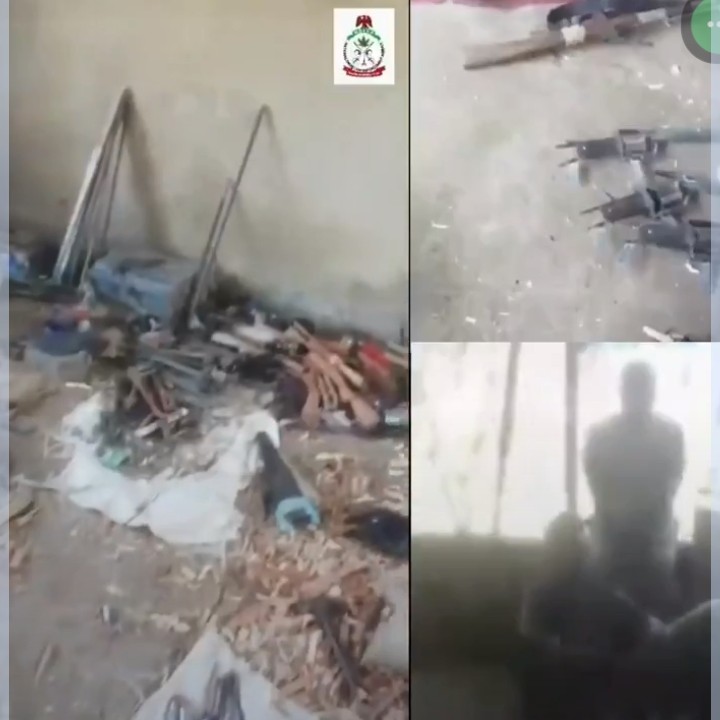
The National Drug Law Enforcement Agency (NDLEA) says its officers uncovered a suspected gun factory in Sabon Garin Kangin, Kaduna State, and arrested its owner. The agency’s Director of Media and Advocacy, Femi Babafemi, shared the update on his X handle on Sunday, November 15, 2026. He said officers recovered finished firearms and materials for making more weapons during a raid. The suspect is accused, and he has not been convicted of any offence.
A Raid That Exposed a Hidden Workshop of Illegal Weapons
NDLEA officers found the factory during a raid on Monday, November 9, according to the agency’s weekly update. The suspect was identified as Sagiru Musa, 45. NDLEA listed 17 locally made Dane guns (locally fabricated long-barrel guns), two pistols, 25 Dane gun pipes and other materials used in making firearms. The statement was part of a wider update on drug arrests in several states between November 9 and 14.
What Officials Reported and What They Have Not Said
Mr Babafemi said the discovery reinforces what he called an established link between substance abuse, drug trafficking and other crimes. NDLEA chairman Mohamed Buba Marwa, a retired brigadier general, said the discovery further underscored the link between illicit drugs and violent crime. That is the agency’s general view. The reports we found do not say that this factory or its owner is tied to any drug offence. One report noted that NDLEA has not said whether Mr Musa has been handed over to the police for prosecution.
The same weekly update mentioned a separate operation. On November 13, officers arrested a 31-year-old woman, Tabara Dauda, along the Abuja-Kaduna Expressway with 196 live AK-47 rounds. The reports do not link her to the factory. These are separate allegations.
Earlier Raids Show a Wider Network of Home-Made Weapon Production
This is not the first such discovery. On April 22, 2026, troops of Operation Enduring Peace dismantled an illegal arms-making site in Langtang North, Plateau State. They arrested two suspects, recovered rifles and tools, and said they were investigating the distribution network. In January 2026, troops in Doma, Nasarawa State, found a similar site and arrested one suspect. A preliminary investigation said it supplied firearms to criminal elements.
The National Centre for the Control of Small Arms and Light Weapons (NCCSALW) also said it had arrested and prosecuted suspects linked to illegal manufacture of firearms and ammunition in Minna, Niger State. These cases are different in size and detail. But they show that illegal production is spread across several parts of the country.
Demand, Profit and Weak Oversight: Forces Behind Local Weapon-Making
Illegal gun-making survives where there is demand. Armed robbers, kidnappers and other criminal groups want cheap weapons. Where policing is thin and weapons can be sold quietly, such workshops can hide in ordinary neighbourhoods.
An NCCSALW official said some locally produced firearms closely resemble imported weapons. He argued that this makes it more important to shut down illegal production. We do not yet know the scale of the suspected Kaduna factory, who bought its products or whether others were involved. Investigators will have to answer those questions.
The National Cost of Illegal Weapons in Circulation
No one knows exactly how many illegal guns circulate in Nigeria, and estimates differ widely. A UN disarmament official put the figure at between one and three million. The NCCSALW cited a 2021 survey of over six million illegal weapons, with about 70 percent in the hands of non-state actors. It also said Nigeria accounts for 70 percent of an estimated 11 million illegal small arms in West Africa. Others cite far higher numbers. These are estimates, not exact counts.
The cost is large whatever the true number. Officials say illegal arms feed banditry, kidnapping and communal violence. The NCCSALW says illegal arms dealings are largely responsible for Nigeria’s 2.2 million internally displaced persons. When people fear for their safety, farms close, schools shut and investment falls. In 2024, the President signed the Control of Small Arms and Light Weapons Act, which officials call a landmark step.
Testing the Link Between Drugs and Violent Crime: Strengths and Gaps in the Claim
There are good reasons to take NDLEA’s concern seriously. Drug use can be tied to crime in some cases, and criminal groups may use the same networks to move drugs and weapons. Officers who find one kind of crime often find another. That is valuable to security work.
But a general link does not prove a specific one. In this case, the reports do not show that Mr Musa’s factory was connected to the drug trade. Evidence in court will decide. It would be unfair to call anyone a drug trafficker or a gun runner before the facts are tested. It would also be wrong to assume that every drug user is violent. The best approach is to follow the evidence in each case.
Practical Steps to Close Down Illegal Arms Production
Agencies should share information so that raids by NDLEA, the police, the army and the NCCSALW support one another. NDLEA should state whether the suspect has been handed over for prosecution, and the case should go to court quickly. Investigators should trace who bought the weapons and where the materials came from.
Communities can help by reporting suspicious workshops and buyers to the authorities. Government can also license and watch legitimate metalworkers more closely, and it can fund the NCCSALW to survey the problem and follow up on the 2024 law. Drug treatment and prevention services should also expand, since the agency itself links substance abuse to crime.
Disarming Crime Needs Evidence, Cooperation and Patience
We welcome the raid, if the facts hold up. A hidden workshop that makes illegal guns is a danger to any community. Taking one down may save lives.
But we also remember what is still unknown. The suspect is innocent until a court decides otherwise. The reports do not yet show who the guns were for or whether any drug case is involved. We hope the agencies will tell the public what they find. Our country needs steady work, shared information and fair trials to reduce the flow of illegal weapons, and those are the things that can keep our communities safe.
Published by Ejoh Caleb