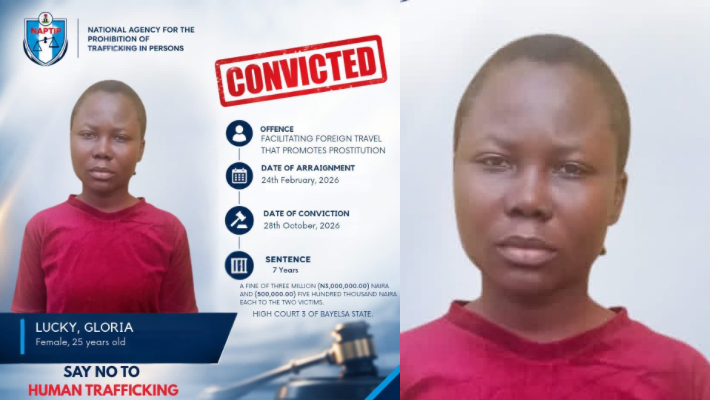
A High Court in Bayelsa State has convicted a 25-year-old woman, Gloria Lucky, on four counts relating to human trafficking and sexual exploitation. Justice Doris O. Adokeme sentenced her to seven years in prison. The sentences on all four counts will run concurrently, which means she will serve them at the same time, not one after another.
The court also imposed fines and ordered her to pay ₦3 million, along with ₦500,000 in compensation to each of the two victims. The National Agency for the Prohibition of Trafficking in Persons (NAPTIP) announced the verdict on Thursday, October 29.
What the Court Found: The Four Counts Explained (A Count Is a Separate Charge Within One Case)
NAPTIP said the counts were conspiracy, facilitating the activities of people engaged in trafficking, procuring a person under 18 for sexual exploitation, and facilitating foreign travel to promote prostitution. They were prosecuted under the Trafficking in Persons (Prohibition) Enforcement and Administration Act, 2015.
NAPTIP did not describe how the offences were committed or where the victims were taken. The victims have not been named, which is right, since survivors of trafficking should have their privacy protected. The report also does not say whether the convict plans to appeal.
Not an Isolated Verdict: An Earlier Bayelsa Case Before the Same Judge
This is not the first time this court has handed down such a sentence. In October 2025, Justice Adokeme sentenced Mariam Omokiri, 29, to seven years in prison and a ₦1 million fine. NAPTIP had charged her with organising and trafficking four girls from Bayelsa to Mali and Senegal for prostitution.
In that judgment, the judge said trafficking is a very serious offence that has damaged Nigeria’s image abroad. A NAPTIP official said the verdict sent a message that Bayelsa is not a safe haven for traffickers. The two cases suggest that the same court treats trafficking firmly, and that the same kinds of crime keep returning to it.
The National Picture: Thousands Rescued, Hundreds Convicted, Many Still Missing (Trafficking Means Moving or Controlling People to Exploit Them)
NAPTIP says it has secured 839 convictions since it began, including 47 between January and July 2026. It also says it rescued 156 victims in that period. Earlier national figures showed that among 25,642 rescued victims, 73.8 per cent were female and 48.1 per cent were children.
The agency says tactics are changing. It warns about fake overseas job offers, loan-for-sex scams and recruitment on social media. These numbers show a large problem and a lot of effort. They cannot tell us how many victims were never found.
How Young People Are Drawn In: Promises, Debt and Silence
Traffickers often start with a promise. A young woman is told of a job, a school place or a better life abroad. In 2025, the Nigerians in Diaspora Commission received girls rescued from Ghana and Mali who said they were deceived with promises of jobs and then forced into prostitution.
Poverty and limited opportunity make such offers more tempting. Debt can also trap a victim. Once she has travelled, she may lose her documents, owe money to her trafficker or fear arrest. Many are afraid to speak out because of shame or threats. Recruiters are often people the family knows, and in this case the convict was a young woman herself, which shows that traffickers do not fit one image.
The Toll on Survivors and the Country
For survivors, the harm is deep. Sexual exploitation can cause injury, illness, fear and long-lasting trauma. Young victims may lose years of schooling, and many face stigma on their return home. Families may also carry debt and shame.
The wider cost is national. Trafficking harms Nigeria’s reputation abroad, as the judge noted in the earlier case, and it drains young talent from communities. It also feeds criminal networks that profit from cross-border crime. Border control, health care and social services all bear the cost of repairing the damage.
Is Seven Years Enough? Weighing Punishment, Prevention and Healing for Survivors (Deterrence Means Discouraging Others From Committing the Same Crime)
Some will welcome the verdict as proof that trafficking carries a cost. A conviction can discourage others, and compensation recognises the harm to each victim. NAPTIP also said the case forms part of its effort to protect vulnerable people.
Others may ask whether concurrent terms fully match the harm, especially when a minor is involved. We cannot judge that without the full judgment. What is clear is that punishment alone is not enough. Survivors also need medical care, counselling, schooling and a way to earn a living. Without that support, they risk falling back into danger.
Closing the Doors Traffickers Use: Early Warning, Honest Recruitment and Strong Follow-Up
Families and communities can ask hard questions about any offer of work or travel abroad, and check recruiters with NAPTIP before anyone leaves. Schools and religious bodies can teach young people how traffickers operate. NAPTIP has already set up school anti-trafficking vanguard clubs for this purpose.
Authorities can strengthen airport and border checks and track online recruitment. The courts and NAPTIP can also publish more details of judgments, without naming victims, so the public understands how these cases work. Anyone who suspects trafficking should report it to NAPTIP or the police.
Justice Delivered, Protection Still Needed: Our Reading of a Court Verdict
We welcome this conviction. It shows that a trafficker can be caught, tried and punished, and it recognises two victims whose suffering was real.
We also note what we do not know. The public has not been told the full facts, and the convict has the right to appeal. We urge NAPTIP to share as much as it safely can without exposing the victims.
Above all, we urge Nigerians not to treat this as the end of the story. For every case that reaches court, others may remain hidden. Parents, teachers, leaders and young people must stay alert, ask questions about every offer that sounds too good, and report what they see. A verdict can punish one trafficker. Only a watchful society can protect the next girl.
Published by Ejoh Caleb