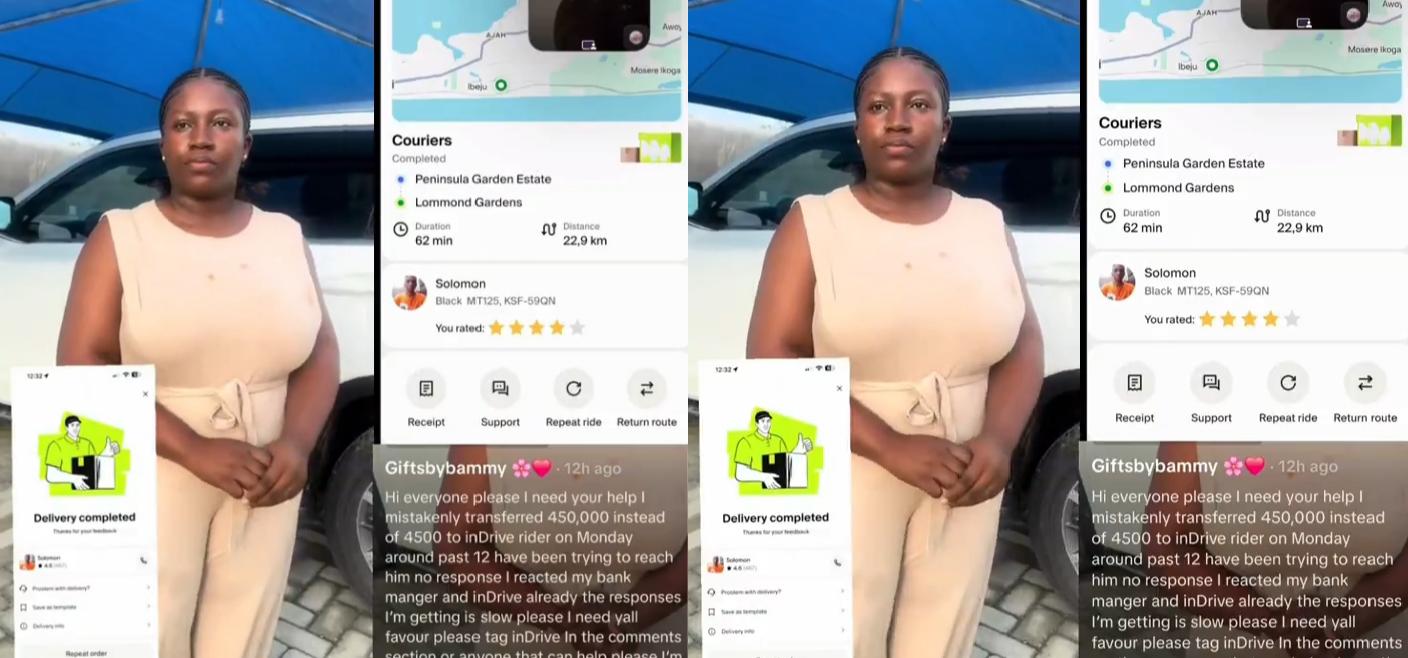
A Nigerian woman has publicly appealed for help after mistakenly transferring ₦450,000 to an InDrive driver, instead of the ₦4,500 fare she owed him for her ride. According to her account, she realised the error shortly after making the transfer and immediately began contacting the driver to ask for the money back. She said he refused to return it despite repeated attempts, and instead began offering shifting excuses, including a claim that another person had opened the account the money was sent to. As of the time of reporting, InDrive had not issued a public statement, and the driver’s identity has not been independently confirmed.
A Familiar Story, With Wildly Different Endings Depending on the Driver (Similar Overpayment Cases in Nigeria)
Mistaken ride-hailing transfers like this one have become a recurring story in Nigeria, and how they end appears to depend heavily on the individual driver’s honesty rather than any reliable system. In July 2026, Lagos resident Ayomide Ayoola accidentally sent ₦76,350 to an Uber driver instead of the ₦7,635 fare she owed. Unlike this case, the driver did eventually pay some of it back, though only in slow instalments, ₦20,000 after eight days, then two further payments of ₦25,000 and ₦23,000, before her husband waived the final ₦715 still outstanding. Ayoola told reporters she also contacted Uber directly, which offered her a goodwill credit for future rides but did not recover the actual money, and her bank told her the transfer could not simply be reversed without the driver’s consent or a court order.
Other cases have gone worse. In late 2024, another Nigerian woman said she mistakenly sent ₦69,000 to an InDrive driver instead of ₦6,900, only to discover the driver had blocked her on every number she had for him, leaving her to publicly beg strangers online to help her reach him. The common thread across these cases, including this latest ₦450,000 incident, is that the amount mistakenly sent is always a clean multiple of the real fare, a single extra zero typed into a transfer field, which suggests the errors themselves are simple and avoidable, even as their consequences for the sender can be devastating.
Why One Extra Zero Can Be So Hard to Undo (The Legal and Technical Reasons Behind the Struggle)
The underlying problem is technical as much as it is human. Nigeria’s instant transfer system is built to move money between banks in under sixty seconds specifically so that transactions feel immediate and convenient, but that same speed removes the built-in delay that might otherwise let a sender catch a typing mistake before the money actually leaves their account. Once the transfer clears, the money legally belongs to whoever received it until they agree to send it back, or until a bank or court forces the issue.
Nigerian law is actually clear that keeping money you know was sent to you by mistake is a criminal offence: Section 383 of the Criminal Code treats fraudulent conversion of property, including money mistakenly received and knowingly kept or spent, as theft, and the equivalent Penal Code provision applies in the north. Central Bank of Nigeria rules also give victims a formal path: once a sender reports the error, the receiving bank is expected to place a Post-No-Debit lien on the recipient’s account to freeze the funds while the matter is resolved, and disputes are meant to be settled within two working days if the case is uncontested. The catch is that this process depends entirely on the recipient’s cooperation. If the recipient refuses to consent to a reversal, as this InDrive driver appears to be doing, banks in practice tend to refuse to move the money without a court order, which pushes the victim toward hiring a lawyer, swearing an affidavit and applying to a magistrate court, a process that can easily cost more time and money than the amount being recovered.
What This Case Costs the Victim, and What It Reveals About a Gap in Nigeria’s Digital Banking Protections (The Real-World Stakes)
For this specific woman, ₦450,000 is not a trivial sum by any measure, and losing it to a single mistyped digit, only to be met with excuses rather than cooperation, represents a serious and avoidable financial setback. Beyond her individual loss, cases like hers highlight a genuine imbalance in how Nigeria’s digital payment system is built: the technology that makes transfers instant and convenient offers almost no protection once a mistake happens, leaving ordinary users to either rely on a stranger’s honesty, as happened in the Ayoola case, or absorb the loss entirely, as this case may end in if the driver continues to refuse.
At a national level, the sheer frequency of stories like this, women publicly pleading on social media for a driver’s phone number or bank details, points to a wider pattern the Central Bank has already begun tracking through its fraud monitoring systems, which watch-listed over 6,000 Bank Verification Numbers for suspicious transactions in a single reporting period. That existing infrastructure, tracing individuals through their BVN, suggests the tools to resolve cases like this quickly already exist within the banking system; what appears to be missing is a fast, low-cost process that ordinary victims can actually use without needing a lawyer or a viral post.
What Would Actually Fix This for the Next Person It Happens To (Concrete Steps and Reforms)
For this specific case, and for future ones like it, financial guides consistently recommend acting immediately: contacting your own bank to formally report the erroneous transfer, providing the exact transaction time, amount and receiving account details, and insisting the bank initiate contact with the receiving institution rather than waiting for the recipient to cooperate voluntarily. Because BVN and National Identity Number linkage is now standard across Nigerian bank accounts, the receiving bank can identify exactly who holds the account the driver’s payment landed in, even if he claims someone else opened it, which undercuts the specific excuse he reportedly gave her.
At a policy level, this case adds to a growing argument for ride-hailing platforms like InDrive and Uber to build a short confirmation delay or an amount-mismatch warning directly into their in-app payment prompts, catching an obvious error, a fare of ₦450,000 for what the app itself lists as a ₦4,500 trip, before the transfer is even sent, rather than leaving the entire burden of correction on the passenger after the fact. Until platforms or regulators close that gap, the Central Bank’s existing Post-No-Debit and BVN watch-list tools remain the fastest formal route available, and this passenger’s next step should be pressing her bank to invoke them directly against a driver whose excuses do not hold up against what the platform and the banking system already know about who received his money.
A Convenience Built for Speed Should Not Come Without a Safety Net
We think what makes cases like this particularly frustrating is how avoidable they are on both ends: a single mistyped digit causes the loss, and a moment of basic honesty from the recipient could always undo it. When that honesty is absent, as it appears to be here, the system currently asks the victim to do most of the work to get her own money back.
We also think it is worth saying plainly that what this driver is doing, by the account given, is not a grey area. Keeping money you know was sent to you by mistake is a criminal offence under Nigerian law, not a private disagreement to be settled between two individuals on the phone.
We hope this woman’s bank moves quickly to freeze the funds and that InDrive cooperates fully in identifying the account holder. More broadly, we think this case is one more reminder that Nigeria’s banking system has built extraordinary speed into everyday transfers without building in an equally fast way to undo the mistakes that speed makes more likely.
Published by Ejoh Caleb