
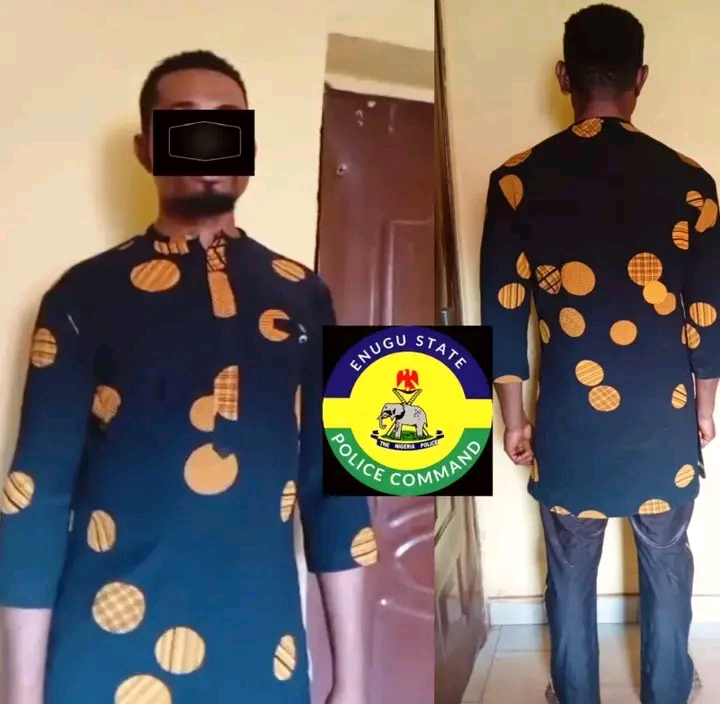
A claim first circulated online from a single source, alleging that a man in Enugu had killed a woman and remained in the room with her corpse for days. The Enugu State Police Command has since confirmed the killing, though the official account corrects several details from that original claim. Police say the victim, identified only as Chinyere, with her surname and age still being established, was allegedly killed on Saturday, September 19, 2026, by 30-year-old Okpara Chibuike Emmanuel at his residence in Olympic Layout, One-Day area, near Agbani Road in Enugu. Police spokesperson SP Daniel Ndukwe said Chinyere was Emmanuel’s girlfriend, not someone he had met through a casual hookup arrangement as the original viral claim suggested, and that the killing followed an argument over who had infected whom with HIV.
According to police, the offensive odour from the decomposing body drew the attention of neighbours, who forced open Emmanuel’s door and apprehended him before officers arrived. That places the discovery roughly two days after the killing, not the four days the original claim described, and it also corrects where the body was kept: police say it was wrapped in nylon and concealed inside the toilet of the apartment, not left out in the room. Officers from the Awkunanaw Division rescued Emmanuel from an angry mob that had gathered at the scene, then formally re-arrested him. During preliminary interrogation, police say Emmanuel admitted to striking Chinyere with a pestle during the argument. The Commissioner of Police, Bitrus Giwa, has ordered the State Criminal Investigation Department to investigate the case and ensure Emmanuel is prosecuted once the investigation concludes. Chinyere’s remains have been moved to a mortuary for preservation and autopsy while police work to trace and notify her relatives.
How This Compares to Other Recent Enugu Cases, and to How Rumours About Deaths Often Spread (Similar Patterns Seen Before)
This is not the only killing to shock Enugu residents this year. In May, police confirmed two separate cases in the state within days of each other: a 40-year-old man allegedly attacked his 60-year-old mother with a cutlass in Igbo-Etiti, and in a separate incident, a man was confirmed to have killed his sister and her child. Those cases, like this one, involved a suspect being confirmed by name through an official police statement rather than left as an anonymous figure in a viral video, which is the detail that distinguishes a confirmed report from a rumour still circulating online.
The gap between what spreads online first and what police later confirm is also a familiar pattern in Nigeria. In Ile-Ife, Osun State, weeks earlier, claims spread that a vigilante member had died after a sexual encounter, with social media attributing his death to a “thunderbolt,” a traditional spiritual curse. Police in that case confirmed only that they were aware of the claims and explicitly cautioned the public against spreading unverified details, without confirming a cause of death. The Enugu case follows the opposite path: what began as an unverified claim from a single page has now been fully confirmed, named and explained by police, which is exactly the kind of outcome that justifies treating early viral claims with caution until an official statement arrives, since some turn out true and some do not.
Why the Original Details Were Wrong, and Why an HIV Disclosure Argument Turned Violent (What Actually Happened, and Why)
The discrepancies between the original viral claim and the confirmed police account point to a common feature of these stories: the earliest version online is often built from a single video and secondhand narration, not a police report, so specific details, the “hookup” framing, the four-day timeline, the body left in the open, tend to be approximations rather than facts. Once police investigate, actual physical evidence, in this case the state of decomposition and Emmanuel’s own account under interrogation, produces a more precise and different picture.
The underlying cause of the killing itself fits a pattern that researchers have documented specifically in Nigeria: violence tied to HIV status within intimate relationships. Multiple Nigerian studies have found that people living with HIV face a significantly higher risk of intimate partner violence than those who are HIV-negative, whether the violence stems from a partner’s reaction to a disclosed diagnosis or from disputes, as alleged here, over how someone became infected. Research from Lagos has also found that unwanted pregnancy and sexually transmitted infections, including HIV, are themselves common outcomes of intimate partner violence, showing how disease status and relationship violence are frequently entangled in both directions, as either a cause of conflict or a consequence of it.
What This Case Reveals About Violence Between Partners, and About the Danger a Suspect Faces From the Public (Effects on Individuals and on Nigeria’s Justice System)
For Chinyere, this was a fatal act by someone she was in a relationship with, and it adds to a documented, troubling pattern in Nigeria: studies report that the lifetime prevalence of intimate partner violence among women ranges widely by region, from around 29 per cent in the South West to as high as 78.8 per cent in the South East, the same region where this killing occurred. A national survey found that spousal violence against women rose from 31 per cent in 2008 to 36 per cent by 2018, indicating the problem has not been improving over time.
The mob that gathered around Emmanuel before police arrived reflects a second, separate danger. Amnesty International documented at least 555 victims of mob violence in Nigeria between 2012 and 2023, attributing the pattern to public distrust in a justice system seen as slow or unreliable. Security analysts note that mob action often begins the moment an accusation is shouted, before any facts are established, which means even a genuinely guilty suspect can be killed by a crowd before ever facing a court, denying both the victim’s family and the public any formal accounting of what happened. In this case, police intervention prevented that outcome, but the fact that a mob had already formed shows how close it came to happening.
What Would Reduce Both Kinds of Harm Here (Preventing Partner Violence, and Preventing Mob Justice)
On the intimate partner violence side, researchers studying Nigerian cases specifically recommend that HIV status disclosure be handled with structured counselling support built into testing and treatment services, precisely because disclosure moments carry an elevated risk of violent reaction from a partner. Community-based education addressing HIV stigma directly, rather than leaving disclosure to happen unsupported within a private relationship, is consistently cited as a way to reduce this specific trigger for violence.
On the mob violence side, the pattern documented by Amnesty International and other researchers points to one consistent fix: faster, more visible police response to reports of a crime, so that communities have less incentive to act before officers arrive. In this instance, police did ultimately rescue Emmanuel and secure a formal arrest, which is the outcome the system is supposed to produce, but the presence of the mob at all shows why that response needs to be faster and more consistently trusted by the public than it currently is.
Getting the Facts Right Matters, Even After the Facts Are Confirmed
We think this case is a useful example of why we were right to treat the original viral claim with caution rather than repeat it as fact. Several of the specific details that spread first, how the couple met, how many days passed, where the body was kept, turned out to be inaccurate once police investigated, even though the core of the claim, that a woman was killed and her body concealed in that area of Enugu, was true.
We also think the confirmed facts deserve their own scrutiny, separate from the rumour that preceded them. An HIV-status dispute ending in a killing is not an isolated event; it reflects a documented pattern of violence tied to HIV disclosure within Nigerian relationships. And the mob that gathered at the scene before police arrived is a reminder that public distrust in the justice system remains dangerously high, capable of turning an arrest into a lynching within minutes if officers had not reached the scene in time.
We extend our condolences to Chinyere’s family, and we will continue to follow this case as the Enugu State Criminal Investigation Department completes its inquiry and Emmanuel formally faces prosecution.
Published by Ejoh Caleb